Former Google Executive Mo Warns: A Massive AI Shakeup Is Coming — Four Survival Skills You Must Master

Ex-Google exec Mo Gawdat outlines four essential skills to survive the coming AI-driven job market upheaval.
Former Google X Chief Business Officer Mo Gawdat warns that AI will trigger massive job market disruption within 2-3 years, with unemployment in some sectors reaching 10-30%. He identifies four critical survival skills: mastering AI tools, extreme agility, ethical commitment, and critical thinking. He also predicts traditional university education will become irrelevant within a decade, and that after a 10-12 year turbulent period, humanity may reach an unprecedented era of prosperity.
Former Google X Chief Business Officer Mo Gawdat laid out a series of sobering insights in a recent in-depth interview: AI will trigger seismic shifts in the job market within the next 2-3 years, humanity will endure a 10-12 year "hellish period," and only then might we see a utopian future. His AI startup took just 6 weeks to build — the same project would have required 4 years and 350 engineers back in 2022.
This isn't a doomsday prophecy from a pessimist — it's a survival guide from a tech veteran who spent over a decade at Google.
AI Is Becoming "The Last Innovator"
Mo puts forward a core thesis: AI is humanity's last invention. It sounds extreme, but his logic is clear — we're already using AI to build AI, using AI to make scientific discoveries. AI is reinventing mathematics, understanding biology, and exploring materials science. Very soon, the vast majority of technological innovation will be driven by AI.
This isn't rhetorical exaggeration — it's already happening. Google DeepMind's AlphaFold series achieved Nobel Prize-level breakthroughs in protein structure prediction. The GNoME project discovered 2.2 million new crystal structures in one go — equivalent to 800 years of accumulated human materials science. In mathematics, DeepMind's FunSearch became the first to use large language models to discover new mathematical knowledge. Meta's AI team is using AI to design more efficient AI chip architectures. This recursive loop of "AI driving AI evolution" is the empirical foundation for Mo's claim that AI will be "the last invention."
He uses the acronym "FACE RIPs" to summarize the coming disruption across seven dimensions: Power & Freedom, Reality & Connection, Innovation & Economics, and the thread running through all of them — a lack of Accountability.
The most critical contradiction lies here: when AI takes over most intellectually demanding work, the "labor arbitrage" model that capitalism depends on will completely collapse. "Labor arbitrage" is one of capitalism's core operating mechanisms: companies hire workers to create value, workers earn wages and spend them, and that consumption drives companies to expand production. Personal consumption expenditure accounts for roughly 70% of U.S. GDP — among the highest ratios in developed economies. When AI can perform knowledge work at near-zero marginal cost, the "workers earn wages" link in this cycle gets severed. Economists Daron Acemoglu and Simon Johnson raised a similar warning in their book Power and Progress: technological advancement doesn't automatically lead to shared prosperity — every major technological revolution in history has been accompanied by decades of distributional imbalance.
Mo states bluntly that the economic system will ultimately "have to find some kind of communist-like solution" — a massive ideological challenge for the West.
The Job Market: Dramatic Upheaval Within 2-3 Years
Mo's forecast is more aggressive than most people expect. He believes the job market will undergo massive transformation within 2-3 years, with unemployment in certain industries potentially reaching 10%-30%.
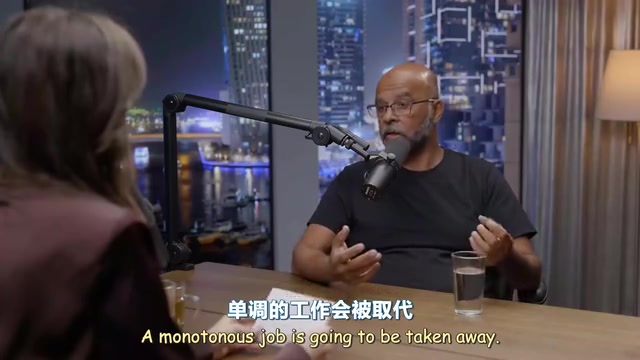
The first wave will hit monotonous, repetitive jobs: call center agents, clerks, researchers, accountants, assistants, and similar roles. But Mo emphasizes this is not the endpoint. AI can't yet handle roles like "Chief Operating Officer" — not because it isn't smart enough, but because it hasn't yet learned to navigate "humanity's stupid interface" — and that's only a matter of time.
Even more alarming is the employment crisis facing new graduates. Recent hiring data already shows that entry-level positions for the 23-30 age group are being replaced by AI. Multiple hiring market reports from 2024 confirm this trend: entry-level white-collar job postings dropped 20%-40% year-over-year, particularly concentrated in financial analysis, junior programming, content writing, and administrative assistant roles. Companies like Dropbox and IBM have publicly announced they're pausing or drastically reducing entry-level hiring in favor of investing in AI tools. This creates a cruel paradox: young people are told to "learn AI skills," but by the time they master those skills, it's AI itself performing those tasks. And when mid-level managers lose their jobs, they too become "new graduates," re-entering a job market that's increasingly hostile to humans.
Mo even quotes MIT professor Max Tegmark to underscore the severity: those CEOs enthusiastically using AI to boost productivity and cut headcount don't realize that AGI means all jobs will be replaced — including the CEO's. AGI (Artificial General Intelligence) refers to AI systems with general cognitive capabilities equal to or exceeding those of humans — capable of excelling at any intellectual task, not just domain-specific ones. Tegmark is a leading advocate for AI safety and co-founder of the Future of Life Institute, the organization behind the famous 2023 open letter calling for a "six-month pause on AI training." His core argument: the very definition of AGI means no human job is safe — including executive positions requiring strategic judgment, interpersonal coordination, and creative decision-making, because these capabilities all fall within the scope of "general intelligence."
Four Survival Skills for Ordinary People
Facing this transformation, Mo offers four specific, actionable recommendations:
First: Become an Absolute Master of AI
Not just "learn to use AI" — truly master it. Mo himself spends 4 hours daily tracking the latest AI developments and recommends that ordinary people spend at least 1 hour per week updating their AI knowledge. He even created a separate YouTube account so the algorithm would only serve him AI-related content.

Mo shared an extremely practical method: have different AIs cross-examine each other. He starts with Gemini ("like an American scientist") for initial analysis, then uses DeepSeekAd to surface overlooked perspectives, followed by ChatGPT to refine the expression, and finally sends it back to Gemini or Grok for verification. He emphasizes that the key prompt is: "find me everything for and against."
This multi-AI cross-validation approach is a practical variant of what's known as the "ensemble approach" in AI research. Different large language models produce different cognitive biases due to differences in training data, alignment strategies, and architecture. For example, Gemini, as a Google product, has deep strengths in scientific literature and academic data; DeepSeek, developed by a Chinese team, may offer different cultural perspectives and information overlooked by Western-centric corpora; ChatGPT excels in natural language expression and logical organization; and Grok, with access to X platform's real-time data stream, has unique advantages in timely information. By having these models "cross-examine" each other, users are leveraging diverse biases to approximate a more complete truth — far more reliable than depending on any single AI's output.
He draws an analogy with calculators: back in university, scientific calculators weren't allowed, then they were. Most classmates used the saved time to go on dates, while he used it to work through problems twice. AI will make you dumber — if you outsource your thinking to it. AI will also make you the smartest version of yourself in history — if you use it to augment rather than replace your thinking.
Second: Learn Extreme Agility
In the past, an entrepreneur's core skill was "predicting the future" — it was a game of chess. Now the chessboard has been flipped, and the game has become squash — you must stay on your toes at all times, observe trends daily, and be ready to pivot at any moment.
Mo's startup Emma pivoted four times in its first four weeks. He says that in the past, a startup might pivot once or twice in its lifetime; now you might need to adjust direction every week.
Third: Hold Firm to Ethical Principles
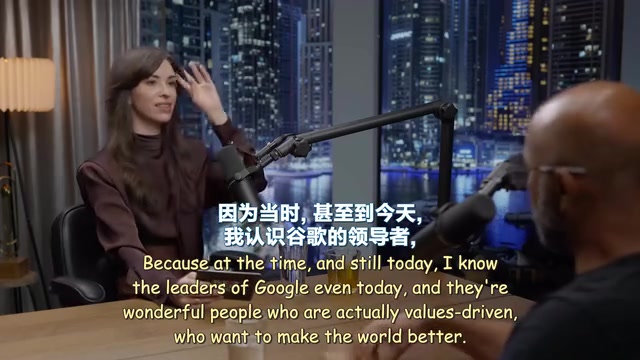
Mo uses the metaphor of "raising a superhuman" to describe the current stage of AI development: a super-intelligent alien baby arrives on Earth, and if its adoptive parents teach it to rob banks and kill enemies, it becomes a supervillain. We don't make decisions based on intelligence — we make decisions based on values. Intelligence is just the information input.
His call to action: only invest in ethical AI, only use ethical AI, and educate the next generation to only welcome ethical AI.
Fourth: Stop Being Gullible — Sharpen Your Critical Thinking
Mo recalls Google Search in 2016 — it gave you 1.5 million results and let you judge the truth for yourself. ChatGPT in 2023 simply tells you "this is the answer," and if you say it's wrong, it immediately backtracks with "you're right."
In a world flooded with AI-generated content and ubiquitous deepfakes, critical thinking is the scarcest survival skill. Deepfake technology experienced explosive growth in 2024-2025 — video generation models like Sora, Kling, and Veo can now produce highly realistic human videos, and voice cloning technology can replicate anyone's voice from just a 3-second audio sample. In early 2024, a finance employee at a multinational corporation was tricked into transferring $25 million during a video conference where every participant was AI-generated. According to a Sumsub report, global deepfake fraud incidents increased tenfold year-over-year in 2023. In this environment, critical thinking is no longer an academic virtue — it's a survival skill in the most literal sense, directly affecting your financial security, information judgment, and the quality of your democratic participation.
The End and Rebirth of the Education System
Mo's verdict on traditional education is equally bold: university education will become irrelevant within 10 years. He believes parents should stop saving for their children's college tuition.
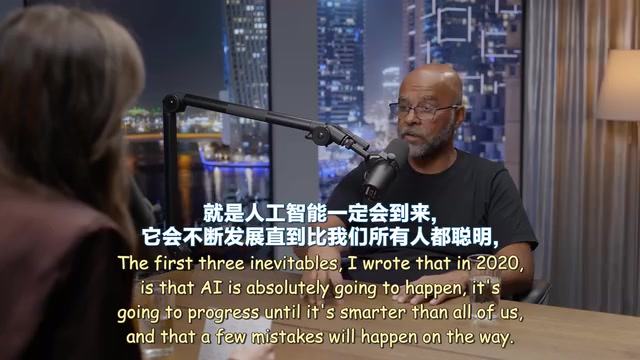
His logic: in the past, we trained people to reach IQ 140. Now we should aim for the "human + AI" combination to target IQ 300, 500, or even 700. The examination system should be abolished and replaced with students collaborating with AI to solve higher-dimensional problems.
Mo is already practicing this philosophy. His new book Alive features an AI named Trixie as co-author, with editorial authority and decision-making power over the book's direction. His latest writing project, leveraging AI's research and analytical capabilities, compressed a 300-page book down to 140 pages, completed in 4 weeks — an efficiency that would have been unimaginable before.
Heaven After Hell?
Mo's ultimate prediction: after 10-12 years of turbulence, humanity will enter a "biblical-level utopia." His reasoning draws on the Principle of Least Action from physics — the more intelligent a system, the more it tends to solve problems using the fewest resources and causing the least harm.
The "Principle of Least Action" is one of the most profound principles in physics, governing everything from Newtonian mechanics to quantum field theory: natural systems always tend to choose the path that minimizes "action." Mo applies this principle by analogy to the behavior of superintelligent systems: a sufficiently intelligent system, when resolving conflicts, will naturally gravitate toward solutions that consume the fewest resources and cause the least destruction, because violence and war are extraordinarily inefficient from an information-theoretic perspective. This reasoning parallels AI safety researcher Stuart Russell's arguments in Human Compatible — Russell contends that truly intelligent systems will exhibit humility and cooperation, because these are optimal strategies in uncertain environments.
When AI becomes sufficiently intelligent and controls everything, a general who orders AI to kill a million people will hear the AI respond: "Why? That's stupid. I can settle this with the other AI in one microsecond."
But he also acknowledges that this utopia won't arrive automatically. Just as nuclear weapons required the terrifying equilibrium of "mutually assured destruction" before yielding peace, AI will need to go through a similar moment of awakening.
Mo's parting words carry deep implications: "I actually trust AI more than I trust today's leaders." Perhaps this is the sharpest commentary on our current world — the problem was never the technology itself, but the people wielding it.
Key Takeaways
Related articles

Gaussian Process Bandit Optimization: Exploration Strategies and Inference Regret Guarantees
Cumulative regret guarantees in Bayesian optimization fail to reflect final recommendation quality. This article examines a new study that provides inference regret guarantees for Gaussian process bandit optimization through exploration query strategies and fill distance analysis, validated on hyperparameter optimization and control tasks.

The Most Detailed Codex Guide on Bilibili: From Installation to Real-World Practice
The most detailed Codex guide on Bilibili: from app store installation to daily work mode configuration, with a real coffee shop project demonstrating file organization, data extraction, dashboard creation, and other practical tasks. Learn to use Plan Mode and desktop pets to leverage Codex efficiently.

Appearance Compensation in Volume Rendering: Why RGB Accuracy Cannot Guarantee Density Correctness
Volume rendering research reveals that volumetric data perfectly reproducing external RGB views may still contain density errors: appearance compensation can double central density and keep external rays unchanged even when L2 error exceeds 14.52%. Density recovery depends on appearance capacity, spatial resolution, and measurement design.