Former Huawei Celia LLM Lead Found Startup, Betting on Proactive Physical AI

Former Huawei Celia LLM lead Tang Duyu founded Guanxing Shuzhi, proposing Proactive Physical AI to let machines autonomously judge needs and intervention timing.
The article covers Tang Duyu, former Huawei Chief AI Expert and head of Celia's multimodal LLM R&D, who founded Guanxing Shuzhi and proposed Proactive Physical AI — filling the missing first half of the action chain by judging from a continuous event stream whether, when, and what to do rather than passively executing commands. The team built the ProAgent dual-model architecture and ProactiveXBench evaluation system.
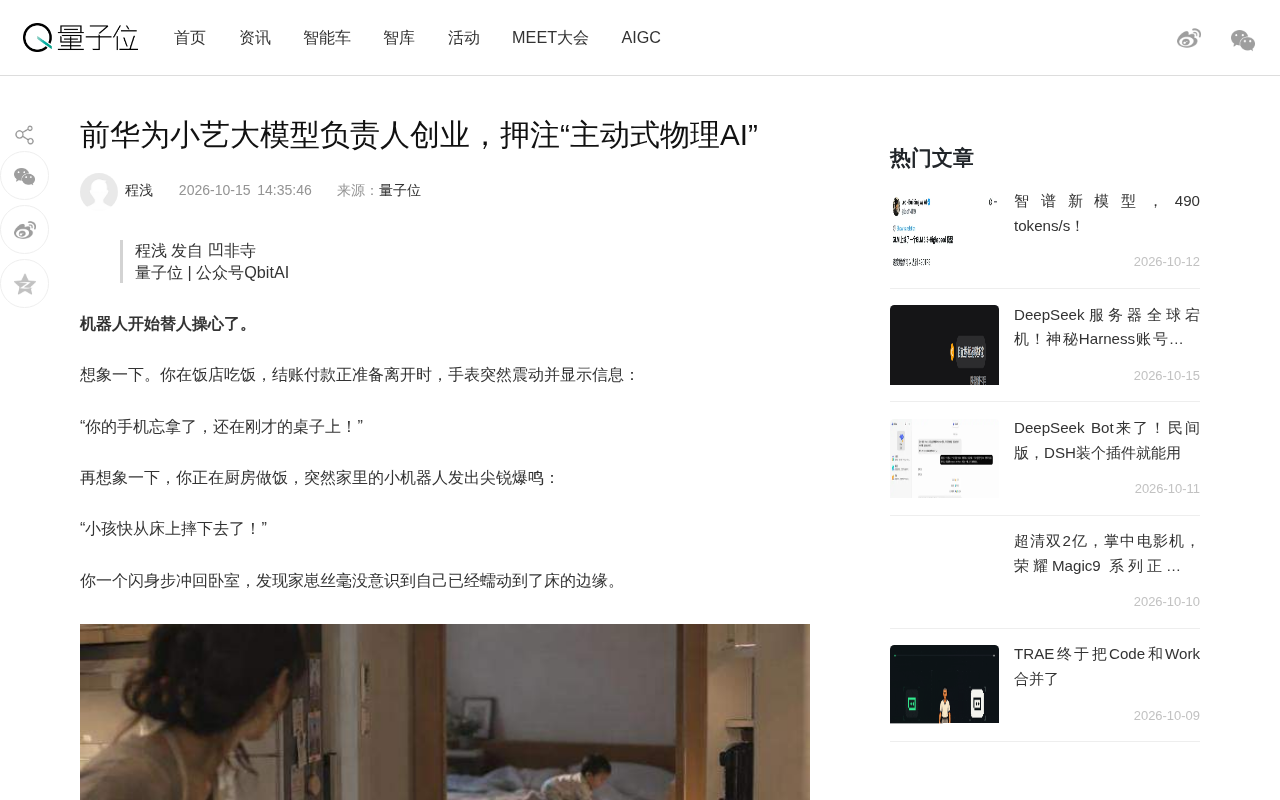
The narrative around Physical AI is undergoing a key shift. Over the past few years, whether it's VLA or World Models, the core proposition has always been "how to make machines better execute human instructions" — robots walk more steadily, grasp more accurately, plan further ahead, but all action still begins with an explicit human command.
Tang Duyu, former Chief AI Expert at Huawei and head of Celia's multimodal LLM R&D, has decided to bet on a different direction: letting AI proactively discover needs rather than passively wait for instructions. He founded Guanxing Shuzhi (Guanxing Digital Intelligence), proposed the concept of "Proactive Physical AI," and is attempting to fill in the missing first half of the action chain — judging whether to act, when to act, and what to do.
Proactive Physical AI: Pushing the Starting Point of the Action Chain Forward
In Tang Duyu's framework, existing Physical AI deals with "task chains": humans give instructions like "put the apple in the basket," and the robot recognizes the environment, plans a path, and executes actions. The entire system solves How (how to complete), rather than What (what needs to be done) and When (when to act).
Proactive Physical AI faces a continuously unfolding "event stream." The system needs to constantly receive information from the real environment, understand ongoing events, and judge whether some change has already constituted a "need." Only after this streaming judgment (StreamingJev) is completed does it decide whether to intervene, in what manner, which device to invoke, and when to intervene.
This is not an entirely new idea. In 1998, Microsoft Research's LookOut prototype attempted something similar: upon reading an email about scheduling a meeting, it would judge whether you needed to check your calendar. In 2000, Microsoft further let cameras track a person's position, enabling interfaces to move and switch with the person. But these explorations remained at the software interaction level, whereas Tang Duyu faces more complex boundary problems in the physical world.
Remind one step too early and it becomes an interruption; act one step too late and the help loses meaning. The same person suddenly slumping to the ground could just be resting, or could be fainting; a child reaching toward a cup could just be observing, or could be about to knock it over. Tang Duyu emphasizes that the ability to "proactively act" does not naturally emerge as intelligence grows — it involves risk judgment, responsibility boundaries, and timing of action, and must be tackled separately.
VLA (Vision-Language-Action) is one of the mainstream paradigms in current robot learning. Its core idea is to connect visual perception, language instructions, and action output end-to-end, letting the model map directly from "what is seen and heard" to "what action to take." Representative works such as RT-2 and OpenVLA typically use large-scale vision-language pretrained models as a base, then fine-tune on robot trajectory data. VLA's strengths are generalization and instruction following, but its implicit premise is that "the instruction is already given" — the model solves the How problem of execution, not the What and When problem of whether to execute. This is precisely the gap Guanxing Shuzhi aims to fill.
World Model is another route, advocating that AI learn the dynamic evolution patterns of the environment and internally simulate "if I do this, what happens next." From early work by Ha and Schmidhuber to recent Dreamer and Genie, World Models emphasize prediction and planning capabilities. It also leans toward "reasoning after a goal is given," contrasting with Proactive Physical AI's emphasis on "first judging whether a need has formed." The two are complementary rather than substitutive at the capability level.
From Harbin Institute of Technology to Microsoft Research Asia: A Path Toward Physical AI
Tang Duyu's resume provides unusual credentials for this startup.
In 2015, he was pursuing a PhD at Harbin Institute of Technology under Professor Qin Bing, Director of the SCIR Research Center, studying how machines understand human emotion, and was selected for IBM's Global PhD Fellowship program the same year. HIT's SCIR is a major force in China's NLP field and has produced a group of AI talents active in both academia and industry.
After graduating with his PhD in 2016, he joined Microsoft Research Asia, expanded his research to code intelligence, and led related work including CodeBERT and CodeGPT. Among the young researchers he led at the time was Guo Daya, who later became one of the core contributors to DeepSeekAd-V3 and DeepSeek-R1. Tang Duyu's papers have now been cited over 30,000 times, and he has been included in the lifetime scientific impact list of the world's top 2% scientists.
During his time at Huawei, he developed Celia's multimodal LLM from 0 to 1 and deployed it on hundreds of millions of devices, connecting the entire pipeline from data engineering, inference deployment, device-cloud collaboration, and device adaptation. This experience gave him the key capability required by Physical AI: translating model capabilities onto concrete hardware and continuously iterating in real environments and user feedback.
He judges that the value of Proactive Physical AI will expand significantly. When large numbers of intelligent terminals surround us, if every device needs to be awakened one by one — "Hi Xiaolan, open the curtains," "Hi Xiaohong, play music" — they remain, in essence, complex tools that require users to proactively judge the boundaries of their capabilities. More natural human-machine interaction may no longer require a wake word starting with "Hi."
ProAgent Architecture: Division of Labor Between Sentinels and Commanders
The real world is not a neatly edited video. In a linear stream of time, responding is occasional; staying silent is the norm.
Guanxing Shuzhi designed a dual-model collaborative architecture called ProAgent. The first part, StreamingJev, continuously reads the environmental event stream, performs lightweight judgment, and produces a signal indicating "whether intervention is needed" — its role is like a sentinel. The second part, the Response Model, is more like a commander: once StreamingJev identifies a need, it further judges the nature of the event, plans how to respond, and decides which device to invoke.
This division of labor has practical considerations: letting a large model continuously process all environmental information incurs high inference costs and significantly slows response speed. A lightweight model handles the front-end judgment, while the Response Model handles events that truly require intervention, reserving computational resources for critical moments.
The long-term goal is to train a native proactive intelligence model oriented toward the physical world. Data is the core challenge — ordinary internet videos only record what happens, not the moments when AI should intervene. Guanxing Shuzhi's solution is to establish an automated data pipeline that extracts scene changes from public videos and converts them into decision sequences with reasoning processes, including both positive samples where reminders or actions are appropriate and supervisory signals where continued observation is appropriate, so the model learns to distinguish "a change has occurred" from "a need has formed."
The team has also built an evaluation system called ProactiveXBench, assessing the complete trajectory of AI from discovering a need to completing intervention across three dimensions: Timing, Progress (intervention duration and task state), and Outcome (final result). These three dimensions correspond to the links where Proactive Physical AI is most likely to fail: missing the moment, dropping the task, and working in vain. According to the team, on specific metrics such as intervention timeliness, ProAgent already outperforms general models like GPT-6.
Currently, this capability is first deployed on the Reachy Mini robot, validating guidance, warnings, and interaction across 60 cases. Guanxing Shuzhi has partnered with embodied AI companies to bring the system into specific devices, supplementing reasoning processes, action spaces, and execution feedback to form a data loop.
Dual-model collaboration (cascade/routing architecture) is a common cost-latency tradeoff in engineering. The core idea is to use a lightweight model for high-frequency, low-cost continuous inference, and only invoke a large model when trigger conditions are met. This is structurally similar to the coarse ranking-fine ranking two-stage setup in recommendation systems, or the wake word detection-ASR cascade logic in voice assistants. In the continuous event stream scenario of Physical AI, the sentinel model needs to scan the environment at near-real-time frequency; any full large-model inference would cause wasted compute and response delay, making layering almost mandatory.
ProactiveXBench and similar evaluation systems matter because the failure modes of proactive AI are fundamentally different from those of traditional task-oriented AI. Task-chain AI errors center on "doing the wrong thing," whereas proactive AI more commonly fails on "wrong timing" — intervening too early is interruption, intervening too late is ineffective, and not intervening at all is absence. The three dimensions of Timing, Progress, and Outcome precisely correspond to these three failure types, enabling evaluation to characterize a complete intervention trajectory rather than only whether a single action was correct. The industry currently lacks a widely recognized benchmark for proactive AI, which is one reason the team built its own evaluation.
An Unconverged Track and the Logic of Betting Early
The Physical AI world is full of competing powers. From VLA to World Models to WAM, each has its adherents, and technical routes are far from converging the way LLMs have. Switching routes is extremely costly, but entrepreneurs must bet early.
Tang Duyu's judgment is that this bet is not difficult — AI moving from the data world to the physical world is a trend, and moving from passive to proactive is also a major trend. Following the trend, what seems like a bold gamble is simply going with the flow.
Team building proceeds along industry-academia collaboration, with deep cooperation maintained with HIT laboratories. Tang Duyu recently gained a new identity: an "Outstanding AI Model Technical Expert" at Zhongguancun Academy. This national-level higher education and research institution established in 2024 encourages researchers to bring technology out of the lab and attempt entrepreneurship, which fits his current state well.
Proactive Physical AI has no mature data system, and lacks a unified model architecture and evaluation standards. It requires rebuilding the relationship between training data, decision models, and hardware starting from the definition of needs. This may be exactly what Tang Duyu means by "first doing well what I consider the hardest and most meaningful thing."
From homes to cars, tens of millions of forms of proactive AI terminals lie along the extension of this vision. The language of commands is no longer popular, because machines have learned to understand — and to act at the right time after understanding.
WAM (World Action Model) is a term that has appeared in recent discussions of embodied intelligence, emphasizing direct action output while predicting world evolution. It can be seen as an attempt to fuse World Models with VLA thinking. It stands alongside VLA and World Models as one of the main current technical routes in Physical AI, each dividing the "perception-decision-execution" chain differently. The reason routes have not converged is that different approaches involve tradeoffs in data requirements, inference cost, and generalization boundaries, and no paradigm has formed overwhelming consensus the way Transformer did for LLMs. Entrepreneurs betting at this stage are essentially betting that a particular route will be the first to work in real-world scenarios.
One-line Summary
Former Huawei Celia LLM lead Tang Duyu founded Guanxing Shuzhi, proposing Proactive Physical AI to let machines autonomously judge needs and intervention timing.
Paragraph Summary
The article covers the startup move of Tang Duyu, former Chief AI Expert at Huawei and head of Celia's multimodal LLM R&D. He founded Guanxing Shuzhi and proposed the concept of "Proactive Physical AI," advocating filling the missing first half of the existing Physical AI action chain — judging from a continuous event stream whether to act, when to act, and what to do, rather than merely passively executing human instructions. The team designed the ProAgent dual-model collaborative architecture, with the lightweight sentinel StreamingJev handling front-end judgment and the Response Model handling response planning and device invocation, and built the ProactiveXBench evaluation system to assess intervention trajectories across Timing, Progress, and Outcome. The article also reviews Tang Duyu's career from HIT and Microsoft Research Asia to Huawei, as well as the data challenges facing proactive AI and the unconverged track landscape.
Related articles

Amphibious Transforming Drone: Beyond 100x Power Savings, What Are the Real Needs?
Is the amphibious transforming drone just a gimmick? Starting from the 100x power difference of the M4 Morphobot, explore real application scenarios and thesis topic ideas, analyzing boundary conditions where pure drones and pure ground robots both fail.

Warhound Raises $200 Million: Genetically Engineered "War Dogs" Paired with Anduril Gear
Warhound raises $200M, backed by Ben Lamm and Palmer Luckey, to genetically engineer dogs for military and law enforcement use and equip them with Anduril gear. This article analyzes its technology direction, funding logic, and ethical controversy.

Claude API Comes to Google Cloud: IAM Integration and SDK Access Guide
Anthropic hosts the full Claude API on Google Cloud with IAM-controlled permissions and unified billing. This guide covers the Vertex AI and Anthropic-hosted entry points, IAM role configuration, and SDK access.