Fortell Raises $163M to Break the Hearing Aid Industry's Stranglehold with AI
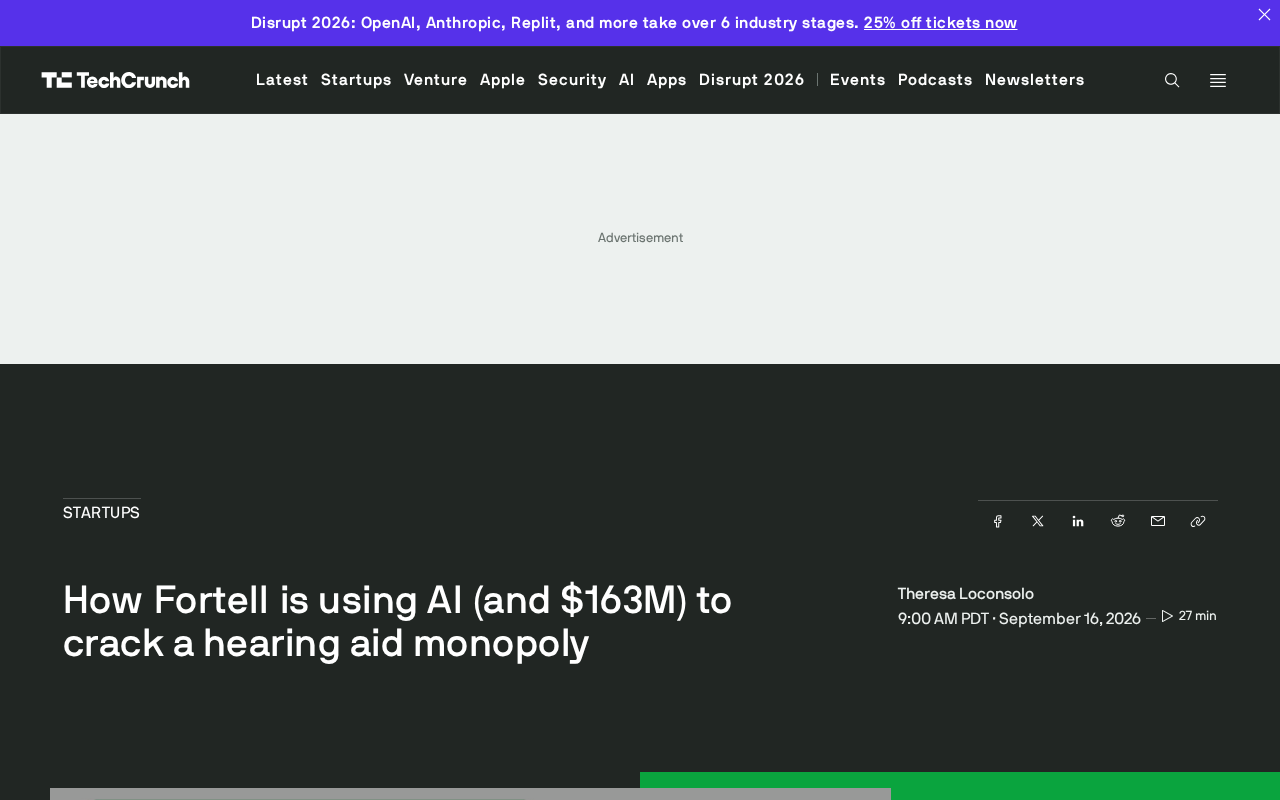
Fortell raises $163M to use AI to disrupt the hearing aid industry's long-standing monopoly.
Founded by Matthew de Jonge after six years of development, Fortell was born from a simple insight: why do people willingly wear glasses but resist hearing aids? The company recently closed a $163M round backed by Founders Fund, Thrive Capital, and Valor Equity. The global hearing aid market is dominated by a handful of multinationals, keeping prices high and innovation slow — leaving adoption rates among the hearing-impaired stubbornly low. Fortell deploys AI for real-time speech-noise separation and contextual adaptation, aiming to break through on both experience and price in an aging, underpenetrated market.
The Question of "Willingness to Wear"
"Why do I have to beg my grandparents to wear their hearing aids, yet nobody ever has to remind me to put on my glasses?" This seemingly simple question is what drove Matthew de Jonge to spend six years building Fortell.
The question cuts to the core of a long-ignored pain point in the hearing aid industry — not whether users can hear clearly, but whether they're psychologically and experientially willing to wear the device at all. Eyeglasses have long evolved from medical devices into everyday accessories and even fashion statements, while hearing aids still carry the stigma of "aging" and "disability" in many people's minds. Fortell is using AI to redefine the category entirely — turning hearing aids into something people actively want to wear, just like glasses.
What a $163M Raise Is Really Signaling
Fortell recently closed a $163 million funding round backed by a heavyweight roster of investors, including Founders Fund, Thrive Capital, and Valor Equity. These firms are renowned in the tech venture world for their sharp investment instincts — their collective bet is itself a powerful market signal.
A raise of this size is uncommon for a hardware startup, especially in a mature market long dominated by a handful of entrenched giants. The fact that capital is flowing in suggests investors believe AI has the power to disrupt this seemingly calcified industry and create value that can genuinely challenge existing players.
For a company that must simultaneously master hardware design, AI algorithms, regulatory compliance, and distribution, deep financial resources are a prerequisite for the long game. The $163 million is both a vote of confidence in the team's execution capabilities and the ammunition Fortell needs to productize and expand its market reach.
The Ambition to Challenge a Monopoly
The global hearing aid market has long been controlled by a small group of multinational companies, forming a near-monopolistic competitive structure. The direct consequence of this concentration is high prices and slow innovation — consumers routinely pay thousands of dollars for a pair of hearing aids, while meaningful product experience improvements have been relatively stagnant.
Fortell is using AI as the lever to shift this dynamic. Traditional hearing aids rely primarily on hardware-level signal amplification and filtering, while AI can distinguish speech from noise in real time across complex acoustic environments and adapt settings contextually — delivering a qualitative leap in the ability to "hear clearly." Even more importantly, AI-driven software iteration can continuously improve the user experience without requiring a hardware upgrade cycle.
Founder de Jonge's six years of product development signals that this isn't a trend-chasing short-term project, but a deep, long-term commitment to integrating technology and experience. Breaking into a mature, monopolized market requires more than capital — the product must demonstrably outperform existing solutions in real-world use.
The hearing aid market's monopolistic structure has deep roots. Six major players currently hold over 90% of the global market share: Switzerland's Sonova (brands include Phonak and Unitron), Denmark's Demant, Germany's Sivantos (the predecessor to WS Audiology), the US's Starkey, Switzerland's Bernafon, and Denmark's GN Audio (ReSound brand). These companies control not only R&D and manufacturing, but have also built formidable distribution barriers by cultivating deep relationships with audiology clinics and ENT physicians over many years. In 2022, the US FDA revised regulations to allow individuals with mild-to-moderate hearing loss to purchase OTC (over-the-counter) hearing aids without a prescription — a policy shift that opened the door for tech companies like Apple and Amazon, as well as brands like Jabra, to enter the market. This regulatory context is precisely what has enabled startups like Fortell to find a foothold.
Can AI Reshape an Aging, Underserved Market?
What makes the hearing aid market unique is that it is simultaneously a high-need market and one with remarkably low penetration. The global population with hearing loss is enormous, yet the proportion who actually wear hearing aids has remained persistently low — driven largely by three compounding barriers: poor product experience, low willingness to wear them, and high price.
Fortell's entry point targets the "willingness to wear" problem — the soft pain point the industry has long overlooked. If AI can make hearing aids truly unobtrusive and natural-sounding, while scale brings prices down, the incremental market opportunity is enormous. As global populations age, the structural demand tailwind creates further opportunity for new entrants.
Of course, the path from a successful fundraise to genuinely reshaping the market is steep. Stringent medical device regulation, incumbent giants' distribution moats, and the need to shift user perception all take time to overcome. But Fortell's story at least poses a compelling question worth sitting with: when AI matures sufficiently, are there opportunities to fundamentally redefine seemingly entrenched, traditional hardware categories?
From a global data perspective, the World Health Organization estimates that approximately 1.5 billion people worldwide experience some degree of hearing loss, of whom 430 million require rehabilitation intervention — yet actual hearing aid adoption rates among adults with hearing loss remain below 20% globally, and fall below 3% in low- and middle-income countries. Price is a central barrier: traditional prescription hearing aids in the US average over $5,000 per pair and are typically not covered by basic health insurance. AI's core applications in the hearing aid context include deep learning-based beamforming technology that can precisely track a target sound in noisy, multi-source environments like a busy restaurant; personalized audiogram adaptation that dynamically adjusts frequency response curves based on real-time user feedback; and speech enhancement algorithms that suppress background noise while preserving the speaker's natural voice timbre. This combination of capabilities gives AI-powered hearing aids a significant advantage in subjective listening experience over traditional products.
Related articles

The Siberian Ice Maiden and the Archaeological Mysteries of the Scythian World
The Siberian Ice Maiden is a Scythian female mummy from the Ukok Plateau. Her tattoos, silk garments, and grave goods reveal ancient nomadic art, social hierarchy, and cross-regional trade — alongside ongoing repatriation controversies.
SQL Row Pattern Matching: Implementing "Row-Level Regex" with MATCH_RECOGNIZE
MATCH_RECOGNIZE gives SQL regex-like power over row sequences. Detect brute-force attacks, fraud patterns, and user behavior flows with clean, declarative syntax — no more messy self-joins.
Hackers Break Into Flock Surveillance Cameras, Exposing the Inner Workings of License Plate Recognition Systems
Hackers breached Flock Safety's ALPR cameras, exposing how license plate recognition systems collect data and the privacy and security risks they pose.