FoundrRadio: Giving Founders Their Own Internet Radio Station

FoundrRadio lets founders run their own live internet radio station, betting on nostalgia and real-time community over on-demand podcasts.
FoundrRadio is a niche Product Hunt launch that lets founders pick a "frequency" and host their own internet radio station, sharing thoughts, conversations, or music via live streaming. It deliberately distances itself from on-demand platforms like Spotify and Apple Podcasts, reviving the linear "what's on right now" experience of traditional radio as its core emotional hook. Targeting founders who care about personal branding, it scored 73 upvotes and ranked #7 on launch day — validating the concept. However, the high bar of continuous content production, the cold start problem, and listener retention remain the key hurdles between a compelling idea and real-world scale.
A Web Radio Platform Built for Founders
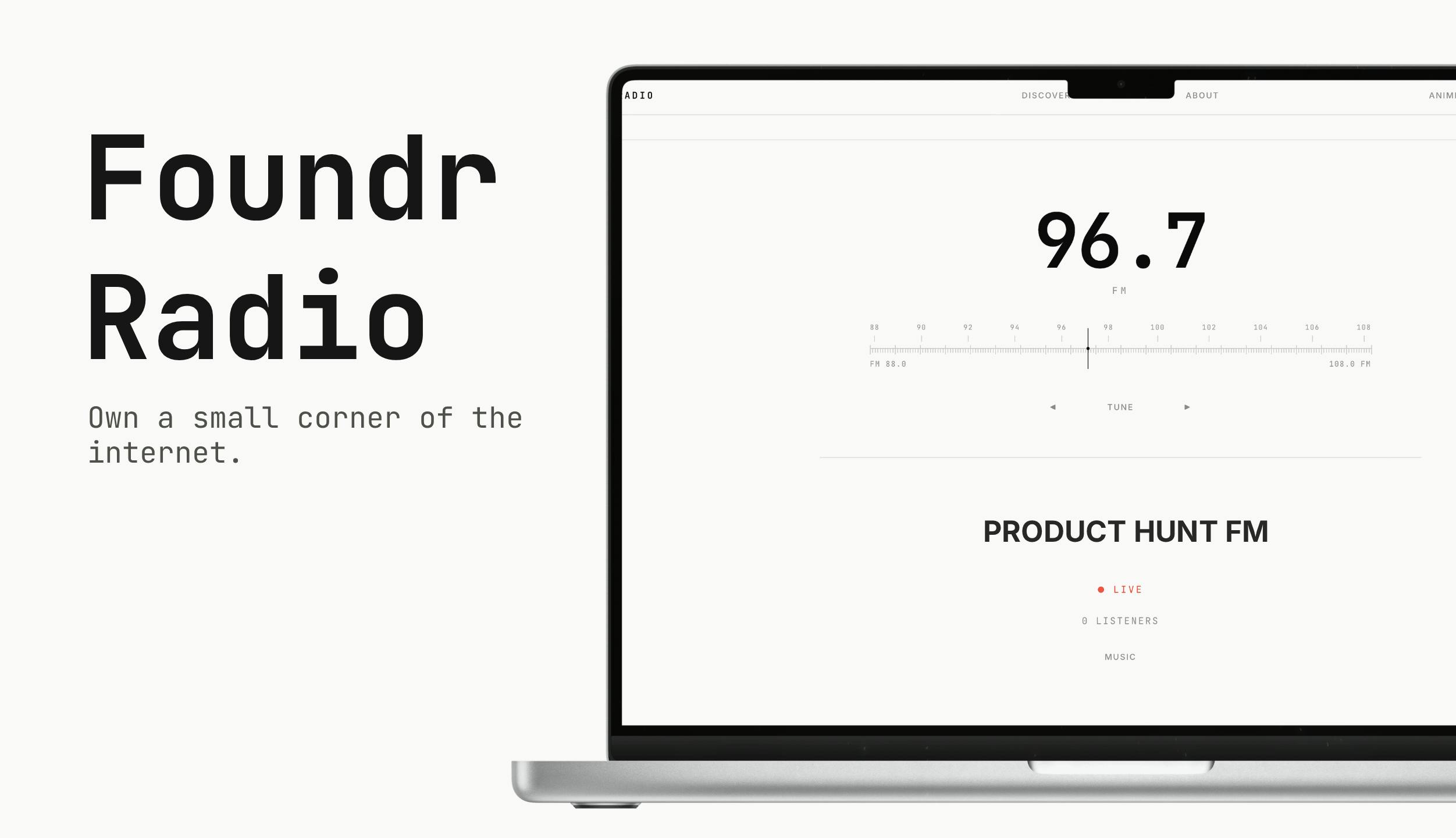
FoundrRadio is a product with genuine character that recently appeared on Product Hunt. Its core idea is straightforward: give every founder their own internet radio station — pick a frequency, go on air, and broadcast to your audience. Listeners can tune in to hear their favorite founders share thoughts, conversations, or handpicked music.
The product's tagline, "Pick a frequency, launch your radio station and go on air," captures the logic perfectly — taking the traditional radio station model and putting it in the hands of founders.
Where Nostalgia Meets Community
In an era dominated by podcasts and short-form video, FoundrRadio's decision to embrace the comparatively retro "radio" format is itself a noteworthy product choice. Founder Animesh S positions it as "your own little corner of the internet," blending nostalgia and community into a single experience.
Unlike the on-demand nature of podcasts, traditional radio's appeal lies in the real-time companionship of "what's playing right now." FoundrRadio carries forward this "go on air" live atmosphere, creating a more immediate and human connection between founders and their listeners. That design distinction is precisely what sets it apart from mainstream audio platforms.
Internet radio and podcasts differ fundamentally in their technical architecture. Podcasts use RSS subscriptions and file downloads in an asynchronous model — listeners can pause, fast-forward, and replay at will. Internet radio, by contrast, simulates traditional broadcast via audio streaming, delivering content linearly along a timeline. Listeners who tune in can only hear from the "current moment" onward, with no ability to skip back. This creates a cost of missing out — but that very irreproducible "nowness" is what gives radio its distinctive sense of companionship and ritual. Protocols like Shoutcast and Icecast have existed since the late 1990s, but real-time radio gradually faded as on-demand platforms like Spotify and Apple Podcasts rose to dominance. FoundrRadio's choice to revive this format is, at its core, a bet on the emotional value of "serendipitous listening" over "intentional consumption."
Why Founders Need Their Own Radio Station
For the founder community, personal brand and community building have never mattered more. FoundrRadio offers more than just a broadcasting channel — it's a place to gather like-minded people and build a lasting community.
Founders can use it to:
- Share reflections and lessons from their startup journey
- Engage with followers in real time through audio
- Play music that reflects their personal taste and shapes a distinctive station identity
- Establish a content hub on the internet with a genuine personal stamp
This "one person, one station" model is fundamentally an experiment in personal IP and media presence. Rather than competing for attention against a flood of content on aggregator platforms, owning a distinct radio "frequency" gives founders a stronger sense of identity and belonging.
Market Reception on Product Hunt
FoundrRadio received 73 upvotes on Product Hunt, earned 10 comments, and ranked #7 for the day — filed under the Music, Radio, and Community categories.
By the numbers, this is a solid if modest showing that reflects genuine community recognition. The 73 upvotes suggest the concept resonates — especially within the founder community, where the idea of "having your own radio station" carries natural appeal. Whether it can move from concept validation to sustained user growth, however, remains to be seen for a niche, nostalgia-driven product like this.
Opportunities and Challenges in Its Positioning
FoundrRadio's greatest strength lies in its differentiated positioning: rather than going head-to-head with podcast giants, it carves out the niche of "founder radio" and uses nostalgic sentiment as an emotional hook.
But the challenges are equally real. The internet radio format demands a continuous stream of content to stay "live," which places significant demands on individual founders' ability to produce material consistently. Lowering the barrier to launch, maintaining station activity, and keeping listeners engaged will be critical to whether the product ultimately works. Beyond that, cold start problems, creator incentives, and content discovery mechanisms are unavoidable challenges for any platform of this type.
For founders who care deeply about personal brand and enjoy real-time community interaction, FoundrRadio offers a fresh and distinctive option. Whether it can truly become that "little corner of the internet" for founders depends on how deeply the product is refined and how seriously community building is pursued.
The cold start problem is the most classic early-stage challenge for two-sided or multi-sided platforms: creators lack motivation to keep broadcasting when audiences are thin, while potential listeners won't stick around when content is scarce — both sides wait on each other, creating a deadlock. Common strategies to break through include: focusing on a single vertical community first (e.g., only serving tech founders), using subsidies or recognition mechanisms to incentivize early broadcasters, and having the platform itself act as the "first broadcaster" to create content density. FoundrRadio's decision to target founders is itself a focusing strategy — and the Product Hunt community happens to be a natural gathering place for exactly that seed audience. But founders tend to have fragmented schedules, and whether they can maintain a consistent broadcasting rhythm will ultimately determine whether the platform's content supply side can sustain itself.
Related articles

WorkBuddy Full Tutorial: Build an AI Office Automation Agent from Scratch
A complete WorkBuddy tutorial: installation, three working modes, multimodal picture book video practice, expert team agent building, and workflow configuration for low-cost AI office automation.

WorkBuddy Agent Complete Guide: From Beginner to Automation in 7 Days
Based on Bilibili's 256-episode WorkBuddy masterclass, this systematically breaks down Tencent's AI office workbench core capabilities: Agent principles, Skill encapsulation, cross-platform connectors, scheduled automation, knowledge bases, and zero-code development, with learning path recommendations.

8 AI Accounts, 7 Failed: An Honest Review of Using AI to Get Work Done
Only 1 of 8 AI-run Bilibili accounts succeeded. We break down the real difference between "performing AI" and "using AI to get work done."