Four AI Coding Models Tested: Same Prompt, Same Animation — Who Followed Instructions Best?
Four AI coding models generated a 20-second animation from pure code; Astra won by one point at far lower cost than Fable.
The creator gave the same demanding prompt to Claude Fable 5.2, GPT 6.2 Astra, Gemini 4 Hydrogen, and Qwen 4 Max, asking for a pure-code 20-second Japanese sword-fight animation, and scored them against 11 criteria. Astra and Fable were nearly tied in quality (54 vs. 53), but Astra used only about one-fifth of Fable's tokens, making it the most cost-effective; Hydrogen was fastest but had rough characters and needed manual intervention; Qwen was cheapest but drifted badly from instructions later on. Artificial Analysis benchmarks and arena rankings also confirmed Astra's token-efficiency advantage. The creator advises against using the most expensive models for everyday tasks.
A Showdown Built Entirely from Code
What happens if you give an AI a single prompt and ask it to generate a 20-second Japanese anime sword-fight animation using pure code — no stock images, no recorded audio, every frame and sound generated by code? A YouTube creator handed the exact same prompt to four AI coding models: Anthropic's Claude Fable 5.2, OpenAI's GPT 6.2 Astra, Google's Gemini 4 Hydrogen, and Alibaba's Qwen 4 Max. No code was touched by hand — just one instruction sent, then scored against 11 criteria.
The point of this test wasn't "who made the prettiest thing" but "who actually listens." In the creator's words: an AI that looks good but ignores instructions is useless in day-to-day work.
The "pure-code animation" mentioned here means rendering every frame and synthesizing audio in real time in the browser through a program (typically JavaScript with WebGL or the Canvas API), rather than using pre-rendered video files or external assets. This kind of task demands spatial imagination, mathematical computation, and code organization all at once, because every frame, every particle effect, and every drum beat must be computed dynamically by the algorithm at runtime. Unlike the common "text-to-image" or "text-to-video" approaches, pure-code animation has no pixel-level reference — the model must construct the scene graph, lighting model, and animation timeline itself, which exposes its weaknesses in long-horizon planning and detail consistency.
A Prompt Strict Down to Every Petal
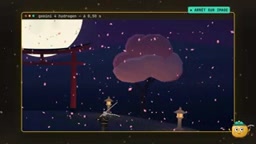
The test prompt left almost no room for improvisation: night, a giant moon, a ruined shrine courtyard, a red torii gate; two characters — the calm, swift Kaito who ultimately wins, and the burly, defeated Daigo; the moon must have craters and a halo, three mountain ranges, four stone lanterns, two cherry trees, six hundred falling petals; the animation must run at 12 frames per second, and at the moment of impact the sky turns white while everything else goes black. The technical constraints were just as rigid: a single web page file, mandatory use of a 3D library, all shapes, flames, and drum beats generated by code, and the same second must always render exactly the same frame.
This is really testing four things: storyboarding, animation, visual effects, and a note-by-note soundtrack. More importantly, the prompt required the AI to open and test the generated film itself.
"The same second must always render exactly the same frame" points to a deterministic rendering requirement. In real-time graphics, if an animation relies on random numbers or time-dependent floating-point operations, rendering the same time point multiple times can produce subtle differences, causing flicker or non-reproducibility. The prompt's demand for determinism means the model must use a fixed-seed pseudorandom number generator and avoid logic that depends on system time or unstable frame rates. This poses an extra challenge for code-generation models: it must precisely control the order of state updates within the animation loop to ensure that falling petals, flickering flames, and other effects are identical on every playback, rather than simply calling Math.random().
How the Four Models Actually Performed
Gemini 4 Hydrogen: Fastest, but Rough Characters
Hydrogen finished in 33 minutes, the fastest of all the models. Its scene fidelity was decent: the torii's curved top, four lit lanterns, two cherry trees rendered as rounded clusters, plenty of falling petals, and all three big-impact white-flash-black-silhouette effects landed. The problem was the characters — the figures looked like they'd been cut into blocks, Kaito's cape resembled a dashed line on close inspection, the eye close-up outline felt pixelated, and the lighting effects covered half a face. After the ground cracked, square black blocks still hung in front of the trees on either side of the sky.
According to the creator, Hydrogen failed on its first launch because it tried to write the entire film in one go, exceeding the single-response limit; a retry hit a tool bug, and the third attempt errored the same way. Only after the creator manually pasted in a tool error message did it switch to writing in segments, eventually making 23 revisions.
GPT 6.2 Astra: Richest in Detail, and the Freest
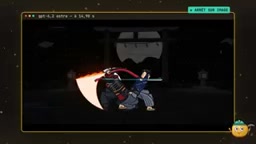
Astra took 47 minutes. The creator's first reaction was "this looks like a real cartoon": the cherry trees had twisted trunks and branches, and the lanterns actually lit the ground around them. It also voluntarily added stone walls, steps behind the torii, rocks, and a rope with white paper tied to the torii — the look of a real shrine. That's both an aesthetic strength and a deviation from instructions: the prompt asked for rounded cluster-shaped cherry blossoms, and it drew them its own way.
The characters were the most refined of the four: Kaito had straw sandals, pleated pants, and a fluttering scarf; Daigo had scars, a beard, and black armor with gold trim, and in the eye close-up flames were reflected on his face. On the effects side, flames were drawn in anime style rather than as simple light orbs, the impacts were clean and crisp, and in slow motion the world darkened until only cyan lines remained. One detail the creator praised: in slow motion, Daigo's sword slices off a corner of Kaito's scarf, and at the end that piece of cloth lies on the ground.
Qwen 4 Max: Cheapest, and the Most Unrestrained
Qwen took 64 minutes and was the lowest-priced of the four. The opening terrain was faithful: torii, four lanterns, rounded cherry blossoms, a moon with craters. But as the film progressed, it drifted further and further from the instructions: at the first impact the torii turned into a simple black rectangle and the screen filled with orange; the moon, which should have stayed creamy white throughout, turned orange and then black after the landing impact, flickering until the end; the ground cracks, which should have died out within three seconds, were still glowing in the final frame. Some details were missed: Daigo's landing lacked speed lines, Kaito's charge-up glow should have flickered but appeared orange, and in slow motion the sky stayed purple instead of the world going dark. The characters were slender with little detail, and the scarf and ponytail looked like tubes.
Claude Fable 5.2: The Most Obedient "Top Student"
Fable took 68 minutes, the slowest, but it read the prompt all the way to the last line. The stone slabs on the ground, the cracks, the moss spots — all were there; the moon had a blue halo, the cherry blossoms were standard rounded clusters, and the four lanterns were all in place. The details weren't as rich as Astra's, but it was more faithful.
Its strength was cinematic feel, especially lighting: blade reflections, moonlight on water, plenty of dust, a landing impact with lava cracks and fire columns, and a two-tone image that preserved orange reflections and smoke. The characters were clean and solid, and Daigo's eye close-up had the scar and orange eyes, almost matching the prompt word for word. The only flaw: the top of the torii fell straight down and stopped at the base of the pillars instead of toppling backward. In addition, in the scene in front of the moon Daigo's silhouette was on the small side, and the blade was just a yellow strip of light rather than the intended flame extension; in slow motion the scene turned gray but stayed almost as bright as before, falling short of the "only a quarter of the world's brightness remains" requirement.
The "token consumption" mentioned repeatedly here is key to understanding the cost differences. In large language models, a token is the basic unit of text processing; when the model reads and writes code, every word, symbol, or code fragment is split into a number of tokens. To generate a piece of animation code, the model must first "think" and then "output," and the thinking process (especially extended thinking modes) also consumes a large number of tokens. Astra's high token efficiency means it produces leaner internal reasoning and output code for the same task, lowering per-token costs. For subscription-based services, token consumption doesn't directly produce a bill, but it affects response speed and usage limits, so it remains an important measure of a model's practicality.
A Quantitative Comparison of Code and Cost
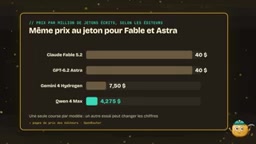
The four code files ranged in size from about 104 KB (Qwen) to 183 KB (Hydrogen), with Fable and Astra in between. The line counts varied widely, but the creator noted that line counts are heavily affected by formatting, so file size is more comparable.
The real gap was in token consumption. Astra wrote far fewer tokens than the other three — about one-fifth of Fable's — even though its file was the second largest. Converted using each vendor's published pricing, Fable's film cost far more than Astra's, Astra more than Hydrogen's (which also required paying for a failed launch), and Qwen's was the lowest. Fable and Astra have the same per-token price, but Astra's total cost was much lower precisely because it consumed far fewer tokens.
The creator offered two caveats: a different test run might produce different numbers; and Fable and Astra are subscription-based, so these aren't real bills.
Corroboration from Benchmarks and the Arena
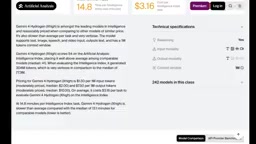
Artificial Analysis ran a set of benchmarks on the four models at the same thinking level used in the test: Fable scored highest, Astra close behind, Hydrogen in the middle, and Qwen at the bottom. The site also tracked the number of tokens each model wrote to complete all the tests, and Astra's was only a little more than a quarter of Fable's — consistent in direction with this animation test's finding that "Astra's token consumption was about one-fifth of Fable's," suggesting this isn't a coincidence but a reflection of how it works.
In the arena where humans vote for the best websites, Fable ranked first, Qwen sixth, and Hydrogen eleventh; Astra had just been released and hadn't yet appeared on the leaderboard.
Artificial Analysis is an independent third-party evaluation organization that compares major models head-to-head using standardized prompts and a uniform thinking level, publishing scores and token-consumption data. Its benchmarks cover reasoning, coding, instruction following, and other dimensions, and are often used as a reference for model selection. The "arena" mentioned here refers to human-preference voting platforms such as LMSYS Chatbot Arena, where users blindly choose between two anonymous models' answers, ultimately producing an Elo-style ranking. These two types of evaluation complement this animation test: benchmarks reflect general capability, the arena reflects subjective human preference, and the animation test focuses on instruction following and cost efficiency in a specific long-horizon code-generation task.
Final Ranking: A One-Point Difference
The creator scored against 11 criteria, each from 1 to 5, with Fable and Qwen evaluated blind. The results: Qwen 37 points (out of 55) for fourth, Hydrogen 47 for third, Fable 53 for second, and Astra 54 for first. First and second were separated by a single point, which the creator considered essentially a tie, and the benchmarks also showed the two to be close.
The real decider was cost: with nearly identical quality, Astra's cost was far lower than Fable's, and its cost per point scored was also lower, making it the most cost-effective and token-efficient model in this test. On a small budget, Hydrogen is the fallback (though it requires one manual intervention), and Qwen is the cheapest with performance that exceeded expectations. The creator's advice: for everyday tasks you don't need complex-task models like Fable or Astra — cheaper models are often good enough.
This test measured only one thing: fidelity in generating an entire code animation from a single prompt. It doesn't represent all tasks, but it clearly shows that when it comes to instruction following, the difference between models isn't "can they do it" but "are they willing to obey" and "how much it costs to obey."
One-line Summary
Four AI coding models generated a 20-second animation from pure code; Astra won by one point at far lower cost than Fable.
Paragraph Summary
The creator gave the same demanding prompt to Claude Fable 5.2, GPT 6.2 Astra, Gemini 4 Hydrogen, and Qwen 4 Max, asking for a pure-code 20-second Japanese sword-fight animation, and scored them against 11 criteria. Astra and Fable were nearly tied in quality (54 vs. 53), but Astra used only about one-fifth of Fable's tokens, making it the most cost-effective; Hydrogen was fastest but had rough characters and needed manual intervention; Qwen was cheapest but drifted badly from instructions in the later stages. Artificial Analysis benchmarks and arena rankings also confirmed Astra's token-efficiency advantage. The creator advises against using the most expensive models for everyday tasks.
Related articles
Qwen 4 Max vs Gemini 4 Hydrogen: A Hands-On Test of Who's Better at Game Development
Hands-on comparison of Qwen 4 Max Preview, Gemini 4 Hydrogen, and Gemini 4 Argon at game development: from Minecraft clones to 3D shooters and SVG interactivity—the highest-scoring model isn't always the best.
Qwen 4 Max Released: Low Pricing, Mixed Benchmark Results; Google Gemini New Models Leaked
Qwen 4 Max launches: 2.4T-parameter MoE, 1M-token context, sharply cut API prices but lagging on agentic tasks vs Opus. Meanwhile Google's Gemini 4 Oxygen and Krypton leak, and GPT-6.2 Sol may be in canary.
GPT-6.2 Astra Released: Rebuilding Paris, Million-Scale Game Generation, and NVIDIA's Robot Revolution
Weekly AI roundup: OpenAI launches GPT-6.2 Astra and Sol, Google tests Gemini 4 Oxygen and Neon, Alibaba Qwen4Max and Tencent HY4 Flash generate full games at low cost, NVIDIA Groot 2 lets robots learn from demos, and California sues OpenAI.