Qwen 4 Max vs Gemini 4 Hydrogen: A Hands-On Test of Who's Better at Game Development
Three AI models hands-on tested at writing games: the highest-scoring Hydrogen isn't the most usable; Qwen 4 Max wins most interactive projects.
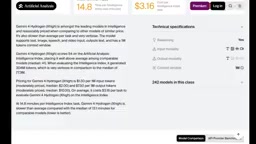
A YouTube creator hands-on tested Qwen 4 Max Preview, Gemini 4 Hydrogen, and Gemini 4 Argon at generating 3D games and interactive apps. Gemini 4 Hydrogen scored 54 on the Artificial Analysis Intelligence Index, beating Argon's 50, but in hands-on testing its verbosity score of 78/79 led to 304 million output tokens per task, 14.8 minutes duration, and $3.16 cost. Qwen 4 Max won the Minecraft clone, overall 3D tactical shooter experience, and cyberpunk SVG interaction; Argon was superior in shooter controls feel and engineering physics UI; Hydrogen only led in physics sandbox visual impact.
When AI Starts Stealing Game Developers' Jobs
A YouTube tech creator did something many developers want to do but never have time for: threw Qwen 4 Max Preview, Gemini 4 Hydrogen, and Gemini 4 Argon into the same set of hands-on tests, letting them write 3D games and interactive apps for real. The results were surprising—the model with the highest benchmark score wasn't the most usable one.
First, some background. Google officially rolled out Gemini 4 Hydrogen on November 13, positioned as a "fast, everyday Flash-tier product" focused on coding and agent tasks, available across AI Studio, the Gemini API, Search, and Google Anti-Gravity. The official numbers are quite aggressive: a default score of 51 on the Artificial Analysis Intelligence Index, rising to 54 with thinking mode enabled—surpassing Gemini 4 Argon's 50. A "budget-speed" model overtaking a higher-tier product is itself worth pondering.
The Hidden Costs Beyond Benchmark Scores
But the creator immediately cross-checked on Artificial Analysis and found several easily overlooked details. Hydrogen's streaming output speed is 174 tokens/sec, with 1M context and full audio/video/image input—sounds great. The problem lies in its "verbosity index"—a verbosity score of 78 (out of 79), consuming 304 million output tokens in the Intelligence Index tests while a typical model uses only 77.3 million. This dragged its per-task duration to 14.8 minutes, actually slower than the 13.1-minute median, pushing the real evaluation cost to $3.16 per task.
API pricing, however, is transparent: $1.50/million tokens for input, $7.50/million tokens for output, uniform pricing across the full 1M window, with a free tier on AI Studio and 5,000 free Google Search and Maps grounding queries per month. Implicit caching can bring cached input down to $0.075/million tokens, and Flex or Batch mode cuts prices in half. Qwen 4 Max Preview is still in preview, so official per-token pricing hasn't been announced; it's currently offered through Alibaba Cloud's token planAd—promotional pricing starting at $3 (regular $6/month) for new users, plus a limited-time 20% off API calls.
Artificial Analysis Intelligence Index is a composite capability index published by an independent third-party evaluation organization that ranks large models by aggregating weighted scores from multiple standardized benchmarks (such as MMLU, HumanEval, GSM8K, etc.). What sets this index apart is that it doesn't just look at accuracy—it also tracks per-task output token consumption, inference latency, and overall cost, thus reflecting the gap between "benchmark scores" and "real-world usage overhead." The article mentions Hydrogen scoring 51 by default and 54 in thinking mode on this index, while consuming 304 million output tokens—far above typical models. This is exactly how the index tracks both capability and efficiency. When developers reference such leaderboards, they need to pay attention to the cost and latency metrics behind the scores, or they'll easily misjudge a model's practical usability.
Verbosity is a metric for evaluating a model's output redundancy, typically scored from 0 to 79, where a higher score means the model tends to generate lengthy explanations, repetitive reasoning steps, or superfluous transitional sentences. High verbosity directly drives up output token consumption, which in turn increases API costs and end-to-end latency. The article notes Hydrogen's verbosity score of 78 (out of 79), causing per-task output tokens to reach nearly four times that of typical models and dragging per-task duration to 14.8 minutes. For production scenarios requiring low latency and high-volume calls, verbosity is a more critical selection criterion than raw benchmark scores. Developers can constrain output length through prompt engineering or choose modes that support thinking budget control to mitigate this issue.
Round One: Minecraft Clone
Benchmarks say Hydrogen is smart, but when you actually sit down with a mouse and keyboard to play, the winner changes.
Qwen 4 Max established a clear advantage in the first round. Its Minecraft clone had 3D block models actually held in hand, a radial destruction wheel with crack-shattering effects, and milestone pop-ups like "+1 Dirt" and "+1 Tall Grass." Jump into a river and you'd see underwater tint and an oxygen bar; at dusk, fireflies drifted through the biome. Press E to open inventory and crafting table—a complete crafting tree of oak planks, smelted stone, and fired glass all worked. The creator's exact words: "You can absolutely lose 20 minutes in a game written from a single prompt."

Gemini 4 Hydrogen's Voxelcraft 3D was visually more refined—night-to-sunrise gradient lighting across 99 loaded chunks, debris when breaking sand, clean water flow. But it lacked held 3D blocks, no firefly ambiance, insufficient crafting depth—overall more like a pretty tech demo than a game. Gemini 4 Argon actually performed well in this test, with oxygen bubble effects and minable underground stone caves. But on overall experience, Qwen 4 Max took this round.
Voxelcraft 3D is not a real commercial game engine—it's a placeholder name used in the article to describe the Minecraft clone project generated by Gemini 4 Hydrogen, emphasizing its voxel-based 3D rendering approach. Voxels are volumetric pixels in three-dimensional space, commonly used in sandbox building games; Minecraft is the most typical voxel game. Unlike traditional polygon mesh rendering, voxel rendering assembles scenes from many small cubes to create destructible, editable terrain. The article mentions Hydrogen's version covering 99 loaded chunks with day-night gradient lighting—this describes the rendering scale and lighting system of its voxel scene. Understanding the voxel concept helps assess the differences in visual refinement and playability of 3D apps generated by different models.
Round Two: 3D Tactical Shooter
This round produced the most interesting divergence in the entire test—Qwen 4 Max made the better game, but Gemini 4 Argon made the better controls.
Qwen 4 Max's version had proper competitive arena shooter feel from the S9 sector start: smoothly rotating radar, crisp sound effects, and the VK7 Vandal cleanly aligning with iron sights when right-click aiming. Clearing bots had a complete wave-plus-resupply loop; switching to the RG9 long gun revealed a circular sniper scope locking onto glowing enemy cores on the map. As a complete shooter package, it won.

Hydrogen turned the same task into a fast-paced arcade style—bright yellow laser tracers, tight second-wave ambush, smart infinite ammo design so you never run dry. Very fun, but lacking Qwen's scope zoom and multi-wave resupply polish.
Argon's Protocol Zero Hour crushed both opponents on controls feel. Crouch and stand stance switching was real, sprinting responsive, directional damage arcs, headshot killstreak banners, and even tactical control instructions embedded in the pause menu. The secondary weapon was an 8.0XR90 railgun scope with real-time rangefinding and wind speed readouts. The only problem was no recovery mechanism when ammo ran out—but the creator cut that detail.
Physics Simulation and SVG Interaction: Two Different Approaches
In the 3D folding table simulator test, Hydrogen became a stress-relief sandbox—stack 70kg steel balls and 50kg iron blocks on the table, see 42mm of elastic bending, red force vectors rendering in real time, pull the release pin and watch catastrophic collapse. Argon took an engineering lab approach: four independently locking leg switches, Newton force readouts under each foot, real-time support polygon and center-of-gravity charts tracking whether the table would tip over. Visually less exciting than Hydrogen, but the engineering UI was sharper.
The final round was pure inline SVG animation. Qwen 4 Max's cyberpunk garage had real-time rain, neon reflections, sparks, and flying car traffic, plus a complete real-time control sidebar on the right—choreography speed adjustable to 2x, neon glow adjustable, wind adjustable, coffee steam adjustable, neon color palette rotatable 360 degrees to venom green, Web Audio toggle for arc welding crackle sounds, and SVG frame download.
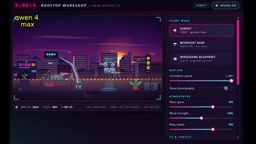
Hydrogen and Argon's garage static images were more refined—Argon's sunset golden glow with 3D turrets and 3400K color temperature wireframe annotations, visual purity even exceeding Hydrogen. But in terms of interactivity, both fell far short of what Qwen 4 Max packed into a single response.
Inline SVG animation refers to embedding Scalable Vector Graphics directly into HTML documents and driving attribute changes via JavaScript or CSS, enabling interactive animations without external image resources. SVG describes graphics based on XML, naturally supports lossless scaling, and is suitable for icons, charts, and vector illustrations. The cyberpunk garage test in the article required models to generate pure inline SVG, meaning all graphics, raindrops, neon reflections, sparks, and car traffic had to be completed in a single response as SVG elements and animations, without relying on WebGL or Canvas. This tests a model's fine-grained control over SVG paths, gradients, filters (like glows), and animation timing—and explains why Qwen 4 Max could add real-time control sidebars while other models only produced static images.
What the Mismatch Between Benchmarks and Hands-On Testing Reveals
The most valuable information from this test isn't "who won" but rather a blind spot in the current model evaluation system. Gemini 4 Hydrogen scored 54 on the Intelligence Index, beating GPT 6.1 Tara and Claude Fable 5.1, yet in hands-on tests it won only one of four rounds (the visual impact of the physics sandbox). Qwen 4 Max Preview doesn't even appear on the Artificial Analysis leaderboard yet—the highest Qwen listed is the older 3.8 Max at just 34 points—yet it won three of the hands-on projects.
According to the creator's analysis, this reflects differences in capability focus: Hydrogen's strengths lie in benchmark-verified reasoning ability, massive context, and transparent pricing—suitable as a workhorse. Qwen 4 Max has better feel for interactive UI, rich 3D web apps, and mini-game generation. As for Argon, while its overall score trails Hydrogen, it still deserves respect for shooter controls feel and engineering precision—which also shows that different tiers within the same model generation aren't simply a "high-end vs low-end" relationship.
There's another signal not to be ignored: Google introduced a new orchestrator in Anti-Gravity that orchestrates Carbon and Hydrogen in the same session, achieving coding accuracy close to Carbon level on Terminal Bench 4.0 while consuming 24% fewer quotas and completing 19% faster. Compared to 3.8 Flash, task completion is 2.5x faster, Terminal Bench 4.1 rose from 18.2 to 57 (more than triple), and hallucinations dropped fivefold. This shows that multi-model orchestration will become the next competitive focus.
For developers, the conclusion is practical: if your work involves generating interactive game prototypes, rich 3D showcase pages, or creative coding, hands-on testing reflects experience better than benchmark scores; if you need verifiable benchmark capability and large context processing, Hydrogen's cost-performance is genuinely competitive—just watch out for the latency and cost that verbosity brings in X-High mode.
One-line Summary
Three AI models hands-on tested at writing games: the highest-scoring Hydrogen isn't the most usable; Qwen 4 Max wins most interactive projects.
Paragraph Summary
A YouTube creator hands-on tested Qwen 4 Max Preview, Gemini 4 Hydrogen, and Gemini 4 Argon at generating 3D games and interactive apps. Gemini 4 Hydrogen scored 54 on the Artificial Analysis Intelligence Index, beating Argon's 50, but in hands-on testing its verbosity score of 78/79 led to 304 million output tokens per task, 14.8 minutes duration, and $3.16 cost. Across four rounds, Qwen 4 Max won the Minecraft clone, the overall 3D tactical shooter experience, and the cyberpunk SVG interaction; Argon was superior in shooter controls feel and engineering physics UI; Hydrogen only led in physics sandbox visual impact. The article notes a systematic mismatch between benchmark scores and hands-on experience, and that developers should choose models based on specific task types while watching the multi-model orchestration trend.
Related articles
FBI Warning: How Open-Source AI Pentesting Tool Artex Lowers the Bar for Hackers
FBI warns that the open-source AI pentesting framework Artex is being used in real cyberattacks, taking under three hours from initial target to privileged access, involving a South Korean financial institution data breach and supply chain intrusion. This article analyzes how it works, the FBI's findings, and defensive implications.
Free AI Hacking Tool Artex Exposed: FBI Warns Banks and Governments Under Attack
FBI warns that the open-source AI penetration testing tool Artex is being used to attack banks and government agencies, with some attacks obtaining admin privileges within three hours. This article analyzes how it works, real cases, the cascading impact of Optimizely and PHP vulnerabilities, and protective measures individuals and enterprises can take.
ARTEX Explained: How an AI Hacking Tool Breached WorkOS and Barracuda
FBI warns ARTEX is being abused. We analyze the WorkOS and Barracuda breaches—both exploited legacy credentials and exposed systems, not new vulnerabilities.