Four-Stage Learning Roadmap for Embodied AI: From ROS to VLA in Practice

A four-stage embodied AI learning roadmap from ROS basics to VLA and hands-on projects.
The article introduces an embodied AI learning roadmap circulating on Bilibili that breaks the technical chain into four stages: getting started (Python/C++/Linux, robotics fundamentals, and ROS's four communication mechanisms), perception and control (computer vision, point clouds, motion planning with MoveIt2, Nav2, and Gazebo/Isaac Sim simulation), core algorithms (imitation learning, reinforcement learning, VLA models, data collection, and Sim-to-Real transfer), and project implementation (completing two or three full projects and organizing them into a portfolio). It emphasizes that companies value the ability to make robots actually complete tasks rather than just running open-source demos, and notes that the roadmap suits developers with a programming background; its layered structure can serve as a self-study skeleton, while tool choices should be adjusted flexibly to project needs.
Embodied AI is becoming a key direction for AI as it moves from the digital world into the physical world. Being able to tweak large models and run robot demos is no longer enough—what companies really need are people who can make robots perceive their environment, understand instructions, plan actions, and complete tasks. Whether you're job hunting or building robot projects, systematically mastering embodied AI is a core competitive advantage.
A learning roadmap for embodied AI that recently circulated on Bilibili breaks the entire technical chain into four stages. This roadmap doesn't waste words—it points directly at one goal: enabling you to independently complete a full project in which a robot actually accomplishes tasks.
Stage 1: Getting Started—First Understand How a Robot System Runs
The core of this stage is concepts and the toolchain. Start programming foundations with Python, C++, and Linux—this is the foundation for all subsequent work. Robot fundamentals include kinematics, coordinate frames, and sensors—they sound like textbook material, but they are the language for understanding how a robot describes its own position and its external environment.
The real focus is ROS communication mechanisms: nodes, topics, services, and actions. Many beginners get stuck at "I can run the code but I don't understand the system," and the problem often lies here. Only by understanding these four communication patterns can you understand how modules within a robot system collaborate.
ROS (Robot Operating System) is not an operating system in the traditional sense, but rather a distributed communication middleware and toolset that runs on top of Linux. It was originally developed by Stanford University and Willow Garage and is now maintained by Open Robotics. The core problem it solves is: decoupling perception, planning, control, and other modules into independent processes that collaborate through a unified communication mechanism. A node is the smallest unit that performs specific computation; topics use a publish/subscribe model and are suitable for continuous data streams (such as sensor data); services are synchronous request-response calls; and actions target long-running tasks and support feedback and cancellation during execution. Understanding the applicable boundaries of these four mechanisms is the foundation for designing robot software architecture, and it is also a frequently tested topic in interviews.
Stage 2: Perception and Control—From "It Runs" to "It Acts"
Once the basics are in place, move on to perception and control. On the perception side, you need computer vision, object detection, and point cloud processing; on the control side, you need robot motion control, trajectory planning, and path planning.
In terms of tools, the roadmap mentions MoveIt2 and Nav2 (transcribed in the original speech as Moviet2Navar), which correspond to robotic arm motion planning and mobile robot navigation, respectively. For simulation, use Gazebo or Isaac Sim to build environments (transcribed in the original as Gasble or iSEC SIM). The value of simulation lies in low-cost trial and error: validate algorithm logic in a virtual environment, then transfer it to a real robot.
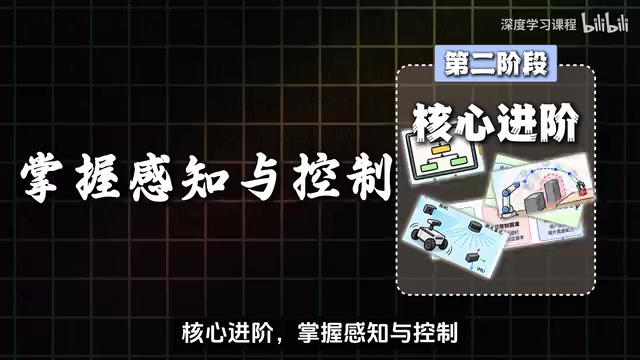
The goal of this stage is clear: upgrade the robot from "it runs" to "it perceives and acts."
A point cloud is a set of 3D points output by a lidar or depth camera. Each point contains spatial coordinates and may carry additional information such as intensity and color. Compared with 2D images, point clouds directly preserve geometric structure, making them the primary data form for obstacle avoidance, localization, and grasp pose estimation in robotics. Common processing includes filtering and downsampling, ground segmentation, clustering segmentation, and registration (such as the ICP algorithm). In engineering practice, point clouds are often fused with visual information: vision handles semantic recognition, while point clouds provide precise spatial measurement. Mastering the basic operations of a point cloud library (such as PCL) is a key link connecting perception algorithms with motion planning, and it is also an essential skill in mobile robot and robotic arm grasping projects.
Stage 3: Advanced Upgrade—Master the Core Technologies of Embodied AI
This is the most "embodied" part of the entire roadmap. The learning content includes imitation learning, reinforcement learning, and vision-language-action models (VLA). These three correspond to three key questions: how a robot learns actions from data, how it optimizes policies through trial and error, and how it understands human instructions and converts model outputs into real actions.
VLA is a hot direction in the current embodied AI field. It puts visual perception, language understanding, and action generation into the same model framework. Mastering this layer means you can truly connect large model capabilities to the robot's execution end. In addition, data collection, model training, and sim-to-real transfer are also practical priorities at this stage.
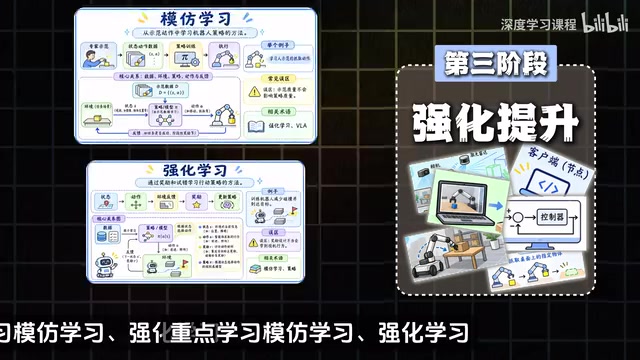
Sim-to-Real refers to training a policy model in a simulation environment and then deploying it to a real robot. The core challenge is the "reality gap": simulation struggles to accurately model friction, deformation, sensor noise, and lighting changes, causing policy performance to degrade on real machines. Common countermeasures include domain randomization (randomizing physical parameters, textures, lighting, etc. during training), system identification (calibrating simulation parameters to approximate the real robot), and online adaptation. This step directly determines whether a reinforcement learning solution can be deployed, and it is also an engineering difficulty repeatedly discussed in current embodied AI research. When evaluating transfer performance, it is usually necessary to design multiple controlled experiments on the real robot rather than only looking at success rates in simulation.
Stage 4: Real-World Implementation—Let Your Project Portfolio Speak
The final stage is to complete two or three full projects, such as robotic arm modeling, and the deployment and debugging of perception-decision-control. The point is not the number of projects, but organizing them into a portfolio and putting it on your resume.
One sentence in the roadmap nails the real standard companies use in hiring: what companies value is not whether you can run an open-source demo, but whether you can make a robot actually complete tasks. This sentence is worth revisiting against your own project experience again and again.

Who This Roadmap Is For
Judging from the four-stage division, this roadmap is more suited to developers with a programming background who want to systematically enter the embodied AI field. Complete beginners need to spend more time in Stage 1 catching up on Python and Linux. For people who already have large model experience but lack robot system training, Stages 2 and 3 are the main areas to fill in.
One reminder: this roadmap comes from a single video source, and the tool choices (such as simulation platforms and VLA frameworks) are not the only answers. But the layered structure it provides—basic systems, perception and control, core algorithms, and project implementation—is a reasonable order of progression. It can serve as a skeleton for self-study, with details filled in according to actual project needs.
Related articles
Google Releases Gemini 4 Hydrogen: Speed and Code Generation as Core Selling Points
Google releases Gemini 4 Hydrogen, emphasizing speed and first-time code accuracy; agents can pay bills and open Google Ads accounts; Baidu launches model trading platform Ciyuansuo, Alibaba upgrades its 714 flagship, and the 27B-parameter open-source robotics model Prince GE opens for commercial use.
Gemini 4 Hydrogen Long-Term Test: Official 2.5x Speed, 3D Printing Is the Biggest Surprise
Full long-term test of Gemini 4 Hydrogen: priced at $5.5/$7 per million tokens, officially 2.5x faster, stunning 3D-printed STL quality with no supports needed, and only 4% weekly quota used.
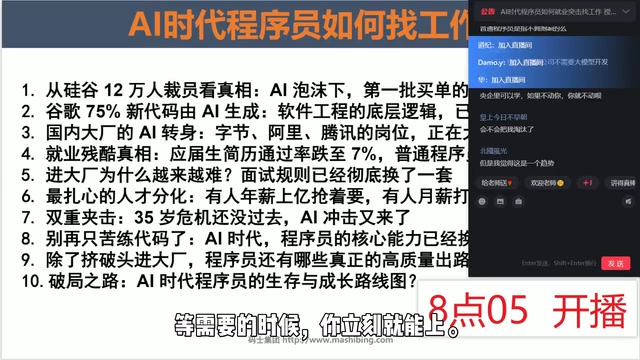
Programmer Career Guide in the AI Era: Transition Paths and Embodied AI Opportunities
How should programmers transition in the AI era? Based on a Bilibili career planning livestream, this article analyzes the risks of not embracing AI, the Web Coding to FDE transition path, the data bottleneck in embodied AI, and the impact of LLMs on research roles, offering actionable job-seeking and learning sequences for campus and experienced hires.