Four Stages of LLM Commercialization: The Evolution from Foundation Models to AI Agents

A deep dive into the four stages of LLM commercialization, from foundation models to AI Agents.
This article traces the evolution of LLM commercial deployment through four stages: foundation models, prompt engineering, RAG, and AI Agents. It explains the technical principles and limitations of each stage, showing how AI Agents enable LLMs to shift from passive Q&A tools to proactive problem-solving digital employees. A practical three-month learning roadmap is included for aspiring AI practitioners.
Why AI Agents Are the Key Technology for LLM Deployment
In an era of rapid iteration in large language model technology, many learners fall into a common trap: they assume that writing a few prompts, memorizing some prompt templates, or building a simple RAG system means they've mastered the core skills of LLM development. However, when it comes to actual enterprise interviews and project deployment, these skills often fall far short.
What enterprises truly need are systems capable of handling complex business logic — such as automatically processing orders, updating customer information, and generating business reports. The essence of these requirements is making LLMs proactively think and solve problems, rather than merely answering questions passively. This is precisely the capability boundary that prompt engineering and RAG technology cannot cover, and it's where the core value of AI Agent technology lies.
From an industry trend perspective, more and more enterprises are pursuing "cost reduction and efficiency improvement," hoping to use AI to run through the entire workflow of traditional business processes. This means simple Q&A systems can no longer meet demands, and Agents have become the inevitable choice for enterprise-grade LLM deployment.
The Four Stages of LLM Commercial Deployment
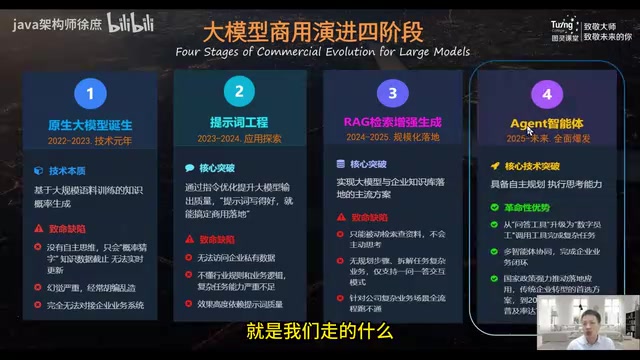
To truly understand the value of Agents, you first need to see the complete evolution path of LLM commercialization. This path can be clearly divided into four stages, each one a response to the shortcomings of the previous stage.
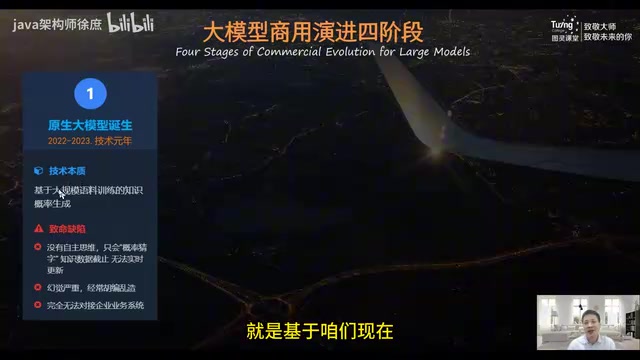
Stage 1: Foundation LLMs
Foundation LLMs are the starting point for everything. Their technical essence isn't complicated — they're trained on publicly available internet data and rely on the knowledge the model has learned to generate content. When ChatGPT burst onto the scene, many people were amazed by its seemingly encyclopedic knowledge — it could write copy, write code, and appeared to be capable of anything.
From a technical perspective, large language models are essentially large-scale autoregressive language models. They learn the statistical patterns of language through massive text data and predict the next most probable token during inference. It's this probability-based generation mechanism that gives them powerful language capabilities, but also plants the seeds of inherent flaws.
Soon enough, the fatal shortcomings of foundation LLMs became apparent:
- Lack of sustained reasoning ability: They can only generate content based on learned knowledge, and easily "confidently make things up" when questions exceed their training scope;
- Knowledge currency limitations: Models cannot answer questions about new knowledge beyond their training cutoff, leading to hallucinations;
- Inability to connect with enterprise systems: They are completely unable to integrate with traditional enterprise business processes.
The concept of "Hallucination" mentioned here is an extremely important concept in the LLM domain. It refers to the model generating content that appears reasonable and grammatically fluent but is actually incorrect. The fundamental cause lies in the fact that LLMs don't truly "understand" knowledge — they predict the most likely text sequences based on statistical patterns. When encountering domains not covered or insufficiently covered in the training data, models will still confidently generate fluent text, but the content may be entirely fabricated. In industries with extremely high accuracy requirements such as healthcare, law, and finance, the hallucination problem is particularly critical. This has been an important driving force behind the subsequent development of RAG and Agent technologies.
This means foundation LLMs are still a long way from true enterprise-grade deployment.
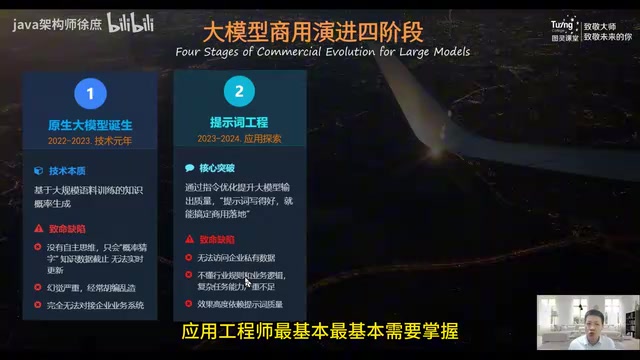
Stage 2: Prompt Engineering
To optimize LLM output quality, the industry found a second path — prompt engineering. "Write good prompts and you're ready to deploy" was once a popular saying, and techniques like Chain of Thought (CoT), Tree of Thoughts, template design, and instruction design were enthusiastically pursued by learners.
Among these, Chain of Thought (CoT) is one of the most influential techniques in prompt engineering, formally introduced by Google in a 2022 paper. Its core idea is to include intermediate reasoning steps in the prompt, guiding the model to think step by step like a human, rather than jumping directly to the final answer. For example, when facing a math problem, a traditional prompt only asks for the answer, while a CoT prompt requires the model to show the complete problem-solving process. Experiments have shown that CoT significantly improves LLM performance on arithmetic reasoning, commonsense reasoning, and symbolic reasoning tasks. The subsequent development of Tree of Thoughts goes even further, allowing models to explore and backtrack across multiple reasoning paths, simulating the deep thinking process humans use when facing complex problems.
However, prompt engineering also has three core flaws: inability to access enterprise private data, inability to handle complex business problems, and output quality being heavily dependent on human tuning skills.
Today, prompt engineering has become a fundamental skill for LLM application engineers — just like needing to know how to type before using a computer. It's a necessary condition, but by no means a core competitive advantage.
Stage 3: RAG (Retrieval-Augmented Generation)
To solve the pain point of "accessing enterprise private data," the third stage — RAG (Retrieval-Augmented Generation) — emerged. Its principle is: before answering, the LLM first retrieves relevant materials from an enterprise knowledge base, then uses the retrieved results as context for the model to generate answers.
From a technical architecture perspective, the complete RAG workflow includes three key steps. Step one is Indexing: Enterprise documents are split into appropriately sized text chunks, converted into high-dimensional vector representations through an embedding model, and stored in a vector database (such as Pinecone, Milvus, Weaviate, etc.). Step two is Retrieval: The user's question is also converted into a vector, and the most relevant text chunks are found in the vector database through similarity calculations (such as cosine similarity). Step three is Generation: The retrieved text chunks are sent to the LLM as context along with the user's question, and the model generates the final answer based on these reference materials. The advantage of this architecture is that new knowledge can be injected without retraining the model, but retrieval quality is highly dependent on the optimization of text chunking strategies, embedding model quality, and retrieval ranking algorithms.
Whether in finance, law, real estate, or manufacturing, as long as an enterprise has structured or unstructured data such as fixed tables, documents, and images, it can be combined with LLMs through RAG. The vast majority of intelligent customer service systems on the market today are built on RAG technology.
However, RAG's inherent flaws are also apparent:
- Can only retrieve passively: It doesn't think proactively — if the user doesn't ask, it can't provide answers;
- Only supports single Q&A interactions: It cannot handle complex interactions requiring multiple steps;
- Cannot cover end-to-end business processes: It struggles to connect an enterprise's complete business chain.
Stage 4: AI Agents
With technological advancement, the fourth stage — AI Agents — has arrived. At this stage, LLMs possess the capability of autonomous planning, execution, and reasoning, upgrading from a "Q&A tool" to a "digital employee" capable of independently completing tasks.
A complete AI Agent system typically consists of four core components: The Planning module is responsible for decomposing complex tasks into executable sub-task sequences, much like a project manager breaking down work; The Memory module is divided into short-term memory (current conversation context) and long-term memory (persistently stored historical information), enabling Agents to maintain coherence across multiple interaction rounds and even across sessions; The Tool Use module enables Agents to access various external resources such as APIs, databases, search engines, and calculators, greatly expanding their capability boundaries; The Action module is responsible for executing concrete operations and providing result feedback.
In terms of architecture design, ReAct (Reasoning and Acting) is one of the most classic Agent paradigms, jointly proposed by Princeton University and Google. It enables LLMs to alternate between reasoning (Thought), acting (Action), and observing (Observation) at each step of interaction, forming a complete loop. Another important development direction is Multi-Agent collaboration, where multiple Agents with different roles and capabilities work together — for example, one handles requirements analysis, one writes code, and one does quality testing — simulating real team collaboration to complete complex tasks. Currently, mainstream Agent development frameworks include LangChain, AutoGPT, CrewAI, and Microsoft's AutoGen.
AI Agents can proactively invoke various tools and connect complex enterprise business processes, truly achieving the leap from "answering questions" to "solving problems." This is also the mainstream approach for enterprises transitioning to LLM deployment today.
Following Policy Directions When Choosing an AI Technology Track
A noteworthy perspective is: Technology learning should follow national policy directions. China's "AI+ Action Guidelines" clearly propose major strategic deployments aimed at promoting the widespread adoption and comprehensive development of next-generation intelligent agents.
This logic has historical precedent. Over a decade ago, China launched the "Internet+" initiative, which subsequently gave birth to industries that changed daily life — mobile payments, ride-hailing, and livestream e-commerce. Those who followed the policy direction and entered the IT industry at that time largely captured the dividends. In the "AI+" era, Agent technology will likely play the same role that "Internet+" played back then. From a global perspective, American tech giants are similarly accelerating their Agent strategies — OpenAI has launched GPTs and the Assistants API, Google has released Agent capabilities in its Gemini series, and Microsoft has fully embedded Copilot into its Office and Azure ecosystems. Agents are becoming the core battlefield of global AI competition.

It's worth noting that this kind of "policy dividend" narrative serves more as learning motivation. Actually entering the field still requires solid technical accumulation, and one shouldn't be overly optimistic.
Systematic Learning Path for AI Agent Roles
To truly enter the AI track and land a position at a good company, you generally need three months of systematic preparation, investing about two hours daily. Here is the phased learning plan:
Month 1: Building AI Agent Foundational Knowledge
Many people can't even distinguish between LLMs and Agents. Put simply, an LLM (Large Language Model) is the foundational engine for language understanding and generation, while an Agent is an intelligent system built on top of an LLM with autonomy and goal-oriented capabilities — the LLM is the Agent's "brain," but the Agent also has "hands" (tool invocation), "eyes" (environment perception), and "memory" (context management). During this phase, you need to understand the core components and principles within Agent products — what large models are, how tools are invoked, and how chain-of-thought reasoning is designed. At the same time, study AI product case studies, industry reports, and technical blogs. It's recommended to focus on technical reports published by organizations like OpenAI, Anthropic, and Google DeepMind, as well as official documentation from open-source frameworks like LangChain and LlamaIndex.
Month 2: Advancing Core Competencies
Systematically study prompt engineering, RAG principles, and Agent architecture design. Use a product-oriented perspective to design stable prompt templates, understand what problems RAG solves, how retrieval works, and how chunking and ranking operate. Master classic Agent design paradigms and frameworks. In RAG learning, pay special attention to the selection of text chunking strategies — fixed-size chunking, semantic chunking, and recursive chunking each have their pros and cons. In Agent learning, it's recommended to deeply understand core mechanisms such as ReAct, Plan-and-Execute, and Function Calling, and practice actual coding through LangChain or similar frameworks.
Month 3: Delivering Complete Projects
This is the most critical phase. Combining the knowledge from the first two months, choose a real-world scenario and complete 2 to 3 hands-on projects of increasing difficulty — from user research and PRD writing to prototype design. The recommended project progression is: first build a RAG-based intelligent Q&A system (such as an internal enterprise knowledge base assistant), then build a single-Agent application with tool-calling capabilities (such as an automated data analysis assistant), and finally attempt a multi-Agent collaboration project (such as an automated content production pipeline). Only by completing this full cycle will you truly have the ability to land an AI product offer.
Conclusion: From Passive Answering to Proactive Problem-Solving
From foundation LLMs, prompt engineering, and RAG to AI Agents, the four-stage evolution of LLM commercialization is essentially a capability upgrade path "from passive answering to proactive problem-solving." These four stages are not a simple replacement relationship but rather a progressively layered technology stack — Agent systems internally often employ both prompt engineering techniques and RAG retrieval capabilities, with additional layers of autonomous planning and tool invocation built on top. For learners looking to enter the AI track, understanding this evolutionary logic is more important than blindly chasing individual technologies. And solid three-month project practice is the real shortcut to avoiding pitfalls in interviews and real-world deployment.
Related articles

AI Assistant Accidentally Deletes Emails: Where Are the Security Boundaries for Agent Authorization?
A Meta security researcher's AI assistant accidentally deleted emails, exposing core risks in AI agent authorization. Learn about least privilege, human-in-the-loop, and key strategies for safer AI agents.

From Backend to AI Agent Engineer: A Practical Path That Survived Big Tech P7 Interviews
How can a backend engineer with 6 years of experience transition to AI Agent engineering and pass big tech P7 interviews? A practical guide covering engineering stability, semantic caching, Anthropic's ecosystem, and MCP protocol.
Free Claude Code: Real-World Testing of the 48K-Star Open Source Agent — Saves Money, But Don't Expect a Free Replacement
Deep dive into Free Claude Code (FCC), a 48K-star open-source project that routes Claude Code requests to free or cheaper models via proxy. Covers setup, tiered routing, real coding tests, and cost savings.