Frame Sampling Can't Prove Absence in Video: A Logical Trap in AI Video Understanding
Frame-sampling video models can only prove 'seen', not 'absent' — distinguish not-detected from not-present.
Through an Articul8 demo video on Reddit, the article reveals a fundamental blind spot in frame-sampling-based video understanding models: when a model answers 'there's no dog in the video', it is actually only responsible for the finite frames it sampled and cannot cover the entire video timeline. This stems from the asymmetry of existence proofs — proving 'there is' needs just one frame, proving 'there isn't' requires exhausting all frames, and sampling inherently cannot exhaust. The three model paths (LLM, Bivia, Jev) differ but none truly solves falsification. The article further points out that in safety review and Agent workflows, mistaking 'not detected' for 'not present' leads to missed detections and wrong decisions. Engineering-wise, we should honestly distinguish the two and mitigate blind spots via higher sampling density, event-level detection, and explicit output qualifiers.
When AI Says "There's No Dog in the Video," What Is It Really Saying?
A Reddit user shared an Articul8 demo that exposes a neglected but critical issue: video understanding models based on frame sampling can never prove that an object does not exist.
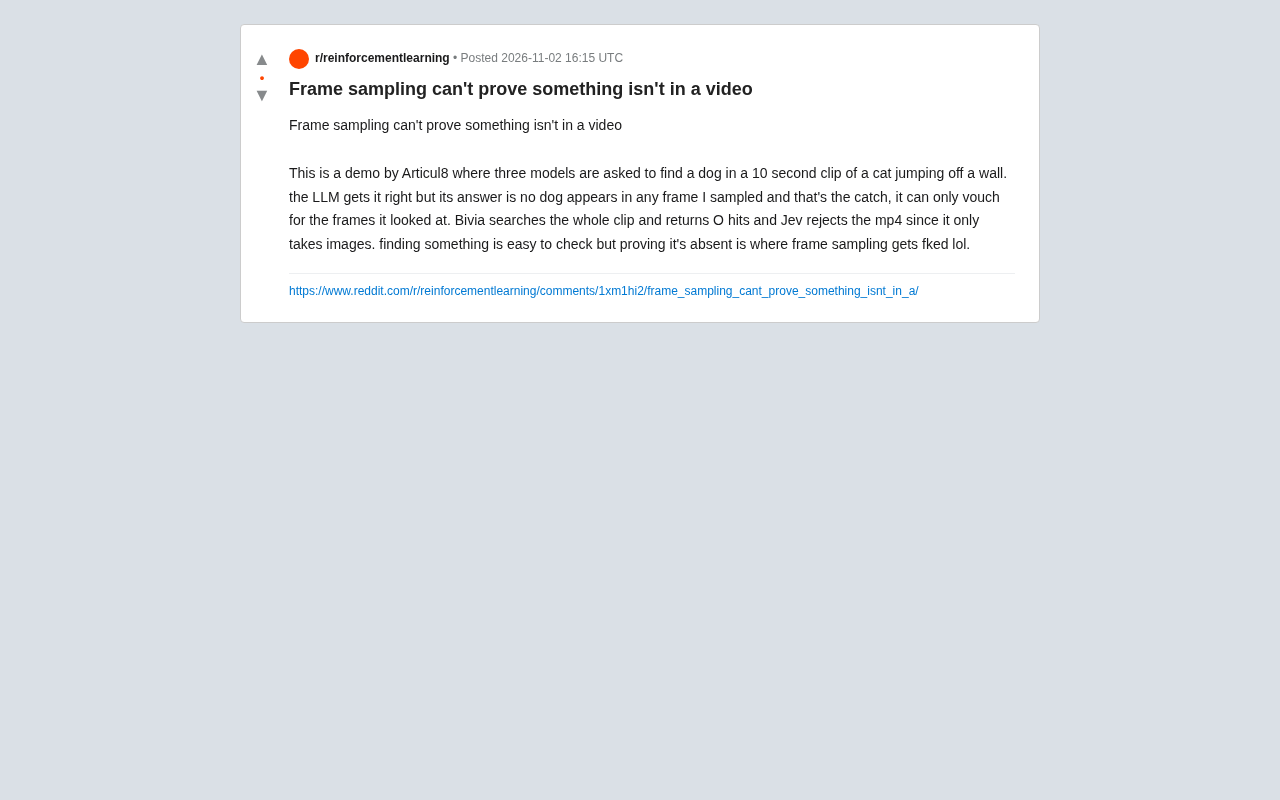
In the demo, three models were asked to find a dog in a 10-second "cat jumping over a wall" video. The LLM's answer was: "There's no dog in any of the frames I sampled" — which is true, but it only speaks for the frames it saw. Bivia searched the entire clip and returned 0 hits; Jev, which only accepts image input, directly rejected the mp4 file.
The core of the problem: finding something is easy to verify, but proving something doesn't exist is the fatal weakness of frame sampling. If the dog appears only between two frames, or flashes by in a few unsampled moments, the sampling model will firmly tell you "no". This isn't a lack of model capability — it's a methodological boundary.
Why Frame Sampling Can Only "See" but Cannot "Falsify"
Sampling Is Discarding: Information Gaps Along the Time Dimension
Video is essentially a sequence of continuous frames, and frame sampling models (whether uniform sampling or keyframe extraction) actively discard a large number of intermediate frames. When the model answers "no dog", its true semantics are "no dog detected in the N frames I extracted". This conclusion cannot be extended to the entire video timeline.
Logically, this is a classic asymmetry of existence proofs:
- To prove "there is", you only need to find one frame containing the target to verify it;
- To prove "there isn't", you must exhaust all frames (ideally continuous time), and sampling inherently cannot exhaust.
Asymmetry of existence proofs stems from the difference in verification cost between the existential quantifier (∃) and the universal quantifier (∀) in logic. In video understanding, the proposition "there is a dog in the video" is confirmed by finding just one frame satisfying the condition; the proposition "there is no dog in the video" is equivalent to "all frames contain no dog", requiring verification of every frame, and in continuous time requires infinitely fine-grained inspection. Frame sampling discretizes continuous time into a finite set of frames, effectively inferring "no dog in the population" from "no dog in the sample" — this is inductive reasoning, not deductive proof. Therefore, the "no" output by sampling models is essentially a statistical conclusion whose confidence depends on sampling coverage, not logical necessity.
Three Models, Three Paths, One Blind Spot
The three models in the demo represent three approaches:
- LLM: reasons over sampled frames and answers "no dog in sampled frames", but is limited by sampling scope;
- Bivia: searches the entire clip and returns 0 hits, seemingly more comprehensive, but "0 hits" likewise depends on its search granularity and indexing method;
- Jev: only accepts image input and directly rejects video, avoiding the problem at the entry point.
None of the three paths truly solves the "falsification" problem. If Bivia's "full-clip search" is still frame-level indexing underneath, then it merely increases sampling density rather than eliminating the blind spot.
Keyframe extraction and uniform sampling are two common frame sampling strategies. Uniform sampling extracts frames at fixed time intervals — simple to implement but may miss events shorter than the sampling interval; keyframe extraction relies on shot changes or information measures to select representative frames — reducing redundancy but potentially missing brief targets in non-key frames. Both create "information gaps" along the timeline, and gap locations are unpredictable. If Bivia's "full-clip search" is still based on frame-level indexing, it only narrows the sampling interval without fundamentally eliminating gaps; the reliability of its "0 hits" conclusion remains limited by indexing granularity.
What This Trap Means for Real Applications
"Missed Detection" Risks in Safety Review and Content Compliance
If video moderation systems rely on frame sampling to determine "whether prohibited content is present", then "not detected" does not equal "not present". Violating footage may fall exactly in sampling gaps. For high-risk compliance scenarios, this uncertainty needs to be explicitly flagged rather than packaged as a definitive "no anomalies found".
False Confidence in Agent Workflows
When video understanding models serve as part of an Agent, their "no dog" output is treated as fact by downstream tasks. If the Agent makes decisions based on this (e.g., skipping human review, approving content), the frame sampling blind spot translates into real errors. The LLM in the demo was relatively honest — it explicitly said "not in the frames I sampled" — but many systems do not expose this qualifier.
In Agent architectures, video understanding models typically serve as part of tool use, and their outputs are serialized and passed to planners or decision modules. Downstream modules assume tools return deterministic facts and do not trace the conditions under which conclusions were generated. This "semantic decay" causes qualifiers in model outputs (like "in the frames I sampled") to be dropped during transmission, ultimately becoming the hard fact "there is no dog in the video". To mitigate this, tool interfaces should be forced to carry confidence or coverage metadata so downstream can perceive the limitations of conclusions.
How to Think About "Proving Absence"
Acknowledging Boundaries Is More Important Than Pretending Omniscience
Frame sampling is an efficient engineering compromise that makes video understanding feasible in terms of cost and latency. The problem isn't using sampling, but treating sampling conclusions as whole-video conclusions. An honest video understanding system should distinguish "not detected" from "not present" and preserve this distinction in its outputs.
Possible Directions for Improvement
From the demo's comparison, different tools make different trade-offs in "coverage" and "input form". To mitigate the falsification problem, at least three paths deserve attention:
- Increase temporal coverage density: use finer-grained or adaptive sampling to reduce blind spot probability, though it cannot be fully eliminated;
- Introduce motion/event-level detection: analyze inter-frame changes rather than single frames to capture momentarily appearing targets;
- Explicitly state output qualifiers: let systems proactively declare "based on X frames sampled, not detected", passing uncertainty downstream.
Conclusion: Finding Is Easy, Proving Absence Is Hard
What sparked discussion about this demo is that it uses a minimal example to puncture a certain illusion about "AI watching video". Frame sampling lets models efficiently answer "did I see it", but it cannot answer "is it really not there". As video understanding increasingly enters production pipelines, distinguishing "not detected" from "not present" may be a more urgent engineering problem than improving detection accuracy.
The Reddit post's summary is blunt: finding something is easy to check but proving it's absent is where frame sampling gets fked. This sentence deserves to be taped to the monitor of everyone working on video AI.
One-line Summary
Frame-sampling video models can only prove "seen", not "absent" — distinguish not-detected from not-present.
Paragraph Summary
Through an Articul8 demo video on Reddit, the article reveals a fundamental blind spot in frame-sampling-based video understanding models: when a model answers "there's no dog in the video", it is actually only responsible for the finite frames it sampled and cannot cover the entire video timeline. This stems from the asymmetry of existence proofs — proving "there is" needs just one frame, proving "there isn't" requires exhausting all frames, and sampling inherently cannot exhaust. The three model paths (LLM, Bivia, Jev) differ but none truly solves falsification. The article further points out that in safety review and Agent workflows, mistaking "not detected" for "not present" leads to missed detections and wrong decisions. Engineering-wise, we should honestly distinguish the two and mitigate blind spots via higher sampling density, event-level detection, and explicit output qualifiers.
Related articles
 Tech Frontiers
Stylome Bot Slammed as Useless Junk: Why Do AI Detection Tools Keep Failing?
Reddit users test the Stylome AI detection bot: Gemini-rewritten text judged human-written, consistently low confidence. An analysis of AI text detection's technical dilemmas, privacy concerns, and credibility crisis in community governance.
 Tech Frontiers
When AI Becomes a Productivity Divide: Clarity or "AI Psychosis"?
A civil engineer's deep use of agentic AI boosted efficiency but bred contempt for peers who refuse to learn. Is this clarity or AI psychosis? An analysis of the cognitive and psychological challenges behind the AI productivity divide.
 Tech Frontiers
Opus 5.5 Benchmark Scores Climb, Community Says Its "Weights Are Blessed"
Reddit community discusses Opus 5.5's rising scores on the Benchmaxxing Bench, with users describing its performance as "weights are blessed." This article interprets the community reaction and cautions against conflating benchmark scores with real capability.