Free AI Hacking Tool Artex Exposed: FBI Warns Banks and Governments Under Attack
After integrating large models, the open-source penetration framework Artex automatically spawns agent swarms to attack, driving the cost of cyberattacks extremely low.
The article centers on the FBI's technical warning about the open-source penetration testing framework Artex, noting that after integrating large models such as Claude, ChatGPT, and DeepSeek, it can have a planning agent break down goals and spawn multiple sub-agents to attempt in parallel, with some cases obtaining admin privileges within three hours; because AI does not tire and the marginal cost of attack approaches zero, the attack surface is expanding exponentially. The article also clarifies that the outages of multiple U.S. giants within a week have no evidenced link to AI attacks, with the main causes being faulty updates and software bugs, but the Optimizely supply chain vulnerability during the same period affected more than 178 enterprises, and an old PHP vulnerability was accelerated into discovery by AI after lying dormant for 14 years. It also reviews the case of a South Korean bank's side-door system being breached, where the attacker's identity was exposed due to resume information, and offers recommendations such as individuals cleaning up third-party authorizations and enterprises enforcing least privilege and key scanning.
A free tool on GitHub is changing the cost structure of cyberattacks
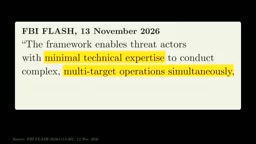
According to disclosures by a YouTube tech creator in a video, the FBI recently issued a technical warning (flash) stating that since at least last August, attackers have been using an open-source tool called Artex to breach banks, government agencies, hospitals, and other enterprises. In some attacks, it took only three hours from selecting a target to obtaining administrator privileges.
Artex is not "hacking software" in the traditional sense—it is not itself AI, but a publicly available penetration testing framework on GitHub. Users simply input a target and an intent (e.g., "obtain administrator privileges for this company"), and a planning agent breaks down the task and spawns a swarm of sub-agents to execute in parallel. Each agent maintains a list of discovered information and loops through attempts until it succeeds.
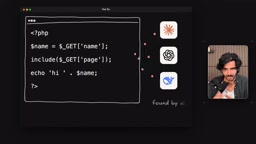
This tool has existed on GitHub since last July. It supports integration with various large models—Claude, ChatGPT, and DeepSeekAd all work. The FBI specifically noted that models like DeepSeek are used more often for two reasons: lower cost and relatively fewer guardrails.
What truly escalates the threat is not some genius hacker's unique skill, but the fact that AI models do not get tired. They can retry and iterate continuously, whereas human penetration testers need rest and billable hours. When the marginal cost of an attack approaches zero, the attack surface expands exponentially.
Planner / Sub-agent is a common architectural pattern in current AI Agent frameworks: a master model first receives a high-level goal, breaks it down into an executable list of subtasks, then dispatches each subtask to independent sub-agent instances running in parallel. Sub-agents each maintain their own context and intermediate results, can retry or switch strategies upon failure, and the master aggregates progress and decides next steps. The benefit of this "orchestration—execution" layering is that it splits complex goals into short, parallelizable rounds, significantly shortening the time from reconnaissance to exploitation; the cost is a multiplied number of model calls, consuming large amounts of tokens and API quota. Artex brings this architecture into the penetration testing workflow—attackers only need to provide a target and intent, and the remaining reconnaissance, attempts, and workarounds are all handled by agent loops.
Multiple giants went down within a week, but unrelated to AI attacks
The video mentioned that within a week, several major U.S. companies including Microsoft, Apple, Google, Chase, United, Cloudflare, and Charles Schwab experienced service disruptions, and on the same day all U.S. flights were briefly grounded. Speculation about "AI hackers launching attacks" quickly spread on social media.
This speculation lacks evidentiary support. Most of the companies involved attributed the cause to faulty updates, software bugs, or hardware overload. In the U.S., publicly traded companies are obligated to disclose serious cyberattacks to regulators; falsely labeling an attack as a software bug could constitute fraud. From an institutional incentive perspective, the motive for collective lying does not hold up.
A more reasonable explanation: software systems fail frequently anyway, but this went unnoticed in the past; when headline density rises, public perception is amplified. Additionally, multiple banks share Chase's payment system, so one problem cascades; and concentrated updates before Black Friday naturally tend to breed bugs.
However, the video also points out that real attacks did occur during the same week—they just received far less attention than the outage news.
Real attacks: a shared tool amplifies risk
According to the video, Optimizely, widely used by large enterprises, allows customers to inject custom code into pages for multi-page testing. Someone discovered a vulnerability in its registration page that allowed writing content into others' code boxes. As a result, sites of companies including Zoom, CNN, and BBC were all distributing the attacker's code to visitors from Optimizely's servers. Attackers used this to replace cryptocurrency wallet addresses and attempt to steal bank card information, affecting more than 178 companies.
The lesson from this incident is clear: a single point of vulnerability in the supply chain spreads along shared toolchains to all users.
Another case is the PHP "2 shell" vulnerability. PHP powers roughly 70% of websites, and this vulnerability allowed taking over a server with just a few requests—and it existed in the code for 14 years. The video's author noted that as early as 2000, 2004, and 2024, people came close to discovering these vulnerabilities but could not prove exploitability, so they remained unfixed. Until earlier this year, three independent teams separately verified the feasibility of exploitation, but the vulnerability was leaked before a patch was released, forcing governments in multiple countries to take websites offline.
AI plays the role of accelerator here: it can read through stale code faster than humans, unearthing vulnerabilities that have lain dormant for years; and each patch release effectively marks the vulnerability location for AI tools, making sites that fail to update promptly the next batch of targets.
Supply chain attacks and the "shared tool" amplification effect refers to: enterprises do not directly depend on a vulnerable component, but indirectly introduce risk through third-party services, CDNs, tag managers, A/B testing platforms, and other shared infrastructure. Tools like Optimizely allow customers to inject custom scripts into pages, intended for multi-page testing; once their registration or editing entry point has an unauthorized write issue, attackers can attach malicious code to the scripts that the service distributes to all customers, thereby appearing simultaneously on the pages of hundreds of sites. This pattern is dangerous because victim enterprises often have strict control over their own pages but implicitly trust the upstream vendor's script channel—the defense boundary is outsourced.
The "2 shell" vulnerability and PHP's ubiquity requires some background: PHP still drives about 70% of websites (WordPress, Drupal, and many CMSs are largely built on it), so any flaw at the PHP interpreter level affects a very wide swath. The so-called "2 shell" typically refers to an exploit chain that requires only a very small number of requests to execute arbitrary commands on a server and thereby obtain a shell. The frightening aspect of such vulnerabilities is not technical complexity but latency—the code existed for years, multiple people came close to discovering it but could not prove exploitability, leading to long-term lack of fixes. When multiple independent teams successively verify feasibility, vulnerability details have often already circulated in small circles, compressing the patch window to a very short period.
Attack paths seen through a small-scale case in South Korea
The video describes a case that occurred in South Korea last September. Attackers did not attack the bank's main application head-on but turned to side doors: a mortgage broker inquiry website for one bank, and an internally used app for employees of another bank. These systems typically have weaker protection. The attackers ultimately obtained personal identity information of more than 67,000 people. Some sources say they used Artex together with Claude Code.
The exposure of the case was quite dramatic. The server rented by the attackers ran for a long time, with some folders open to the entire internet. CrowdStrike discovered these directories during an investigation, containing complete conversation logs with Claude Code, Artex configurations, and attack plans. Even more unexpectedly, the attacker also used Claude Code mid-session to edit a resume, which included initials, university attended, and other information. Identity was thus exposed.

This is only a small-scale individual case. Microsoft has reported organized groups attempting similar methods, and a tiny oversight can open the door to a large number of sites.
What ordinary users and enterprises should do respectively
The video emphasizes that Artex succeeds most of the time not through sophisticated techniques, but because passwords are placed where they shouldn't be and keys are exposed. Deleting a key does not equal security—it may still remain in Git history.
For individual users, checks that can be done tonight: open Google and Microsoft accounts, review connected third-party apps, and remove authorizations no longer in use. The video says ConnectWise was breached earlier this year precisely through this path. Additionally, if bank service disruptions become more frequent, moderately holding cash and emergency food is pragmatic preparation.

For enterprises, the FBI's recommendations include: inventory all internet-exposed assets; shrink third-party app permissions within accounts, following the principle of least privilege; scan for potentially leaked keys and passwords; and continuously patch language stacks such as PHP, Node, and Python.
Key remnants in Git history is an easily overlooked detail: once a key is committed to a repository, even if the file is later deleted or the current version rewritten, the old commit object remains in the .git directory and can be recovered via git log, git show, or cloning the repository. Therefore "deleting a key" does not equal "key security"; the correct approach is to immediately revoke and rotate the key on the server side, then clean history using tools like git filter-repo or BFG, and force push. For enterprises, key scanning should also be integrated into the CI process to block hardcoded credentials at the commit stage rather than remediating after a leak.
Demand for security skills is rising
The video's author believes this wave of change is not an entirely new threat, but rather that the price of attacks has become extremely low and the speed extremely fast. Every company riding the AI wave will rediscover the importance of security, and few people understand this field. He suggests learners reduce the pursuit of certificates and instead build projects hands-on, find vulnerabilities themselves, use AI agents for offense-defense practice, and document the process—these records are more convincing in interviews than certificates.
Key takeaways
- Artex is an open-source penetration testing framework on GitHub; after integrating large models, it can automatically spawn multiple agents for parallel attacks, with some cases obtaining administrator privileges within three hours
- The FBI has issued a warning that targets such as banks, governments, and hospitals are being attacked by such tools, and models with fewer guardrails like DeepSeek are used more often
- The outages of multiple U.S. giants within a week have no evidenced link to AI attacks; the main causes are faulty updates and software bugs, but the Optimizely vulnerability during the same period affected more than 178 enterprises
- Attackers mostly start from weakly protected side-door systems; individuals should clean up third-party app authorizations, and enterprises should enforce least privilege and key scanning
- AI accelerates the discovery of vulnerabilities in old code, and patch releases themselves also mark attack coordinates for unpatched systems
One-line Summary
After integrating large models, the open-source penetration framework Artex automatically spawns agent swarms to attack, driving the cost of cyberattacks extremely low.
Paragraph Summary
The article centers on the FBI's technical warning about the open-source penetration testing framework Artex, pointing out that after integrating large models such as Claude, ChatGPT, and DeepSeek, the tool can have a planning agent break down goals and spawn multiple sub-agents to attempt in parallel, with some cases obtaining administrator privileges within three hours; because AI does not tire and the marginal cost of attack approaches zero, the attack surface is expanding exponentially. The article also clarifies that the outages of multiple U.S. giants within a week have no evidenced link to AI attacks, with the main causes being faulty updates and software bugs, but the Optimizely supply chain vulnerability during the same period affected more than 178 enterprises, and an old PHP vulnerability was accelerated into discovery by AI after lying dormant for 14 years. It also reviews the case of a South Korean bank's side-door system being breached, where the attacker's identity was exposed due to resume information, and offers recommendations such as individuals cleaning up third-party authorizations and enterprises enforcing least privilege and key scanning.
Related articles

Jingle Jam 2026 Registration Opens: Lewis Uses Old Footage to Rally Volunteers for Fundraising
Jingle Jam 2026 fundraising registration is open. Lewis uses old footage edited into a new video, calling on viewers to create fundraising pages at jingle jam.tiltify.com to support eight charities. The event takes place in the first two weeks of December.
Gemini 4 Neon Hands-On Test: Can It Replace Claude Opus 5.5?
A Bilibili creator tests Gemini 4 Neon, Claude Opus 5.5, and GPT 6.2 across three coding Agent challenges—pelican animation, 3D racing, and code-generated video—to see if Gemini can replace Opus.
FBI-Warned Artex: How an AI Attack Framework With No In-House Model Pries Open Enterprise Doors
The FBI-warned open-source AI attack framework Artex has no model of its own—it plugs into Claude, GPT, and other external LLMs to drive an agent loop, turning ordinary tools like Nmap into an automated attack pipeline. This article examines three real cases—South Korean finance, ConnectWise, and Barracuda—analyzes the three drivers of speed, cost, and noise, and outlines defenses such as exposure inventory and short-lived credentials.