Free Fire Returns to India: Garena Launches Localized Version After Four-Year Ban

Garena's Free Fire returns to India with a localized version after a four-year ban, facing competition from BGMI and compliance rebuilding challenges.
Garena's battle royale mobile game Free Fire has officially returned to India with a localized version after a four-year ban. India was once its largest user market. Garena originally planned an India-exclusive version for September 2023 but delayed it; this return is expected to adapt network, payment, data storage, and content preferences to regulatory requirements. However, the market has changed—BGMI and local games now hold significant share, raising acquisition and retention difficulty. The return validates localized compliance pathways but user loss and brand gaps remain challenges.
According to RSS sources, Garena's battle royale mobile game Free Fire has officially returned to the Indian market with a localized version after a four-year ban. The news marks the re-entry of this tactical competitive game—once popular worldwide—into one of the largest mobile gaming markets in the world.
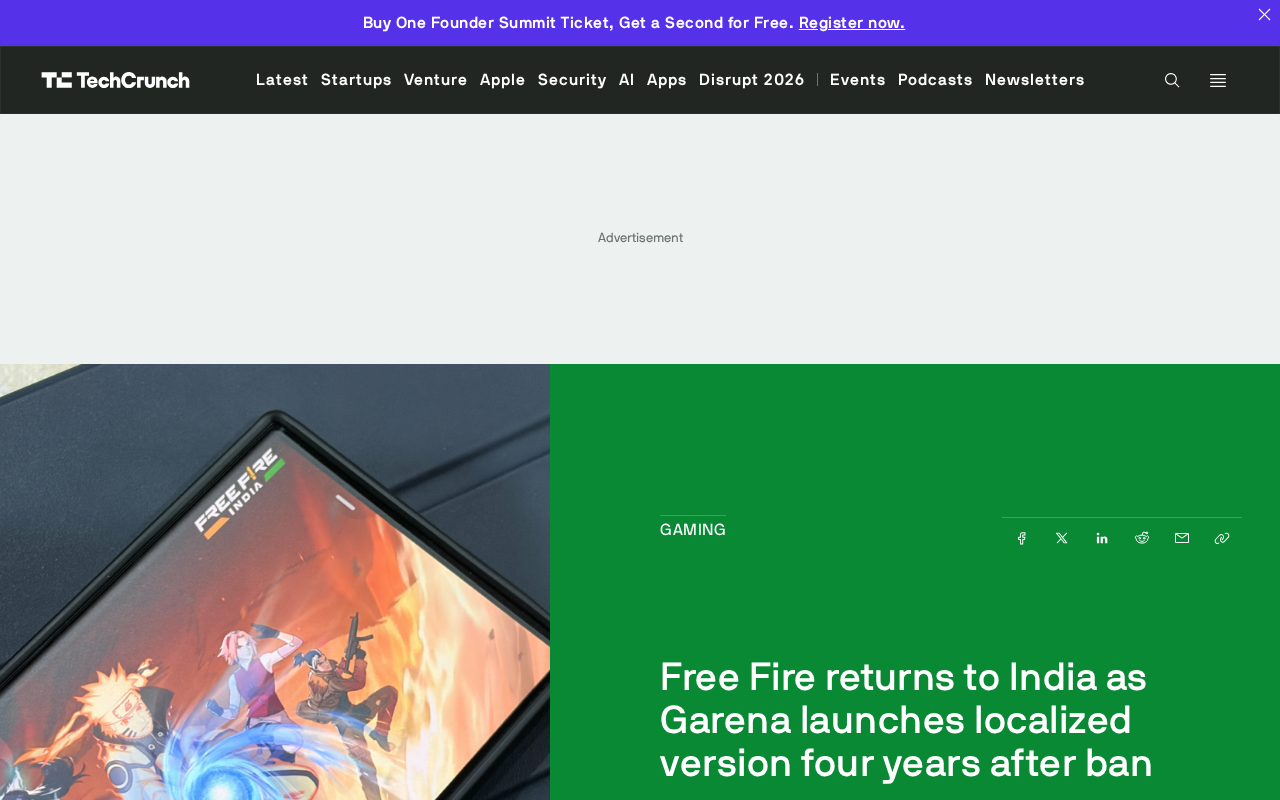
Ban Background and Timing of Return
Free Fire was previously taken down due to the Indian government's ban on certain China-linked apps. The ban forced Garena to suspend operations in India, which had been one of Free Fire's largest user markets. The return was not sudden—as early as 2023, Garena had planned to launch an India-exclusive version, originally scheduled for September of that year, but ultimately delayed the release.
After additional preparations, Garena has finally re-entered the Indian market with a localized version. This version is expected to be adapted to Indian players' network conditions, payment habits, and content preferences, in order to comply with local regulatory requirements and rebuild user trust.
Around 2020, the Indian government, citing Section 69A of the Information Technology Act and grounds such as "damaging national sovereignty and territorial integrity, defense security, and public order," banned hundreds of China-linked mobile apps in batches. Such bans are typically issued by India's Ministry of Electronics and Information Technology, requiring app stores and internet service providers to stop offering downloads and access. For banned apps, the impact goes beyond channel removal—it also includes the inability to monetize through official payment channels, blocked brand partnerships, and natural user attrition. Subsequently, some companies sought compliant returns by introducing Indian local capital, adjusting data storage and operating entities, and strengthening content moderation—forming the important institutional context for understanding Free Fire's return to the market with a localized version.
Localization Strategy and Market Competition
Launching a localized version is Garena's core strategy for rebuilding the Indian market. Compared with the global version, the India-exclusive edition may make adjustments in data storage, payment channels, and social features to meet the Indian government's compliance requirements.
Notably, during the four years of Free Fire's absence, the landscape of India's mobile gaming market has changed significantly. Competitors such as Battlegrounds Mobile India (BGMI) have captured substantial user share, and local games are growing rapidly. Garena faces a more intensely competitive market environment, with user acquisition costs and retention difficulty both higher than before the ban.
Battlegrounds Mobile India (BGMI) is Krafton's India-exclusive version of PUBG Mobile, which quickly filled the tactical competitive void left by Free Fire after its launch in 2021. BGMI has also experienced takedowns and re-listings by the Indian government, and its operating strategy emphasizes Indian local servers, data localization, and esports event deployment. During the four years of Free Fire's absence, BGMI and local manufacturers' shooting and battle royale products jointly divided user time and spending budgets, creating high switching costs and social relationship lock-in. For the returning player, this means not only reacquiring new users but also facing mature competitors with established social circles and event ecosystems—naturally making user acquisition costs and retention difficulty significantly higher.
Industry Impact and Observations
Free Fire's return has multiple implications for India's gaming ecosystem. On one hand, it validates the feasibility of international gaming companies returning to the Indian market through localized compliance pathways; on the other hand, the user loss and brand awareness gap caused by the four-year ban are challenges Garena must overcome.
From an industry perspective, the return also reflects room for relaxation in India's regulatory environment under specific conditions. For other gaming companies that have been similarly affected, Garena's localization strategy provides a reference case. However, whether the market will embrace it still requires observation of subsequent user data and revenue performance.
Currently, Garena has not disclosed specific user targets or revenue expectations for the Indian version. Considering Free Fire's continued popularity in Southeast Asia and Latin America, the effectiveness of the India market restart will directly affect its competitive position in the global tactical competitive category.
Data localization is a key compliance dimension in India's regulatory environment. The Reserve Bank of India has required domestic storage of payment system data since 2018, and subsequent personal data protection legislative discussions have continued to strengthen restrictions on cross-border data flows. For gaming companies, this means user accounts, payment records, and behavioral data may need to be stored on servers within India and subject to local legal jurisdiction. Meanwhile, India is tightening scrutiny of games involving gambling, lotteries, and virtual item trading, and localized versions often need to adjust payment mechanisms and content ratings. If Garena can meet these requirements in data storage, payment channels, and content moderation, its case will be replicable; otherwise, compliance costs may offset the market increment brought by the return.
One-line Summary
Garena's Free Fire returns to India with a localized version after a four-year ban, facing dual challenges from competitors like BGMI and compliance rebuilding.
Paragraph Summary
Garena's battle royale mobile game Free Fire has officially returned to the Indian market with a localized version after a four-year ban. The game was previously taken down due to the Indian government's ban on certain China-linked apps, and India had been one of its largest user markets. Garena originally planned to launch an India-exclusive version in September 2023 but delayed it; this return comes after additional preparations and is expected to have adapted network conditions, payment habits, data storage, and content preferences to comply with regulatory requirements. However, the Indian market landscape has changed over four years, with competitors like BGMI holding substantial share and local games growing rapidly, increasing user acquisition and retention difficulty. The return validates the feasibility of international gaming companies re-entering India through localized compliance pathways, but user loss and brand awareness gaps remain challenges, with subsequent user data and revenue performance yet to be observed.
Related articles

Lightpanda: A Headless Browser Built for AI and Automation
Lightpanda is a headless browser built from scratch in Zig for AI and automation, with 37,852 GitHub stars. This analysis covers its technical approach, design choices, and use cases.

From Will Smith Eating Spaghetti to AI Short Films: The Astonishing Pace of AI Video Evolution
Tracing AI video's evolution: from Runway's 2019 short film *The Orange* to the Will Smith spaghetti video, a Twitter comparison reveals the astonishing pace of technological progress in just a few years.

Opus 4.6 Chat Experience: Why Do Older Models Feel More "Human"?
A Reddit user shares a late-night chat with Opus 4.6, noting older models feel more personable. We analyze the causes of model personality differences and the balance between capability and experience.