Frequent Data Incidents at Inference Providers Signal a Trust Crisis in AI Infrastructure
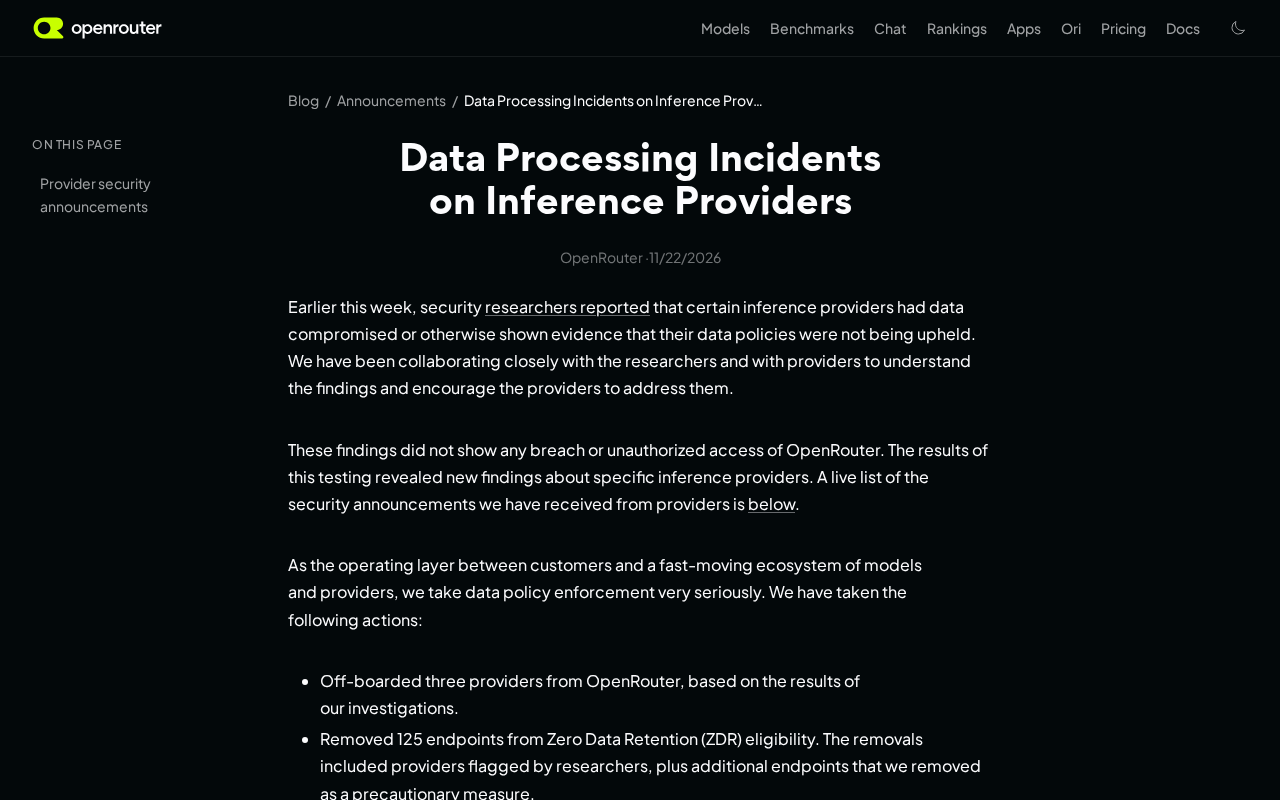
Data incidents at inference providers expose gaps in AI infrastructure's data governance transparency.
Starting from a Hacker News thread on data processing incidents at inference providers, the article argues that although the original post was sparse and discussion lukewarm, the issue matters: inference is where prompts, context, and outputs are actually processed, and without auditable boundaries, upstream data policies are undermined. It analyzes why inference-layer incidents go unnoticed—fragmented service forms, blurred accountability, invisible hosted defaults—and notes impacts on compliance and engineering, then proposes three paths: choose transparent, audit-friendly providers, keep architecture replaceable, and pre-desensitize prompts and context.
Frequent Data Incidents at Inference Providers Signal a Trust Crisis in AI Infrastructure
A Hacker News thread titled "Data Processing Incidents on Inference Providers" sparked a small discussion. The post itself offers limited information and didn't gain much traction, but it touches on a problem obscured by rapid iteration: as model inference becomes increasingly dependent on third-party hosted services, is the handling of data at the inference stage actually controllable?
The Incident Itself: Sparse Information, But a Clear Signal
The original post disclosed no specific incident details, no vendors involved, and no scope of impact, and the discussion section had only 7 comments. This "low information density" may itself point to two things: first, public disclosure mechanisms for data processing incidents at inference providers remain immature; second, developers' attention is still focused on model capabilities and cost, with insufficient attention paid to data governance at the inference layer.
But that doesn't mean the problem is unimportant. On the contrary, inference is where user data actually "lands"—prompts, context, retrieved content, and generated outputs are all processed here. Once this layer lacks auditable boundaries, even the most rigorous upstream data policies will be undermined.
Why Data Incidents at the Inference Layer Are Easily Overlooked
The data processing boundaries of traditional cloud services are relatively clear: storage, compute, and networking each have distinct roles, and compliance auditing has mature templates. Inference services, however, take a more fragmented form—many platforms simultaneously handle routing, caching, logging, and security filtering, stretching the data processing chain and blurring accountability.
Participants often assume "hosted means secure," but hosted providers may have differentiated default settings around log retention, request replay, and multi-tenant isolation. These settings are normally invisible and only surface when problems occur, which is why such incidents are hard to detect in advance.
Multi-tenant isolation refers to the mechanism by which a cloud provider, when hosting multiple customers' workloads on the same physical or virtual infrastructure, ensures that one party's data cannot be accessed by another through namespaces, virtualization, memory isolation, network policies, and other means. Inference services typically run with high-density batch processing, and GPU sharing, KV Cache reuse, and mixed request queues all expand the contact surface between tenants. If isolation strategies are weakened in the pursuit of performance optimization—for example, if caches are not partitioned by tenant or log aggregation lacks attribution filtering—cross-tenant data residue or leakage can occur. Such problems often don't show up in SLA metrics and can only be discovered through independent audits or penetration testing.
Request replay has two meanings in the context of inference services. The first is legitimate replay at the operational level: platforms save request samples for troubleshooting or quality evaluation and re-execute them, which introduces the risk of prompts and context being retained a second time. The second is replay attacks at the security level: attackers intercept and resend valid requests to bypass authentication or trigger unintended computation. For users, the key question is whether the provider retains request samples by default, for how long, and who can access them. These settings usually don't appear in public documentation, yet they are core checkpoints in data governance audits.
Practical Impact on Developers
For enterprise developers, data processing incidents at inference providers directly transmit to both compliance and engineering levels. On compliance, data cross-border transfer, sensitive information retention, and audit trails may all develop gaps due to changes in provider policies; on engineering, incidents often mean re-evaluating the request chain, adding desensitization logic, or even migrating services.
The more realistic problem is that most teams lack independent means to verify inference providers' data processing behavior. Observability tools typically cover only latency and error rates, rarely touching the dimension of "how data is processed."
Observability in AI infrastructure usually refers to the collection and analysis of operational metrics such as latency, throughput, error rates, and token consumption, with a data model designed around "whether the system is healthy" rather than "where the data flows." As a result, traditional APM and logging tools struggle to answer whether an inference provider records full prompts, whether it writes context to third-party storage, or whether it performs secondary forwarding during security filtering. Covering the data governance dimension requires supplementary means such as data lineage tracking, egress traffic auditing, and configuration baseline comparison—which explains why most teams are blind in this dimension.
Viable Paths for Selection and Governance
With insufficient information, teams can rely on a few relatively reliable principles. First, prioritize providers that have public documentation on data processing policies and are willing to offer audit interfaces; second, preserve replaceability in architecture, avoiding binding sensitive data processing entirely to a single inference platform; third, perform pre-desensitization on prompts and context to reduce the impact surface of any single incident.
These practices cannot eliminate risk, but they can transform invisible risks into manageable engineering constraints. In the short term, data governance for inference services is more likely to depend on users' self-protection than on unified industry standards.
Pre-desensitization refers to identifying and replacing sensitive fields in prompts, context, and retrieved content at the client or gateway layer before requests enter the inference service—for example, replacing ID numbers, phone numbers, and internal project codenames with placeholders, then restoring them as needed after the model outputs. Its value lies in moving data protection responsibility forward to a boundary the user controls: even if log retention or isolation fails on the provider side, only desensitized content is leaked. The implementation challenge is balancing recognition accuracy with semantic fidelity—over-desensitization harms model performance, while under-desensitization renders the effort useless. It typically requires layered processing combining rule engines with lightweight classification models.
Conclusion
The post alone is not enough to form a complete narrative of an industry-level event, but it serves as a reminder: trust in AI infrastructure is built not only on model scores but also on the transparency of the data processing chain. As inference services become the default option, this transparency deserves to be taken more seriously.
One-line Summary
Data processing incidents at inference providers expose gaps in data governance transparency across AI infrastructure.
Paragraph Summary
Starting from a Hacker News discussion thread about data processing incidents at inference providers, the article notes that although the original post was sparse and the discussion lukewarm, the problem it points to deserves attention: inference is where prompts, context, and generated outputs are actually processed, and once auditable boundaries are lacking, upstream data policies are undermined. It analyzes why inference-layer incidents are easily overlooked—fragmented service forms, blurred accountability, invisible default settings of hosted services—and explains that such incidents impact both compliance and engineering. Finally, it proposes three viable paths: prioritize providers with transparent policies and audit support, preserve architectural replaceability, and perform pre-desensitization on prompts and context.
Related articles

Former Inmate Reveals Psychopath Ratio in Prison: About 200 Out of Every 880
Former inmate Larry Lawton shares on Lex Fridman's podcast that about 200 of 880 life-sentence inmates are psychopaths—a 23% ratio. He explores the blurred line between good and evil, social dynamics in prison, and wisdom from dark experiences.

Getting Started with Local AI: A Practical Guide to Inkling, Qwen, and Unsloth
A beginner's guide to local AI, explaining the roles of Inkling, Qwen, and Unsloth in local LLM deployment and fine-tuning, covering model selection, quantized inference, lightweight fine-tuning workflows, and trade-offs between local and cloud solutions.

Open Social Web Alliance Launched: A New Starting Point for Decentralized Social
The Open Social Web Alliance has emerged, sparking heated discussion on Hacker News. This article outlines its positioning, the core disagreements in community discussion, and the real-world challenges facing the open social web in interoperability, content governance, and identity migration.