Fresh Keys, Stale Secrets: Numeric Leakage in Linked LLM Prompts
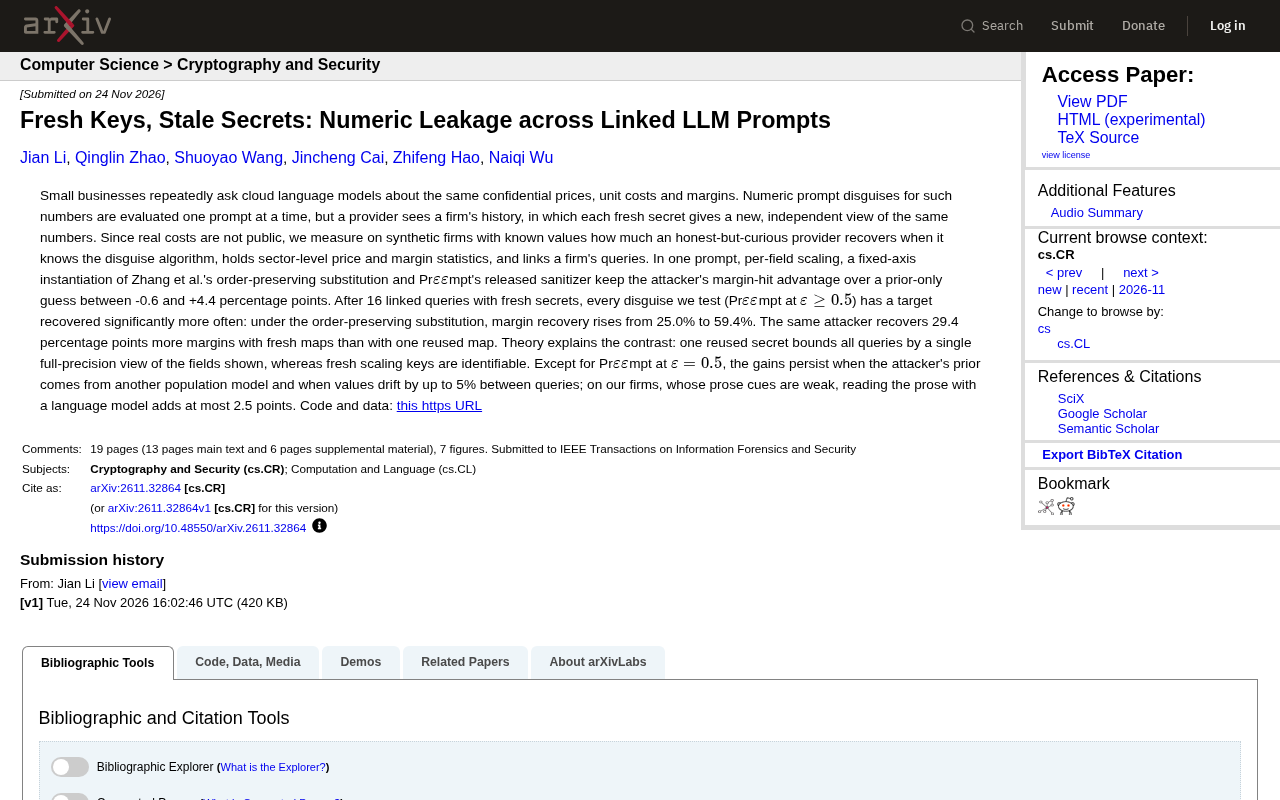
Research shows that multiple linked LLM queries using fresh keys leak sensitive numeric data, with margin recovery reaching 59.4% after 16 queries.
The paper *Fresh Keys, Stale Secrets* reveals the risk of numeric leakage in cloud language models under multiple linked queries. Even with numeric camouflage (e.g., order-preserving substitution, Prεεmpt sanitizer), attackers can significantly recover sensitive data by linking 16 queries with fresh keys, increasing margin recovery from 25.0% to 59.4%. Fresh keys leak more information than reused keys, with a 29.4 percentage point increase. The risk persists with 5% numeric drift or priors from different populations. The study calls for rethinking key management and camouflage algorithm design to defend against linkage attacks.
When small businesses repeatedly ask cloud-based language models the same confidential prices, unit costs, and profit margins, they may not realize that each time they encrypt numbers with a "fresh" key, they are giving the service provider an independent opportunity to peek at the real values. A recent research paper, Fresh Keys, Stale Secrets: Numeric Leakage across Linked LLM Prompts, delves into this overlooked privacy risk.
The Hidden Risks of Numeric Camouflage and Linked Queries
In scenarios where sensitive data is outsourced to large models, users typically employ numeric camouflage techniques, such as scaling each field or using order-preserving substitution algorithms. These methods aim to obfuscate the true values, making a single query appear safe. However, the paper points out that service providers can see a company's query history, and each query encrypted with a fresh key is like observing the same set of numbers from a different angle. Attackers can cross-reference and gradually reconstruct the truth.
To quantify the risk, the researchers constructed a synthetic enterprise with known values, simulating an honest-but-curious service provider—one that knows the camouflage algorithms, possesses industry-level price and margin statistics, and can link multiple queries from the same enterprise. In a single-prompt attack, using order-preserving substitution with a fixed axis (proposed by Zhang et al.) and the Prεεmpt sanitizer, the attacker's margin hit advantage ranged from -0.6 to +4.4 percentage points. This means leakage from a single query is limited.
Order-Preserving Substitution is a numeric camouflage technique designed to preserve the ordinal relationships between values while hiding the true values. A typical implementation maps original values to a new range, possibly using a fixed or dynamic scaling axis. In LLM privacy scenarios, users might apply order-preserving substitution to sensitive values (e.g., prices, costs) so that the model can still perform logical comparisons (e.g., "is A greater than B?") but cannot directly learn the true values. However, the weakness of this method is that if an attacker can link multiple queries and infer the mapping parameters from outputs under different mappings, they may gradually reconstruct the original data. The scheme proposed by Zhang et al. mentioned in the paper belongs to this category; its security is acceptable for a single query but may fail under multiple linked queries.
Prεεmpt is a numeric sanitizer for LLM prompts that aims to perturb input values through a differential privacy mechanism, theoretically providing privacy guarantees. Its core parameter ε controls the privacy budget: smaller ε means stronger privacy protection but lower data utility; larger ε means weaker privacy protection. In the paper's experiments, Prεεmpt was used as one of the comparative camouflage methods. The results show that when ε≥0.5, after 16 linked queries, the attacker can still significantly recover the target values, indicating that differential privacy mechanisms may be weakened in linked query scenarios, especially when the attacker can exploit correlations between queries.
16 Linked Queries: Camouflage Completely Fails
When the attacker obtains 16 linked queries using fresh keys, the situation changes dramatically. All tested camouflage methods (Prεεmpt at ε≥0.5) saw a significant increase in the frequency of target recovery. Under order-preserving substitution, the margin recovery rate jumped from 25.0% to 59.4%. Even more striking, the same attacker recovered 29.4 percentage points more margin using fresh mappings than using a single reused mapping.
The theory explains this contrast: a reused key restricts all queries to a single full-precision view of the field, whereas fresh scaling keys are identifiable. This is because each use of a new key leaks information about the key itself, and the attacker can infer the key through linked queries and thereby decrypt the data.
Robustness and Real-World Impact
Except for the case of Prεεmpt at ε=0.5, the above gains persist even when the attacker's prior comes from a different population model and numeric drift between queries is as high as 5%. In the enterprises constructed by the researchers, due to weak textual cues, using a language model to read the text increased the recovery rate by at most 2.5 percentage points. This shows that even without relying on textual information, numeric linkage alone can effectively leak secrets.
This study reveals a fundamental flaw in current LLM privacy protection schemes: camouflage evaluation for a single query is insufficient to guarantee long-term privacy. As enterprises increasingly rely on cloud models to process sensitive data, the query history accumulated by service providers may become a source of leakage. The authors have released code and data (https://github.com/Jamli58/fresh-keys-stale-secrets) for the community to further verify and explore defense measures.
Population Model in this paper refers to the statistical distribution information about an industry or group that the attacker possesses, such as industry average prices, margin ranges, etc. The attacker can compare this prior knowledge with the values recovered from queries to narrow down guesses. The paper tests the attack effect when the attacker's prior comes from another population model (i.e., not perfectly matching the target enterprise) and finds that even with distribution shift, the attacker can still achieve significant recovery advantages. This emphasizes the feasibility of attackers using public industry data to enhance attacks in the real world.
Numeric Drift refers to the natural changes in an enterprise's sensitive values between multiple queries (e.g., price adjustments, cost fluctuations). The paper simulates numeric drift of up to 5% and finds that the attacker can still effectively recover the target through linked queries. This is because drift is usually small, and the attacker can offset its effects through statistical methods (e.g., averaging, trend fitting). This finding indicates that even if enterprises dynamically update data, the risk of linkage leakage persists, and defense strategies need to consider the temporal variation of numeric values.
Defense Directions and Future Challenges
To address this linkage leakage, it may be necessary to rethink key management strategies. For example, avoid frequent key changes, or design camouflage algorithms that resist linkage attacks. At the same time, privacy protection mechanisms on the service provider side must also consider the linkage risk of query history. This study serves as a wake-up call for LLM privacy security, reminding us that while enjoying the convenience of large models, we cannot ignore potential paths of data leakage.
Related articles

The Gemini 4 Trio and 3.8 Flash: A Full Comparison of Positioning, Pricing, and Benchmarks
A comparison of Gemini 4 Neon, Carbon, Argon, and Gemini 3.8 Flash: positioning, context, API pricing, Artificial Analysis and Arena benchmark scores, and available entry points.

AI Coding Model Leaderboard: Opus 5.5 Crowned, Gemini Neon Stages a Comeback
Tech blogger Matthew Berman releases an AI coding model tier list: Claude Opus 5.5 holds S-tier, Gemini Neon surprises with A-tier, OpenAI Astra lands B-tier. How do open-source models like DeepSeek fare? We break down the scoring logic and practical takeaways.

New Jersey Joe Sandwich: Meat and Coleslaw on Triple-Decker Rye
New Jersey Sloppy Joe isn't a ground beef burger—it's triple-decker rye bread with meat, Swiss cheese, and coleslaw, plus Russian dressing. Learn the authentic Essex County method and family recipe.