FreshCtx 0.5.0 Integrates with Agno: A State Validation Solution for AI Agent Tool Calls
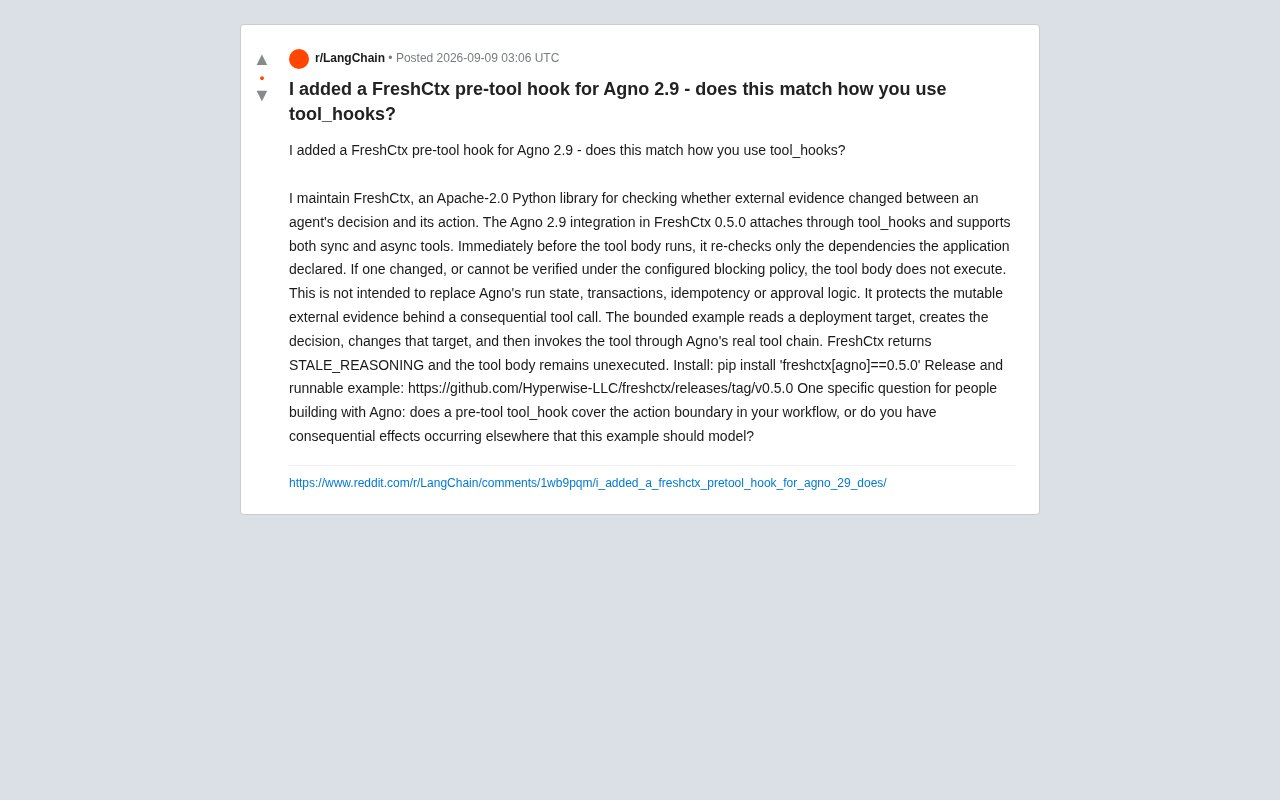
FreshCtx 0.5.0 integrates with Agno 2.9 to validate external state before AI Agent tool execution.
FreshCtx 0.5.0 introduces deep integration with the Agno 2.9 framework via its tool_hooks mechanism, addressing the state consistency gap between AI Agent decision-making and tool execution. By using pre-tool hooks, it re-validates external dependencies just before execution, returning a STALE_REASONING error if state has changed. The library supports both sync and async calls with declarative dependency checking, acting as a defense-in-depth layer alongside existing transaction and idempotency mechanisms.
The State Consistency Challenge in AI Agent Tool Calls
In AI Agent development, there's a common but easily overlooked problem: after an Agent makes a decision based on some external state, that state may have already changed by the time the tool call is actually executed. This time window between "decision" and "execution" can lead to serious consistency issues.
AI Agent Basics: An AI Agent (intelligent agent) is an AI system capable of perceiving its environment, making autonomous decisions, and executing actions. Unlike traditional single-turn dialogue models, Agents have continuous interaction capabilities and can invoke external tools (such as APIs, databases, file systems, etc.) to accomplish complex tasks. In a typical Agent workflow, a large language model (LLM) serves as the "brain," responsible for understanding tasks, formulating plans, and selecting appropriate tools, while the tool-calling mechanism acts as the bridge between the Agent and the external world. This architecture enables AI systems to go beyond pure text generation and actually operate on real-world resources and systems.
The Nature of the State Consistency Problem: In distributed systems and concurrent programming, state consistency has always been a core challenge. For AI Agents, this problem has a unique dimension: there's a time gap between the Agent's decision-making process (LLM reasoning) and its execution process (tool invocation), during which external state may change. For example, an Agent reads that "Server A has 30% load" and decides to deploy a new task, but before actually executing the deployment command, the server load may have already surged to 95%. This "read-decide-write" race condition is traditionally solved in software engineering through locks, transactions, and similar mechanisms, but the asynchronous and distributed nature of Agent systems makes the problem significantly more complex.
FreshCtx is an Apache-2.0 open-source Python library specifically designed to detect changes in external evidence between an Agent's decision and actual execution. The latest release, version 0.5.0, implements deep integration with Agno 2.9, providing developers with an elegant state validation mechanism.
Understanding the Apache-2.0 License: Apache License 2.0 is a permissive open-source license published by the Apache Software Foundation. It allows users to freely use, modify, and distribute the software, even for commercial purposes, without requiring derivative works to be open-sourced (unlike the "copyleft" nature of GPL). Key provisions include: retaining the original copyright notice and license text, declaring modifications to the original code, and providing patent grants that protect users from patent litigation. This license is widely popular in enterprise environments because it protects the rights of open-source contributors while placing no barriers on commercial use. FreshCtx's choice of Apache-2.0 means it can be freely integrated into commercial products, reducing the legal risk of enterprise adoption.
Technical Implementation of the Agno Integration
Introduction to the Agno Framework: Agno is a modern AI Agent development framework that provides the infrastructure for building production-grade Agent applications. Its core features include tool registration and invocation management, state persistence, error handling, and observability support. The tool_hooks mechanism introduced in Agno 2.9 is an important extension point system that allows developers to inject custom logic at critical nodes in the tool execution lifecycle. This design follows the Open-Closed Principle, enabling the framework to maintain core stability while offering high extensibility. The hook mechanism is widely used in software engineering for middleware, plugin systems, and other scenarios, providing standardized interfaces for third-party extensions.
FreshCtx 0.5.0 integrates through Agno's tool_hooks mechanism — a key design choice. The specific implementation features include:
Precise Execution Timing Control
The pre-tool hook triggers immediately before the tool function body executes, making it the ideal moment to check state consistency. At this point, the Agent has completed its decision-making but has not yet produced any actual side effects.
The Engineering Value of the Hook Mechanism: A hook is a design pattern that allows custom code to be inserted at specific execution points without modifying core logic. In Agno's tool_hooks, the pre-tool hook fires before the tool function executes, while the post-tool hook fires after. This design brings multiple advantages: first, Separation of Concerns — validation logic is decoupled from business logic; second, Composability — multiple hooks can be chained together; and third, testability — hook logic can be tested independently. Compared to manually adding validation code inside each tool function, the hook mechanism achieves elegant handling of cross-cutting concerns — a concrete application of Aspect-Oriented Programming (AOP) thinking in Agent systems.
Dual Support for Synchronous and Asynchronous Calls
The integration supports both synchronous and asynchronous tool invocations, ensuring consistent protection across all execution modes.
Synchronous vs. Asynchronous Programming Models: Synchronous and asynchronous are two fundamentally different program execution models. Synchronous execution proceeds step by step in sequence, with the caller waiting for the called function to return; asynchronous execution allows other tasks to be performed during waiting periods, handling results through callbacks, Promises, or async/await syntax. In Python, asynchronous programming is based on the asyncio library and coroutine mechanisms. For AI Agent systems, async support is critical: LLM inference may take several seconds, and tool calls may involve network requests — a synchronous model would lead to resource waste and sluggish response times. FreshCtx's support for both models means it can adapt to different application architectures, whether traditional blocking scripts or high-concurrency async services.
Declarative Dependency Checking
Developers simply declare the external states their tools depend on, and FreshCtx automatically re-validates those dependencies. If changes are detected, or if the state cannot be verified under the configured blocking strategy, the tool function body will not execute.
The Declarative Programming Paradigm: Declarative programming emphasizes "what to do" rather than "how to do it," contrasting with imperative programming. In a declarative style, developers describe desired outcomes and constraints, leaving execution details to the framework or runtime. SQL queries, React component definitions, and Terraform configurations are all classic examples. FreshCtx adopts declarative dependency checking — developers simply annotate which external states a tool depends on (such as a configuration file or database record), and the framework automatically handles state snapshots, change detection, and validation logic. This elevation in abstraction level significantly reduces cognitive load and error probability, allowing developers to focus on business logic rather than low-level state management details.
Practical Use Case Demonstration
The example code provided by the project showcases a typical usage scenario:
- The Agent reads a deployment target configuration
- Makes a decision based on that configuration
- Before execution, the deployment target is modified externally
- When the tool is called through Agno's tool chain, FreshCtx detects the state change
- Returns a
STALE_REASONINGerror, and the tool function body remains unexecuted
This mechanism effectively prevents the execution of operations based on stale information. It's important to emphasize that FreshCtx is not intended to replace Agno's existing runtime state management, transaction handling, idempotency, or approval logic — rather, it provides an additional layer of protection for the mutable external evidence behind tool calls.
Idempotency and Transaction Handling: Idempotency refers to the property that an operation can be executed multiple times and still produce the same result — a key attribute for building reliable distributed systems. For example, "set user status to active" is idempotent, while "add 100 to account balance" is not. Transactions provide ACID properties (Atomicity, Consistency, Isolation, Durability), ensuring that multiple operations either all succeed or all roll back. In Agent systems, these concepts are critical: network failures may trigger retries, and concurrent Agents may operate on the same resources. FreshCtx explicitly states that it does not replace these mechanisms but rather serves as a supplementary layer. This embodies the "defense in depth" security engineering principle: multiple independent layers of protection collectively improve system reliability, so that the failure of any single mechanism doesn't lead to catastrophic consequences.
Race Conditions and Time-Window Attacks: A race condition is a classic problem in concurrent systems where program behavior depends on uncontrollable event timing. TOCTOU (Time-Of-Check to Time-Of-Use) vulnerabilities are a security concern where attackers exploit the time window between a check and its corresponding use to modify state. In Agent scenarios, this window can span several seconds: LLM reasoning takes time, and there may even be approval workflows between decision and execution. Even without malicious attacks, normal concurrent operations can lead to inconsistencies. For example, two Agents simultaneously read "inventory: 100 units," both decide to ship 50 units, and the actual inventory ends up negative. By re-validating state just before execution, FreshCtx compresses this time window to a minimum, dramatically reducing the risk of inconsistency.
Observability and Debugging: Observability is the ability to understand a complex system's internal state, achieved through the three pillars of logs, metrics, and traces. For AI Agent systems, debugging is particularly challenging: the LLM decision-making process is opaque (black-box characteristics), tool call chains can be lengthy, and errors may manifest with a delay. FreshCtx's structured error code like STALE_REASONING provides a critical observability signal that enables developers to: 1) track the frequency and patterns of state inconsistency events in logs; 2) set up monitoring alerts to detect systemic issues; and 3) quickly identify root causes during debugging. This design embodies the "fail-fast" principle: expose problems early rather than letting erroneous states propagate.
Design Boundaries and Open Questions
FreshCtx's design focuses on the critical action boundary of tool invocation. However, in real-world Agent workflows, side effects with real-world impact can occur at multiple stages.
In the Reddit post, the author posed an important question to the community: for developers building applications with Agno, does the pre-tool hook sufficiently cover the action boundaries in their workflows? Are there other stages that produce significant side effects and would benefit from similar state validation mechanisms?
This question touches on a core challenge in Agent system design: how to find the right balance between flexibility and safety. Different application scenarios may yield different answers.
Quick Start Guide
The installation command is straightforward:
pip install 'freshctx[agno]==0.5.0'
Complete runnable examples and release notes are available on GitHub: https://github.com/Hyperwise-LLC/freshctx/releases/tag/v0.5.0
Technical Significance and Outlook
FreshCtx's Agno integration represents an important direction in Agent reliability engineering. As AI Agents take on increasingly more automated tasks in production environments, ensuring that decisions are based on the most current and accurate state information becomes critically important.
This hook-based architectural design also provides the community with a reference example: how to implement critical safety mechanisms through extension points without being invasive to the core framework. For developers building reliable Agent systems, this project is well worth a deep dive.
Key Takeaways
- FreshCtx 0.5.0 achieves elegant state consistency validation through Agno 2.9's tool_hooks
- The pre-tool hook detects changes in external evidence before tool execution, preventing operations based on stale information
- Supports both synchronous and asynchronous tool calls, using declarative dependency checking to reduce development complexity
- Functions as part of a defense-in-depth strategy, supplementing rather than replacing existing transaction and idempotency mechanisms
- The open-source community is actively exploring other critical boundaries in Agent workflows that need state validation
Related articles
Deep Dive into vLLM Worker-Side GPU KV Cache Initialization
Deep dive into vLLM's Worker-side KV Cache GPU memory allocation, covering the full pipeline from KVCacheConfig generation to physical memory binding via ModelRunner.
Zepto Builds AI Customer Service with MLflow: An Evaluation-Driven Practice Guide
Deep dive into how Zepto built an evaluation-driven AI customer service system using MLflow and Databricks, achieving 60% faster responses and 40% less manual handling. From technical architecture to practical insights.

Iran Captures U.S. Underwater Drone in Strait of Hormuz: A Comprehensive Analysis
Iran announces capture of U.S. Navy underwater drone in Strait of Hormuz. In-depth analysis of the incident, strategic value of UUVs, U.S.-Iran geopolitical competition, and implications for global energy security and military dynamics.