freshtools' Multi-Domain Strategy: Why AI Tool Sites Favor .cfd and .icu

freshtools uses four cheap TLDs to build a brand domain matrix — a low-cost placeholder sample.
Starting from four links in an RSS feed, the article notes that freshtools uses .cfd, .domains, .fun, and .icu simultaneously, forming a typical small multi-domain matrix. It analyzes the motives: bulk-squatting cheap TLDs to prevent brand hijacking, and using TLD semantics to test search entry points. It warns of mirror-site and authority-dilution risks, concluding this is a brand placeholder sample worth referencing but not copying.
Multi-Domain Matrix: Four Entry Points for One Tool Site
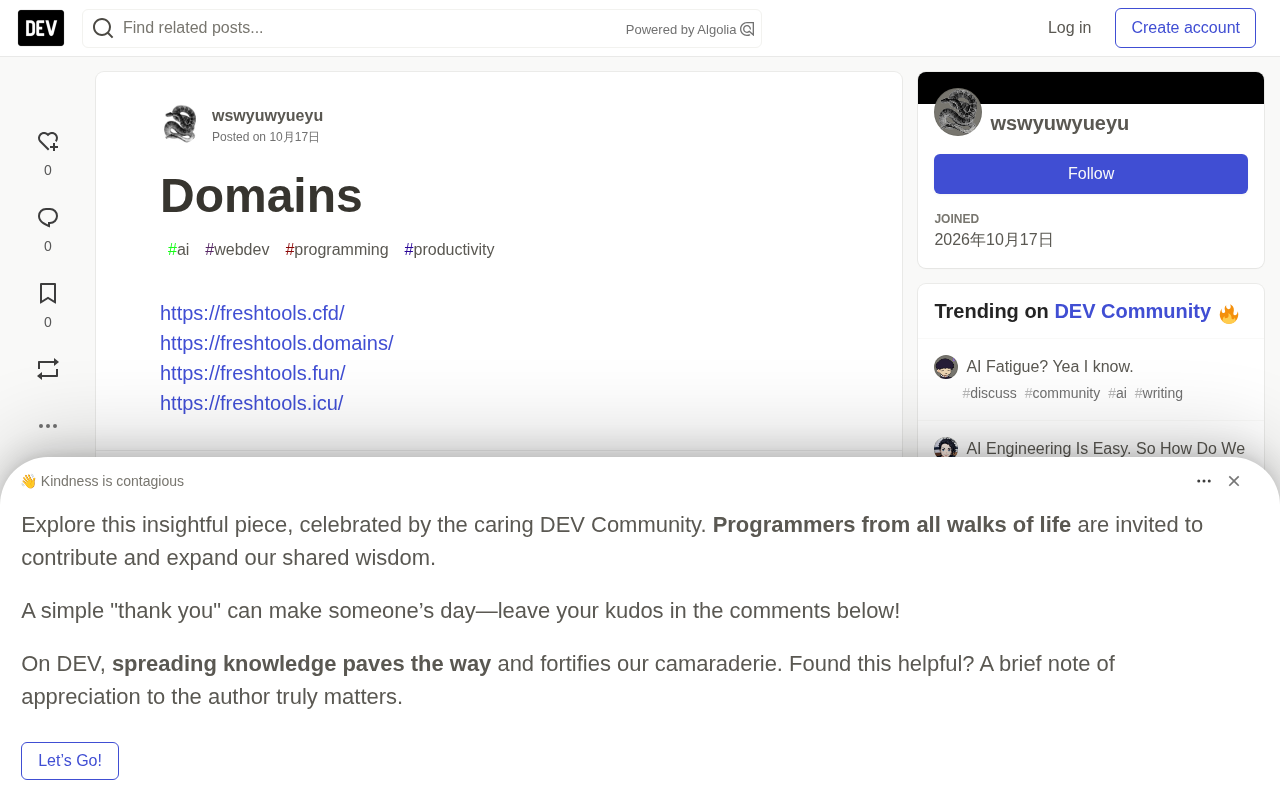
In a Reddit RSS feed, someone posted a set of links: freshtools.cfd, freshtools.domains, freshtools.fun, and freshtools.icu. Four domains all pointing to the same brand name, with TLDs ranging from the relatively common .fun to the more obscure but recently opened .cfd and .icu — forming a typical small-scale multi-domain matrix.
These TLDs aren't unusual on their own, but their concentration under a single brand suggests the operator behind them is likely doing two things: first, bulk-registering cheap TLDs to squat on the brand term and prevent it from being taken or impersonated; second, leveraging the small search ecosystems tied to different TLDs to test which entry point users are more likely to remember.
The Cost and Traffic Logic Behind TLD Selection
Annual fees for .cfd and .icu are typically lower than traditional TLDs like .com, and first-year promotional prices can be negligible. For individual developers or small teams, surrounding the brand term "freshtools" with a few cheap TLDs is a very low-risk move.
But low price alone isn't the reason. What's genuinely interesting is how TLDs match use cases: .fun suits lightweight consumer-facing tools, .icu hints at an "I See You"-style friendliness, and .domains reads like a natural category word — it gives freshtools.domains an extra layer of semantic relevance when users search for "domain-related tools." It's impossible to tell from the links alone whether each domain hosts different functionality, but the differentiated semantic packaging of domains is itself a lightweight SEO placeholder strategy.
New generic top-level domains (new gTLDs) are the prerequisite for understanding this set of TLDs. Since 2012, ICANN has broken the .com/.net/.org monopoly and opened up over a thousand new TLDs in batches — .fun, .icu, and .cfd all belong to this group. Their registries are mostly commercial entities with flexible pricing strategies: first-year fees are often as low as a few yuan or even free, while renewals return to normal ranges. This "low barrier to entry, renewal-based filtering" model makes bulk registration of brand-related TLDs extremely cheap. Note that filing (ICP) and resolution policies for different TLDs vary in mainland China — some new gTLDs cannot complete ICP filing, so if targeting domestic users, verify availability before choosing a TLD.
Is the Multi-Domain Play Worth Following for AI Tool Sites?
AI tool aggregator sites are among the fastest-growing site types in recent years, and domains — as the most visible brand asset — naturally get reused. Showing four domains at once could be A/B entry-point testing, or simply making the cost of brand protection public. For ordinary users, the immediate question raised by multiple domains is: which one is the main site?
The caveat here: the common risk with such multi-domain sites is diluted authority and duplicate content. If all four domains resolve to the same set of pages, search engines may classify them as mirror sites; if the content differs across each, operating costs double. In rare cases, multiple domains are also used for redirect testing or short-link distribution. Absent more information, this set of links looks more like a brand placeholder sample than a complete operational model to reference.
Mirror sites and authority dilution are search engines' most direct response mechanism to multiple domains. When several domains resolve to identical or highly similar pages, search engines use canonical signals to select one primary version for indexing, while the rest may be treated as duplicate content and demoted — or even trigger manual penalties. Common workarounds include: using 301 permanent redirects to point secondary domains to the main site, setting canonical tags on secondary domain pages pointing to the main site, or having secondary domains serve only as brand showcase pages without hosting main content. If operators want each domain to develop independently, they must ensure content, backlinks, and user bases genuinely diverge — otherwise multiple domains bring not traffic, but maintenance costs and diluted authority.
Conclusion
freshtools' four domains demonstrate a lightweight brand protection approach: covering the brand term with low-cost TLDs while testing whether semantic TLDs can bring extra search entry points. It's a useful reference for developers, but not something to copy wholesale — whether to follow suit depends on whether you're willing to bear the dispersed responsibility and authority that multiple domains bring.
One-line Summary
freshtools uses four cheap TLDs to build a brand domain matrix — a low-cost placeholder sample.
Paragraph Summary
The article starts from four links appearing in an RSS feed, noting that freshtools uses four TLDs — .cfd, .domains, .fun, and .icu — simultaneously, forming a typical small-scale multi-domain matrix. The author analyzes the motives: first, bulk-registering cheap TLDs to squat on the brand term and prevent it from being taken or impersonated; second, using TLD semantics (such as .domains' industry relevance) to test different search entry points. The article also warns that if multiple domains resolve to the same set of pages, they risk being treated as mirror sites with diluted authority; if content differs across each, operating costs double. The conclusion is that this set of links is closer to a brand placeholder sample — useful as a reference for developers but not something to copy wholesale.
Related articles

Amphibious Transforming Drone: Beyond 100x Power Savings, What Are the Real Needs?
Is the amphibious transforming drone just a gimmick? Starting from the 100x power difference of the M4 Morphobot, explore real application scenarios and thesis topic ideas, analyzing boundary conditions where pure drones and pure ground robots both fail.

Warhound Raises $200 Million: Genetically Engineered "War Dogs" Paired with Anduril Gear
Warhound raises $200M, backed by Ben Lamm and Palmer Luckey, to genetically engineer dogs for military and law enforcement use and equip them with Anduril gear. This article analyzes its technology direction, funding logic, and ethical controversy.

Claude API Comes to Google Cloud: IAM Integration and SDK Access Guide
Anthropic hosts the full Claude API on Google Cloud with IAM-controlled permissions and unified billing. This guide covers the Vertex AI and Anthropic-hosted entry points, IAM role configuration, and SDK access.