From Action to Learning: How Experience Selection Enables Continuous Evolution of AI Agents

Experiments with a 4B language agent show optimizer-aware gradient experience selection significantly outperforms random and high-NLL selection.
A study of a 4B-parameter language agent systematically compared nine experience selection strategies, addressing which experiences from successful records to learn from. Using two fixed pools of 256 experiences each, controlling total experience and selection freedom, it trained 288 student models and evaluated them on 128 development task groups. Optimizer-aware gradient selection achieved success rates of 81.45% and 73.19%, improving 8.25 and 5.96 points over random selection and about 4 points over high-NLL selection, with all eight initialization seeds positive. A frozen reproduction on 128 held-out task groups confirmed the gains. The study also found ranking rules and selection space must be co-designed: relaxing coverage constraints improves gradient selection but degrades random selection. Experience selection should be a key component of continuously learning agents, not an isolated technique.
Title
From Action to Learning: How Experience Selection Enables Continuous Evolution of AI Agents
Meta Description
A study of 4B language agents compares nine experience selection strategies, finding that optimizer-aware gradient selection achieves success rates of 81.45% and 73.19% in two experience pools, significantly outperforming random and high-NLL selection, offering new insights for designing continuously learning agents.
Article Content
The successful records generated by agents interacting with their environment are a natural source of training data. But success alone is not enough to determine which experiences are worth learning from. A study of a 4B-parameter language agent systematically compared nine experience selection strategies, revealing the critical impact of "which experiences to learn from" on continuous learning outcomes.
Experimental Design for Experience Selection
The study constructed two fixed experience pools, each containing 256 distinct items, with a consistent global selection degree of freedom and a presentation count of 768. The experiment used eight initialization seeds and two sampling seeds, training a total of 288 student models. Each student model was evaluated on 128 development task groups using a shared executor. This design controlled the total amount of experience and the degree of selection freedom, making comparisons between different selection strategies fairer.
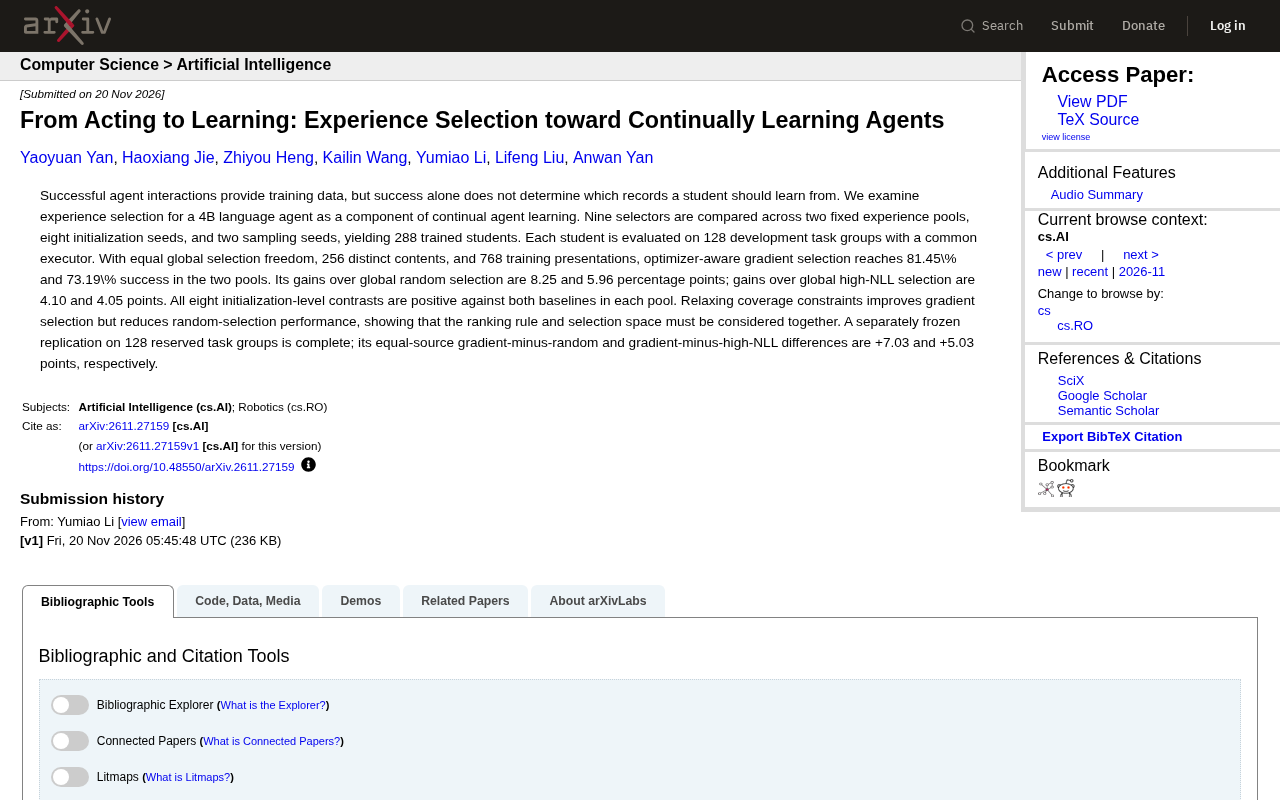
Among the nine selectors, optimizer-aware gradient selection performed most prominently. In the two experience pools, its success rates reached 81.45% and 73.19%, respectively. Compared to global random selection, the gains were 8.25 and 5.96 percentage points; compared to global high-NLL (negative log-likelihood) selection, the gains were 4.10 and 4.05 percentage points. Across the eight initialization seeds, gradient selection's advantage over both baselines was positive in every case, indicating that this advantage is not random fluctuation.
Negative log-likelihood (NLL) is a common metric for measuring a language model's predictive capability on a sample: for each token in an experience, the model provides its conditional probability, and the negative log is averaged; a lower NLL indicates the model is more "confident" about that sample. In the context of experience selection, high NLL means the model currently finds that experience difficult to predict. However, high-NLL samples may fall into two categories: first, effective patterns that the model has not yet mastered but can learn; second, unlearnable signals caused by label noise, rare anomalies, or environmental stochastic events. If high-NLL samples are prioritized indiscriminately, the latter will interfere with training in the form of "difficult but unhelpful" data. Gradient selection outperforms high-NLL selection precisely because it looks not only at the magnitude of the loss but also at whether the gradient direction of the loss with respect to the current parameters aligns with the model's learning needs, thereby filtering out noisy samples whose gradients are chaotic and difficult to generalize from.
Why Gradient Selection Is More Effective
The core idea of gradient selection is to choose data based on the student model's gradient response to experiences under its current parameter state. The optimizer-aware approach further accounts for the optimizer's update dynamics, making the selected experiences better aligned with the model's current learning needs. In contrast, random selection does not differentiate experience value, and high-NLL selection tends to pick experiences that the model currently finds difficult to predict—but difficulty does not equal benefit; some high-NLL samples may simply be noise or outliers that are actually harmful to continuous learning.
The study also found that the selection space and ranking rule must be considered jointly. When the coverage constraint was relaxed, gradient selection's performance improved, but random selection's performance declined. This means that expanding the selection space benefits gradient selection because it can more precisely locate high-value experiences; but for random selection, a larger space merely increases the proportion of noise. Therefore, a ranking rule cannot be evaluated in isolation; experience selection mechanisms should be designed in conjunction with the constraints on the selection space.
Optimizer-aware means that when selecting experiences, the approach considers not only the raw gradient of the loss function with respect to the parameters but also the influence of the optimizer's internal state (such as Adam's first/second moment estimates, learning rate scaling, etc.) on the actual update direction and step size. The same raw gradient can produce very different parameter update magnitudes under different optimizer states: when momentum is large, the gradient direction is amplified by historical accumulation; when the second moment estimate is large, the effective learning rate for that dimension is suppressed. Optimizer-aware gradient selection can therefore estimate "how large and how stable an update this experience will actually produce under the current optimizer state," rather than merely looking at the instantaneous magnitude of the gradient. This makes the selected experiences better match the model's actual learning rhythm at that moment, avoiding samples whose gradients appear significant but are suppressed by the optimizer state and thus produce almost no effective update.
Frozen Reproduction Confirms Robustness
To verify the reliability of the results, the study conducted a separately frozen reproduction experiment on 128 held-out task groups. Under equivalent source conditions, gradient selection differed from random selection by +7.03 percentage points and from high-NLL selection by +5.03 percentage points. The direction of gains in the reproduction experiment was consistent with the main experiment, with slightly different magnitudes, but all remained positively significant. This cross-validation enhances the credibility of the conclusions, showing that the advantage of gradient selection generalizes across different task groups.
Implications for Continuously Learning Agents
This study sends a clear signal: continuous learning for agents cannot rely solely on the naive logic of "success means learn." Among successful interaction records, the learning value of different samples varies significantly, and the selection strategy directly affects final capability. For resource-constrained 4B-level language agents, carefully designed experience selection can substantially improve learning efficiency without increasing the total amount of experience.
From an engineering perspective, optimizer-aware gradient selection requires additional computation of gradient information, but compared to re-collecting large amounts of interaction data, this overhead is worthwhile. In the future, how to extend gradient selection to larger-scale models, how to dynamically adjust selection space constraints, and how to avoid degradation of the experience pool in multi-round continuous learning scenarios are all directions worth exploring.
This study positions experience selection as a component of continuous agent learning rather than an isolated technique. As agents move from passive execution toward continuous learning, the design of experience selection mechanisms will become one of the key variables determining learning efficiency.
Background Supplement
Coverage constraint is a diversity control mechanism in experience selection: it requires that selected experiences cover enough categories in terms of content type, task family, or semantic distribution, preventing the selector from repeatedly picking a few high-value samples and leading to monotonous utilization of the experience pool. There is tension between coverage constraints and ranking rules—the tighter the constraint, the more the ranking rule can only make local selections within each coverage bucket; when the constraint is relaxed, the ranking rule gains a larger global selection space. The observed phenomenon that "relaxing coverage constraints improves gradient selection but degrades random selection" is precisely a manifestation of this tension: gradient selection can use the expanded space to precisely locate high-value experiences, while random selection in a larger space merely introduces more low-value or noisy samples proportionally. Therefore, the tightness of coverage constraints should match the precision of the ranking rule—the higher the precision, the more the constraint can be relaxed.
One-line Summary
Experiments with a 4B language agent show that optimizer-aware gradient experience selection significantly outperforms random and high-NLL selection.
Paragraph Summary
A study of a 4B-parameter language agent systematically compared nine experience selection strategies to answer "which experiences from successful records should be learned from." The experiment constructed two fixed pools each containing 256 experiences, controlled the total experience amount and selection freedom, trained 288 student models, and evaluated them on 128 development task groups. Results show that optimizer-aware gradient selection achieved success rates of 81.45% and 73.19% in the two experience pools, improving by 8.25 and 5.96 percentage points over random selection and about 4 percentage points over global high-NLL selection, with all comparisons across eight initialization seeds being positive. A frozen reproduction experiment on 128 held-out task groups confirmed the consistent direction of gains. The study also found that ranking rules and selection space must be designed jointly: relaxing coverage constraints improves gradient selection but degrades random selection. The conclusion is that experience selection should become a key component of continuously learning agents, not an isolated technique.
Related articles

Turn Your Phone Into a Thermal Camera: Thermal Master 8mm Macro Thermal Imager Review
Thermal Master is a phone-attached thermal camera with 8mm macro focus, compatible with iPhone and Android. Ideal for home inspection, circuit repair, and spotting overheating components—portable and easy to use.
In the Age of AI Programming, Should You Still Write Code by Hand?
Do you still need to write code by hand now that AI programming tools are widespread? A YouTube creator gives a conditional answer: during learning you must type it yourself—friction forces real understanding.

A New App Built Exclusively for Women's Sports, With No Real-Money Gambling
A new app focused exclusively on women's sports launches, aiming to change how fans engage with women's sports and explicitly avoiding real-money gambling. This article analyzes its product logic, compliance considerations, and commercial prospects.