From AIGC to AI Agent: Core Strategies and Practical Guide for Multi-Agent Development in 2025

In 2025, AI evolves from AIGC to AI Agents, with multi-agent systems becoming the industrial standard.
This article explains the fundamental difference between AIGC and AI Agents: AIGC can only generate content, while AI Agents can autonomously plan tasks, invoke tools, and deliver results. 2025-2027 represents the golden window for AI Agents, with multi-agent systems becoming the mainstream architecture for enterprise applications through specialized Agent collaboration. Industrial deployment requires solving five core challenges: task orchestration, tool integration, memory management, fault tolerance, and hallucination control. Mastering Agent development will be a core competitive advantage for AI practitioners.
Introduction: Why Is 2025 Called the Year of AI Agents?
If you've been following developments in the AI space, you've likely heard this prediction: 2025 is the inaugural year of AI Agents. From the AIGC wave sparked by ChatGPT to the deployment of Multi-Agent systems across industries today, AI is undergoing a qualitative leap—from "eloquent talker" to "capable doer."
This article starts with the fundamental differences between AIGC and AI Agents, then dives deep into the core concepts and development strategies for industrial-grade multi-agent projects, helping you build a systematic understanding of this cutting-edge field.
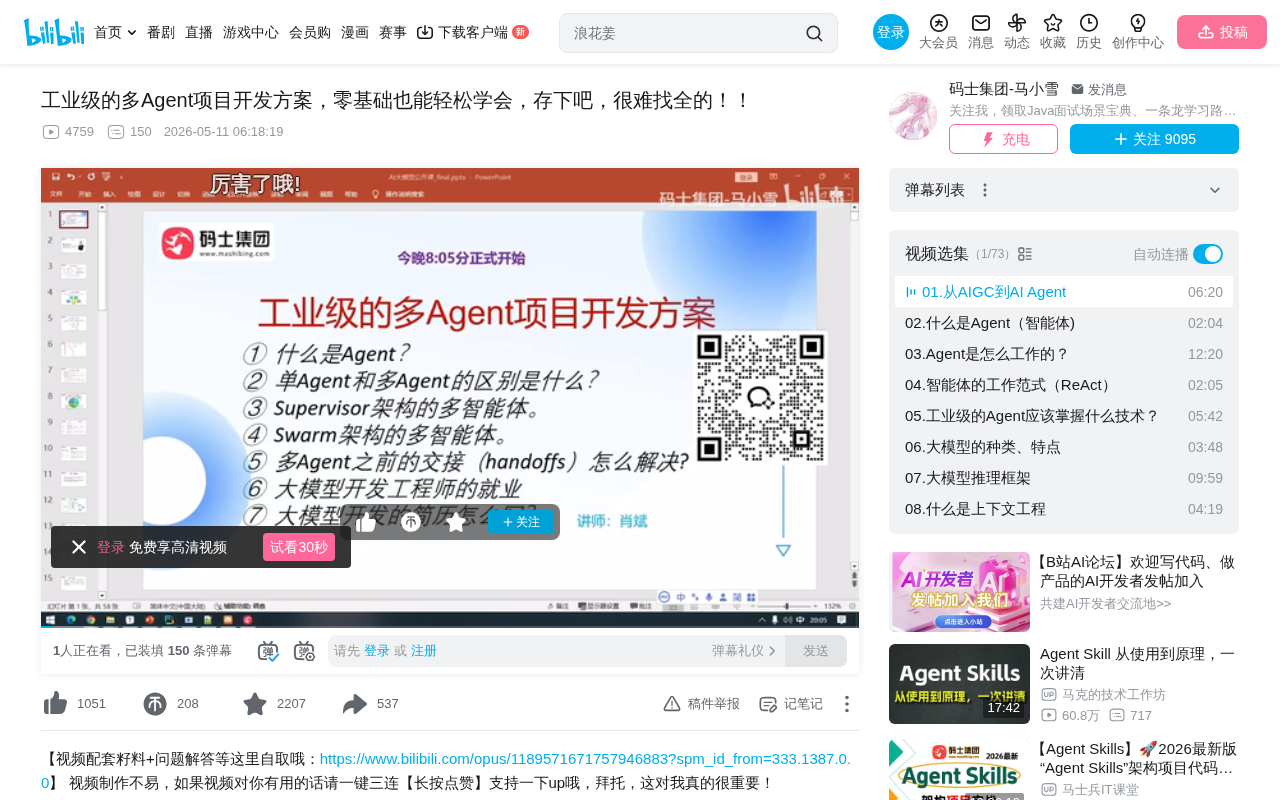
The Limitations of AIGC: Why Large Models Are "Not Quite Ready"
Core Capabilities and Ceiling of Large Models
Open DeepSeek, Tongyi Qianwen, or any other large model product, type in a question, and the model responds—this process is typical AIGC (AI Generated Content), using AI to generate content.
Large models certainly shine at knowledge Q&A, text generation, and code writing, but in actual use you'll likely encounter a common problem: large models tend to produce "hallucinations" when dealing with specialized domain questions—confidently delivering incorrect answers.

This isn't a bug in any particular model; it's an inherent limitation of current large language model architectures. Models are fundamentally probability-based text generators—they don't truly "understand" the world, nor can they verify the correctness of their own output.
From a technical root cause perspective, the "hallucination" phenomenon in large models stems from their underlying architecture—Transformer models learn statistical co-occurrence relationships between words across massive text corpora through self-attention mechanisms, essentially performing "next token prediction." Models don't possess mechanisms for storing and retrieving factual knowledge; their "knowledge" is distributed across weight matrices with billions of parameters, making precise querying impossible as with a database. When a model encounters domains insufficiently covered in its training data, it "fabricates" seemingly reasonable but actually incorrect content based on statistical patterns of language. This is the fundamental reason why models excel at general knowledge but struggle in specialized domains (such as latest regulations or internal corporate data).
An Intuitive Example: Can a Large Model Book a Flight for You?
Suppose you tell DeepSeek:
"Book me a flight from Shanghai to Beijing tomorrow at 4 PM, with a price not exceeding 1000 yuan."
Can DeepSeek actually book you a flight? The answer is no.

If you ask it "What is AIGC?" it can give you a polished answer. But ask it to actually execute a task involving external system interaction—querying flights, comparing prices, placing orders and making payments—it simply cannot do it.
This exposes the fundamental shortcoming of the AIGC paradigm: it can only generate content, not execute actions, and certainly cannot deliver usable results.
From AIGC to AI Agent: From Generating Content to Completing Tasks
What Exactly Is an AI Agent?
The core concept of an AI Agent can be summed up in one sentence: enabling large models not only to think and express, but to autonomously plan tasks, execute them step by step, and ultimately deliver usable results.
The comparison table below helps you quickly understand the differences:
| Dimension | AIGC | AI Agent |
|---|---|---|
| Output | Text, images, and other content | Deliverable action results |
| Interaction Mode | Single Q&A | Autonomous planning, multi-step execution |
| External Capabilities | None | Can invoke tools, APIs, databases |
| Typical Scenarios | Writing articles, answering questions | Booking flights, data analysis, automated workflows |
Returning to the flight booking example: a true AI Agent should be able to complete the following end-to-end pipeline:
- Understand Intent: Parse user requirements (time, departure, destination, budget constraints)
- Plan Tasks: Determine which tools to invoke (flight query API, price comparison system, payment interface)
- Execute Step by Step: Query flights → filter qualifying options → complete booking
- Deliver Results: The user actually receives a usable e-ticket for boarding
This is the essential leap from "generating content" to "completing tasks." The key technical bridge enabling this leap is the Function Calling mechanism. Here's how it works: developers pre-define a set of available functions (tools) along with their parameter descriptions. After understanding user intent, the large model no longer outputs a direct text response but instead outputs a structured function call instruction (containing the function name and parameter values). The application layer receives this instruction, executes the corresponding real function (such as calling a flight API), and returns the execution result to the model for further processing. OpenAI pioneered the standardized Function Calling interface in 2023, and major model providers quickly followed suit—this mechanism has become fundamental infrastructure for Agent development.

2025-2027: The Golden Window for AI Agents
From an industry trend perspective, 2025 to 2027 is expected to be the hottest three-year period for AI Agents. If the past two years of AIGC changed how we access information, then AI Agents will change how we get work done.
Currently, 70%-80% of large model deployment projects still revolve around AIGC, but the proportion of AI Agent projects is rising rapidly. For practitioners looking to enter the large model space, understanding AI Agents is no longer a bonus—it's an essential skill.
Industrial-Grade Multi-Agent Systems: Architecture Design and Core Challenges
Why Do We Need "Multi"-Agent Collaboration?
A single Agent is like a versatile but insufficiently specialized employee—limited in efficiency when facing complex tasks. The design philosophy of a Multi-Agent System is: have multiple Agents, each specialized in different domains, collaborate to complete tasks—like a well-organized, efficient team.
Take an enterprise-grade intelligent customer service system as an example. It might include the following Agents:
- Intent Recognition Agent: Determines which business category the user's need belongs to
- Knowledge Retrieval Agent: Searches the enterprise knowledge base for relevant information (based on RAG technology)
- Business Execution Agent: Calls backend systems to complete specific operations (refunds, rebooking, etc.)
- Quality Review Agent: Checks response accuracy and compliance
The RAG (Retrieval-Augmented Generation) technology that the Knowledge Retrieval Agent relies on is currently the most mainstream solution for addressing large model hallucinations. The core idea is: before the large model generates an answer, first retrieve document fragments relevant to the user's question from an external knowledge base, then inject these retrieved results as context into the Prompt, allowing the model to generate answers based on real data. A typical RAG pipeline includes: document chunking → vectorization (Embedding) → storage in a vector database → semantic retrieval when user asks a question → concatenating Top-K results into the Prompt → large model generates the final answer. This approach preserves the large model's language generation capabilities while ensuring factual accuracy through external knowledge sources.
Each Agent handles its own responsibilities, working together through coordination mechanisms to achieve comprehensive capabilities far exceeding those of a single Agent.
From Prototype to Production: Five Core Challenges in Industrial Deployment
From lab demos to industrial-grade deployment, multi-agent systems need to overcome these key challenges:
1. Task Orchestration and Scheduling
How do multiple Agents divide work? How are task flows defined? Should execution be sequential or parallel? This requires a reliable orchestration framework for unified management. Common approaches include DAG (Directed Acyclic Graph) orchestration and event-driven architecture.
Specifically, in DAG (Directed Acyclic Graph) orchestration, each node represents an Agent or task step, directed edges represent dependency relationships and data flow between tasks, and the "acyclic" property ensures tasks don't fall into infinite loops. This approach suits scenarios with relatively fixed processes. Event-driven architecture is more flexible—each Agent acts as an independent event consumer, communicating asynchronously through message queues (such as Kafka or RabbitMQ). When one Agent completes a task, it publishes an event, and other related Agents automatically trigger execution upon detecting the event. Event-driven architecture is better suited for complex scenarios requiring dynamic adjustment of execution paths, but it also introduces higher debugging and tracing complexity.
2. Tool Invocation and System Integration
An Agent's "action capability" comes from its tool-calling ability (Function Calling). Industrial-grade systems need stable integration with existing enterprise APIs, databases, and third-party services, placing high demands on interface design and exception handling. In real engineering, the tool invocation layer typically needs to handle timeout retries, rate limiting and circuit breaking, parameter validation, permission control, and a host of other issues—far more complex than simple API calls in the demo stage.
3. Memory and Context Management
How do you maintain context consistency across long conversations and multi-turn interactions? How do you distinguish and manage short-term memory (current session) versus long-term memory (user preferences, historical behavior)? This directly determines the upper bound of user experience.
In technical implementation, short-term memory is typically achieved by maintaining a conversation history window, constrained by the model's Context Window; long-term memory requires persistent storage and semantic retrieval via vector databases. Vector databases are the core infrastructure for implementing semantic retrieval and long-term memory in AI Agent systems—unlike traditional relational databases based on exact matching, vector databases store high-dimensional vectors (typically 768 or 1536 dimensions) converted from text through Embedding models, and achieve millisecond-level semantic similarity search through Approximate Nearest Neighbor (ANN) algorithms. Among mainstream solutions, Milvus is the representative open-source distributed vector database suitable for large-scale production deployment; Pinecone is a fully managed cloud service that reduces operational overhead; additionally, Weaviate, Qdrant, ChromaDB, and others each have their own strengths.
4. Fault Tolerance and Observability
Agents will inevitably make mistakes in production environments. Systems need error detection, automatic retries, degradation strategies, and human intervention mechanisms, along with comprehensive log tracing and monitoring/alerting systems.
5. Hallucination Control and Fact Verification
Through RAG (Retrieval-Augmented Generation), knowledge graphs, fact-verification Agents, and other means, minimize hallucination output from large models. This is the baseline requirement for industrial-grade AI applications—in finance, healthcare, and legal domains, a single hallucination can have serious consequences.
AI Agent Developer Guide: Skill Roadmap and Career Prospects
Recommended Learning Roadmap
If you plan to enter the AI Agent development field, here's a suggested progressive learning path:
- Foundation Layer: Master the basic principles of large language models (Transformer architecture, Prompt Engineering, fine-tuning methods)
- Framework Layer: Become familiar with mainstream Agent development frameworks (LangChain, AutoGen, CrewAI, MetaGPT, etc.)
- Engineering Layer: Learn Function Calling mechanisms, RAG system construction, and vector database usage (Milvus, Pinecone, etc.)
- Architecture Layer: Understand multi-Agent collaboration patterns, task orchestration design, state management, and communication protocols
- Practical Layer: Participate in real projects, accumulating experience in industrial-grade deployment, performance optimization, and troubleshooting
Regarding framework selection, several mainstream frameworks in the current Agent development ecosystem have different focuses: LangChain is the earliest and has the most complete ecosystem, providing full-pipeline abstractions from Prompt management to tool invocation, suitable for rapid prototyping; AutoGen, from Microsoft Research, focuses on multi-Agent conversational collaboration patterns, supporting automated discussions and task allocation between Agents; CrewAI emphasizes "role-playing" style Agent design, driving collaboration by defining each Agent's role, goals, and backstory; MetaGPT simulates a software company's organizational structure, having different Agents play roles like product manager, architect, and programmer to collaboratively complete software development tasks. Framework selection should consider the specific scenario's complexity, team tech stack, and performance requirements holistically.
Career Prospects and Market Demand
In the current market, demand for AI Agent-related positions is growing rapidly. Whether it's "AI Architect," "Agent Development Engineer," or "Large Model Application Engineer," mastering Agent development capabilities will become one of the most competitive technical directions in the next 3-5 years.
From a salary perspective, engineers with multi-agent system design and deployment experience typically command 30%-50% higher compensation than traditional backend development roles in tier-one cities.
Conclusion: The Critical Turning Point from "Can Talk" to "Can Do"
AI is transitioning from "can talk" to "can do." AIGC solved the content generation problem, while AI Agents aim to solve the task execution problem. Multi-agent systems, as the advanced form of Agent technology, are becoming the mainstream architectural choice for enterprise-grade AI applications.
For every tech professional following AI developments, now is the best window to dive deep into Agent technology. Don't wait until this field has matured before entering—the best time to start learning is always now.
Related articles
Deep Dive into AI Agent Skill Design: …
Deep Dive into AI Agent Skill Design: Engineering Practices from Anthropic and Perplexity
A deep dive into Skill design philosophy from Anthropic's Claude Code team and Perplexity's Agent team, covering the Tax Test, Gotchas Flywheel, progressive disclosure, and Eval-First practices for building high-quality AI Agent skill systems.
Deep Dive into OpenAI's Official GPT-5…
Deep Dive into OpenAI's Official GPT-5.6 Prompting Guide: The Shift from Manual to Automatic
A deep dive into OpenAI's official GPT-5.6 Sol prompting guide: conciseness-first, outcome-oriented design, autonomy boundaries, tool routing, and reasoning intensity tuning.
 Deep Dives
Deep Dive into How OpenClaw (Open-Source Crayfish) AI Agent Works
Deep analysis of OpenClaw AI Agent internals: System Prompt, tool calling, SubAgents, Skill system, memory, and Context Engineering explained.