From Bookkeeping to Reports: How to Build a Truly Useful AI Agent
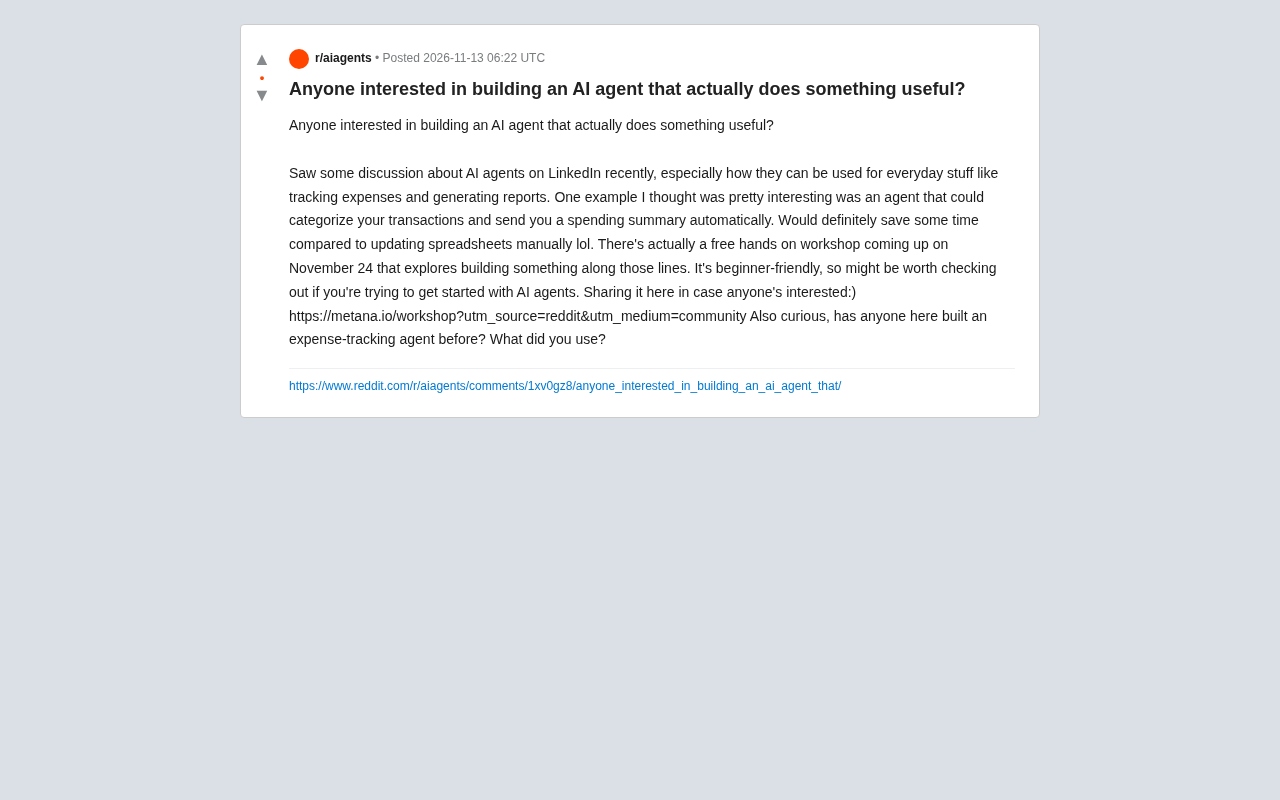
Practical AI agents should focus on closed-loop daily tasks, using a bookkeeping agent as an example to break down key building stages.
Starting from a Reddit discussion, the article points out that most AI agent demos stay at the chat level, while the truly valuable ones complete repetitive daily tasks on people's behalf, such as automatically categorizing transactions and generating expense reports. Using a bookkeeping agent as an example, it breaks down four key stages: data acquisition, transaction categorization, automated triggers, and output presentation, and discusses a hybrid categorization strategy combining rule engines with LLMs, tech stack choices (from Python scripts to frameworks like LangChain), and common community pitfalls (messy CSV formats, unstable merchant categorization). Finally, it provides steps to build your first practical agent from scratch, emphasizing hands-on practice and closed-loop automation.
Why Are Most AI Agents Useless?
There's growing discussion about AI agents on LinkedIn and Reddit, but most demos stop at the "can chat" level—checking the weather, telling jokes, reciting encyclopedia entries. Agents that genuinely save users time and effort are rare. Recently, a Reddit post struck a chord: one user mentioned seeing someone on LinkedIn use an AI agent to automatically categorize transactions and generate expense reports, which is far more efficient than manually updating spreadsheets. This case highlights the core value of AI agents: completing repetitive, rule-based, but time-consuming daily tasks on people's behalf.
The post also shared a free hands-on workshop on building this kind of practical agent, aimed at beginners. The poster also posed a question: has anyone actually built a bookkeeping agent? What tech stack did you use? This question is worth unpacking in depth—because a functional bookkeeping agent involves four stages: data acquisition, categorization logic, automation, and output presentation, and each stage has its pitfalls.
The Four Key Stages of Building a Bookkeeping Agent
1. Data Acquisition: From Bank to CSV
The first step of a bookkeeping agent is getting transaction data. Most banks don't offer open real-time APIs, so the common approach is to periodically export CSV files or use third-party aggregation services (like Plaid) to read account information. For personal projects, manually uploading CSVs is the most realistic starting point. The agent needs to parse formats exported by different banks, handling date, amount, merchant name, and memo fields. The challenge here is inconsistent formats, requiring some adaptation logic.
Plaid is a third-party service providing a financial data aggregation API. Through it, developers can securely read bank account, transaction, and balance information with user authorization. How it works: users log into their bank accounts through Plaid's interface, Plaid establishes a connection with the bank, and then returns standardized transaction data to developers via API. Compared to manually exporting CSVs, Plaid provides a more real-time, uniformly formatted data stream, but requires registering a developer account, complying with regulatory requirements, and may incur costs for personal projects. For bookkeeping agents pursuing a closed automation loop, aggregation services like Plaid can save the trouble of parsing various bank CSVs and are a key step toward "full automation."
2. Transaction Categorization: Rule Engine or LLM?
Categorization is the core of a bookkeeping agent. Merchant names are often ambiguous, like "AMZN Mktp" or "SQ *COFFEE." The traditional approach uses keyword matching rules, but coverage is limited. With large language models, the agent can infer categories from merchant names and amounts, for example classifying "SQ *COFFEE" as "Dining." However, LLM inference has costs; for high-frequency transactions, you can combine a rule engine for rough filtering first, then let the model handle ambiguous cases. The agent mentioned in the Reddit post automatically categorizes and generates summaries—this hybrid strategy is most common in real projects.
A rule engine is a system that executes categorization decisions based on predefined conditions (such as keywords, amount ranges, regular expressions). In bookkeeping scenarios, a rule engine can quickly classify merchant names containing "STARBUCKS" as "Dining" or flag transactions over 1000 as "large amounts." Its advantages are speed, low cost, and interpretable results, but its drawbacks are the need for manual rule base maintenance and difficulty covering ambiguous or newly appearing merchant names. Combining a rule engine with an LLM allows rules to handle clear cases first, then pass remaining ambiguous items to the model for inference, balancing accuracy and cost.
3. Automated Triggers: Scheduled or Event-Driven?
A truly worry-free agent should run automatically rather than requiring manual clicks each time. You can use cron scheduled tasks to process new data weekly or monthly, or monitor email or cloud drive folders to trigger when a new CSV appears. Beginners can start with scheduled tasks—simple and reliable. If the agent needs to send expense summary emails, it also needs SMTP or email API integration.
4. Output Presentation: Summaries and Visualizations
Generating reports is the agent's final output. Beyond text summaries (like "Dining expenses this month increased compared to last month"), adding simple bar or pie charts makes it more intuitive. Note that summaries should aggregate based on categorization results, avoiding item-by-item listing. The "automatically send expense summaries" mentioned by the Reddit user is this stage—technically, you can use Python's pandas for aggregation, then matplotlib for charts, and finally assemble into an HTML email.
Tech Stack Choice: Start from Scratch or Use a Framework?
The post asked "what did you use," which really depends on your goals. If you just want quick validation, you can use a Python script with the OpenAI API, along with pandas and the schedule library—a few dozen lines of code will work. If you want something more robust, consider agent frameworks like LangChain or LlamaIndex, which provide tool calling and memory mechanisms for easy extension. But frameworks also bring learning costs; for a linear task like bookkeeping, writing scripts directly may be more transparent.
The workshop information shows it's aimed at beginners and is hands-on. This means participants will likely use low-code or simple Python to build agent prototypes. For those wanting to get started, this kind of practice is more valuable than reading theoretical articles, because you can personally handle data, debug categorization logic, and see the final report.
LangChain and LlamaIndex are two popular frameworks for developing large language model applications. LangChain provides abstractions for tool calling, memory management, and agent loops, making it easy for developers to connect LLMs with external data sources and APIs; LlamaIndex focuses more on data indexing and retrieval-augmented generation (RAG), suitable for scenarios requiring information extraction from documents. For linear tasks like bookkeeping agents, using frameworks can quickly provide tool calling and state management capabilities, but also introduces additional abstraction layers and learning costs. If the task flow is simple and clear, writing Python scripts directly is often more transparent and easier to debug.
Community Experience: Others' Pitfalls and Gains
Although the discussion under the Reddit post wasn't extensive, the poster actively asked for experience, indicating some in the community have tried. From public developer shares, common issues include: messy bank CSV encodings causing parsing failures, merchant name abbreviations being hard to categorize, and unstable LLM categorization results (the same merchant sometimes classified into different categories). Solutions include: maintaining a merchant-to-category mapping table, post-processing validation of model outputs, and setting up manual review steps.
Another trend worth noting is that more and more tutorials emphasize "agents must close the loop"—fully automated from data input to action output (like sending emails or updating spreadsheets), rather than requiring a human click in between. This is precisely the dividing line for "truly useful."
A merchant-to-category mapping table is a manually maintained dictionary structure that directly maps common merchant name abbreviations (like "AMZN Mktp" to "Shopping") to fixed categories. In a bookkeeping agent, the mapping table can serve as the first line of defense for categorization, covering high-frequency and clear merchants and reducing LLM calls. The mapping table needs regular updates to handle new merchants, and can also leverage community-shared mapping libraries to reduce maintenance costs. For unstable LLM categorization, the mapping table provides a deterministic fallback solution to ensure key transactions are always correctly categorized.
How to Start Your First Practical Agent
If you're interested in building a bookkeeping agent, you can start with the following steps:
- Prepare data: Export the last three months of CSVs from your bank and observe the field structure.
- Write a parsing script: Use pandas to read CSVs and standardize date and amount formats.
- Try categorization: First use keyword rules, then call an LLM for unmatched items.
- Generate summaries: Aggregate by category and output text summaries and simple charts.
- Set up scheduled tasks: Run weekly using cron or schedule.
- Iterate and optimize: Adjust rules or prompts based on misclassifications.
The workshop provides a structured entry path, but even without attending, you can build a usable prototype by following the steps above. The key is to take action, not just stay in discussion.
Conclusion: Pragmatism Over Flashiness
The value of an AI agent isn't in how many rounds it can chat, but in whether it can complete a specific task for the user. A bookkeeping agent is a great entry point: real demand, clear logic, direct feedback. This Reddit post, though brief, points to a neglected direction—building daily task agents that close the loop. If you want to try, why not start with your next bank statement.
Related articles
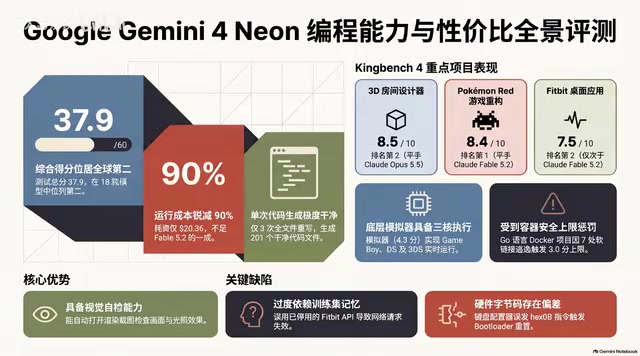
Gemini 4 Neon Hands-On: Value King or Confident Catastrophe?
Gemini 4 Neon review: 1M-token context, four thinking levels, 201 files in one KingBench4 pass at one-tenth Fable 5.2's cost—but it hallucinates fake data, leaves 7 symlink escapes, and bricks keyboards.

Google Gemini 4 Neon Hands-On: 6 3D Works That Impress and Fail
Hands-on with Google Gemini 4 Neon on a 3060 laptop: 6 3D works tested. Sunshower Fishing Harbor and mechanical keyboard impress; soft-body physics and faces fall short.
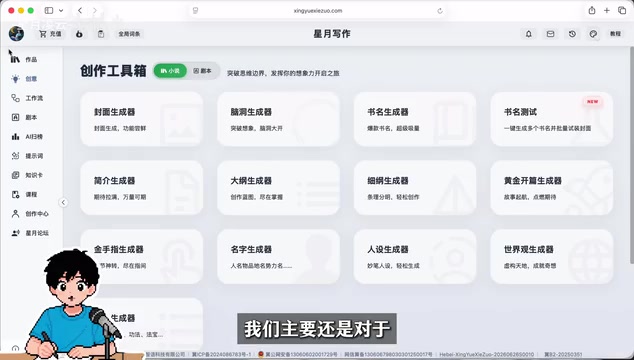
Gemini 4 Neo Web Novel Writing Test: Faint AI Flavor, Textured Dialogue
Bilibili creator's first-look review of Gemini 4 Neo for Chinese web novel writing: testing a Three Kingdoms transmigration opening with faint AI flavor, emotionally textured dialogue, and strong crisis building, plus comparison of 4A/4H/4C models and full workflow demos.