From Chain to Graph: Why LangGraph Is Essential for AI Application Development
Why AI application development is shifting from Chain to Graph — and why LangGraph leads that evolution.
This article systematically explains the paradigm shift in AI application development from Chain to Graph. While Chain dominated early development with its linear simplicity and mature ecosystem, it exposes four fundamental limits in complex Agent scenarios: no backtracking, no native state management, no dynamic branching, and no structured memory. Graph structure overcomes all four through nodes, edges, and shared state, while LangGraph operationalizes this as a production-ready engineering foundation — earning its reputation as the "operating system for Agents."
The Paradigm Shift in AI Development: From Chain to Graph
The development paradigm for AI applications is gradually shifting from traditional chain structures (Chain) to graph structures (Graph). This isn't a concept invented out of thin air — it's an evolution driven step by step by the demands of complex real-world scenarios. In the first chapter of a LangGraph tutorial series, the core argument is this: the move from Chain to Graph is an inevitable direction in AI technology development, and LangGraph is currently the best engineering vehicle for that evolution.
To understand why this shift is inevitable, we need to start with the most familiar concept — Chain. It had its golden era, but when we actually start building complex Agent applications, the ceiling of chain-based architecture becomes visible at an alarming pace.
Chain's Golden Era and Its Capability Limits
In the early days of AI application development, almost everyone used the Chain pattern. Its rapid adoption came down to three core advantages.
First, it's a purely linear pipeline — simple and intuitive. Like following a recipe step by step, you string together a Prompt, a model, and a parser, and the entire execution path is clear with almost no learning curve. Second, the component ecosystem is mature. Between official releases and community contributions, there are ready-made components for tool calls, model integration, and result parsing — you just grab what you need and combine them. Third, it's ideal for rapid prototyping. With simple syntax and high-level abstractions, you can turn an idea into a working demo in five minutes. The time from inspiration to prototype is extremely short, and the cost of experimentation is very low.
The problem isn't that Chain is bad — it's that its capability boundary is very well-defined. Once you step into complex Agent applications, four fundamental limitations become unavoidable:
- No way to backtrack: Execution is unidirectional. Once a step is complete, it moves on. If something goes wrong midway, there's no going back. Errors propagate forward and pollute all subsequent reasoning, with zero capacity for self-correction.
- No native state management: Execution can only pass the output of one step to the next. Complex context and intermediate variables must be stored and passed manually — one misstep and data is lost.
- No dynamic branching: Execution can only proceed linearly. It can't dynamically choose a path based on intermediate results — like a road with only one straight lane where you can't turn even if there's a blockage ahead.
- No structured memory mechanism: In multi-turn conversations, history must be manually stitched into the Prompt. Maintaining state consistency is difficult, and contradictions between turns are common.
These are problems that the chain design simply cannot solve by nature — no amount of patching can break through them. This naturally gave rise to the graph structure as a new solution.
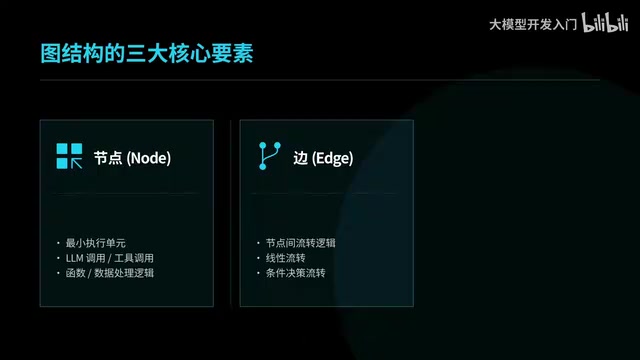
The Three Core Elements of Graph Structure
To understand graph structures, you need to grasp three fundamental building blocks.
Node is the smallest unit of execution in a graph — think of it as a functional station. Calling a large language model once is a node. Calling a tool is a node. Writing a function to process data can also be a node. Each node is responsible for one specific task.
Edge is the transition logic between nodes — like the connecting routes between stations. It can be a simple direct link from A to B, or it can carry decision logic, choosing which path to take based on the current situation.
State is the most critical element of the entire graph structure. Think of it as a shared public notebook for the whole graph. Every node can write to it and read from it. Context, intermediate results, and conversation history are all stored here and synchronized across the entire execution.
In one sentence, the core logic of graph structure is: replace chains with graphs, let nodes carry specific functions, let edges define execution paths, and let state accumulate all information — building an intelligent execution framework that is both flexible and capable of backtracking.
Graph structure is not an original invention of the AI field — it's borrowed from the theory of directed graphs in computer science. In mathematics and computer science, a graph consists of vertices and edges; a directed graph requires each edge to have a clear direction. LangGraph brings this classical data structure into AI workflows, drawing on both Directed Acyclic Graph (DAG) design and, more importantly, Directed Cyclic Graph (DCG) design — the latter allows for cyclic paths, which is the technical foundation for iterative Agent behaviors like "execute → reflect → retry." Unlike DAGs in traditional workflow engines (such as Apache Airflow), LangGraph allows cycles in the graph, enabling an Agent to repeatedly execute a segment of logic until a condition is met, without restarting the entire process each time. This cyclic graph structure is a fundamental prerequisite for advanced Agent capabilities like self-correction and multi-turn reasoning.
A Four-Dimensional Comparison: Graph vs. Chain
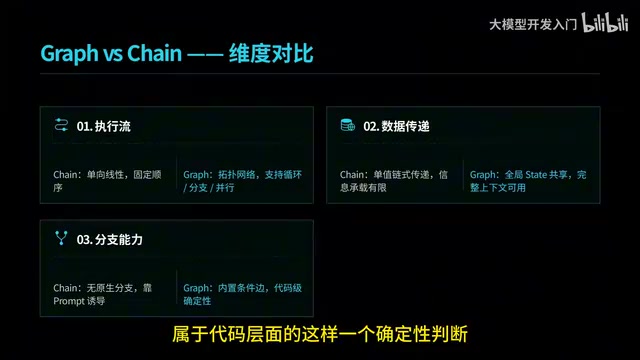
A direct comparison across four dimensions makes the differences immediately clear.
Execution flow: Chain is unidirectional and linear — the order is completely fixed, like a one-way street. Graph is a topological network structure that supports loops, branches, and parallel execution — like a full city road network where you can route however you like.
Data passing: Chain uses single-value sequential passing — each step only passes its output to the next, carrying limited information. Graph uses a globally shared State — any node can access the full information at any time.
Branching capability: Chain has no native branching. Any conditional logic must be embedded in a Prompt and rely on the model to choose, which is highly unreliable. Graph has built-in conditional edges — deterministic logic at the code level where the chosen path is always clear.
Fault tolerance: Chain has essentially no fault tolerance — one bad step collapses everything downstream, with no retry capability. Graph supports retries, fallback logic, and even checkpoint-based resumption, so a failure mid-run doesn't require starting over from scratch.
LangGraph's Three Core Value Propositions
As a framework built on top of graph structure, LangGraph delivers three practical values.
Deterministic process orchestration: With Chain, complex logic often gets stuffed into Prompts — it becomes a black box, and you have no idea why a particular path was chosen. LangGraph transforms decision logic from a black-box Prompt into white-box code. The entire workflow is visualizable, testable, and traceable. Logic is predictable, debuggable, and monitorable — far more reliable than Chain.
State-driven design philosophy: LangGraph provides a unified State abstraction. Whether for multi-turn conversations, tool calls, or memory management, everything is stored using the same standard data carrier, dramatically reducing the development cost of complex interactions.
Production-ready engineering foundation: Built-in support for checkpoint resumption, human-in-the-loop intervention, and streaming output — all capabilities required in production environments. No need to build from scratch; it's ready to use in production-grade settings.
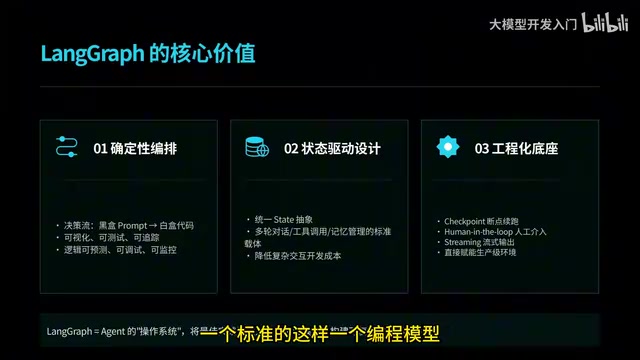
This is exactly why the industry often says LangGraph is like an operating system for Agents — it crystallizes industry best practices into a standardized programming model, helping build a reusable AI development ecosystem.
The comparison of LangGraph to an "Agent operating system" has a specific meaning. Traditional operating systems provide foundational capabilities to applications — process scheduling, memory management, I/O abstraction — so developers don't have to worry about hardware details. LangGraph plays a similar role for Agents: it standardizes general-purpose capabilities including state persistence, node scheduling, tool call routing, and Human-in-the-Loop intervention. The Human-in-the-Loop capability is particularly critical — before high-risk operations (such as sending emails, executing code, or calling paid APIs), LangGraph can pause execution at a specific node and wait for human confirmation before proceeding. This is an important safety mechanism for controlling the boundaries of autonomous AI behavior in production environments, and it's a capability that pure Chain-based approaches struggle to implement gracefully.
Three Core Takeaways
First, Chain is well-suited for simple, linear pipeline scenarios — highly efficient for straightforward tasks — but it falls short in complex Agent scenarios. Its limitations are baked into the underlying design and cannot be patched away.
Second, graph structure is naturally suited for solving complex decision problems. Built on the core model of nodes, edges, and state, it supports loops and backtracking, offering strong expressive power that can adapt to a wide variety of complex business scenarios.
Third, LangGraph is the standardized engineering foundation for AI applications. It encapsulates industry best practices, provides a standardized programming model, and delivers comprehensive engineering support for complex AI systems.
The next chapter of the tutorial will break down LangGraph's core concepts one by one: State as the central data carrier, Node as the basic unit of execution, Edge for defining data flow direction, and Conditional Edge for dynamically selecting paths based on state. These four components form the complete foundation of graph-based computation and are the key to actually deploying multi-agent architectures in production.
Related articles
Automattic Executives Signed Reciprocal Severance Agreements During Mullenweg's Brief Ouster
Automattic's CFO and General Counsel signed reciprocal severance agreements during Matt Mullenweg's brief ouster, covering one year's salary and accelerated equity vesting, raising corporate governance concerns.
H3 Singularity Optimization: 40% Speed Boost With Better Image Quality
A Reddit user's Minimax Singularity workflow tip: insert an RTX upsampler before H3 Latent for 40%+ speed gains and better quality. Covers parameters, 12-bit output, and more.
Glyph: A Multi-Strategy Agent System for Automated Enterprise Data Catalog Annotation
Glyph is a multi-strategy LLM agent system for enterprise data catalogs that automates column description generation and sensitivity ontology tagging, grounding outputs in pipeline source code to improve accuracy.