From Copilot to Auto Bug Fixing: The Evolution of AI Coding Tools and the Reshaping of the Developer's Role

AI coding tools evolve from code completion to autonomous whole-codebase repair, shifting developers toward review and building.
Using a short video as a thread, the article outlines three stages of AI coding tools: 2022 GitHub Copilot's real-time completion, 2023 Cursor's Agent forming a suggestion-edit-test loop, and 2025 Claude Code's whole-codebase bug tracing. It advocates letting AI handle repetitive fixing while developers focus on architecture and product judgment, and reminds readers that human approval remains essential—the more proactive the tools, the more critical human judgment becomes.
Every developer has been through this moment: you finish writing the code, run it, and it crashes—that one bug devours your entire afternoon. This short YouTube video sketches, in under 60 seconds, the evolutionary path of AI coding tools over the past few years—from GitHub Copilot's code completion, to Cursor's Agent automatically planning and making changes, to Claude Code's retrieval and repair across the entire codebase. Behind this evolutionary line lies a fundamental change in how developers work.
Three-Stage Evolution: From Completion to Autonomous Repair
GitHub Copilot: The Starting Point of Code Completion
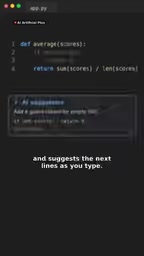
The video marks 2022 as the turning point. GitHub Copilot's contribution lies in reading the current code context in real time and suggesting the next few lines as you type. It solves the efficiency problem of "writing"—you no longer need to type boilerplate code character by character, and completion suggestions greatly accelerate the coding rhythm.
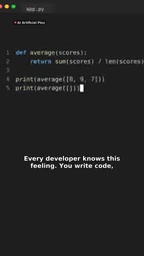
But Copilot's limitations are equally obvious: it doesn't truly understand why a bug occurs. Suggested code may introduce new errors, and the process of locating problems still depends on the developer. Completion solves input speed, not debugging cost.
Code completion is based on the in-context learning capability of large language models: having seen massive amounts of public code during training, the model can predict the most likely next token sequence based on the variable names, function signatures, and comments in the current file. GitHub Copilot relies on the OpenAI Codex model, issuing real-time inference requests at the cursor position through an IDE plugin and presenting candidate completions as gray "ghost text" that you accept by pressing Tab. This mode is essentially single-point, local generation—the model only sees the context window around the current buffer, doesn't grasp the project-level dependency graph, and can't execute code or observe runtime results. So it excels at boilerplate, common API calls, and repetitive patterns, but it can't verify whether a suggestion is correct, let alone locate defects that only surface at runtime. Understanding this architectural limitation is what makes it clear why "completion" and "bug fixing" are two different levels of problems.
Cursor: The Agent Starts Taking Action
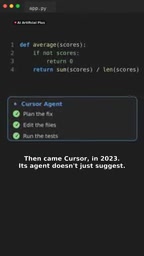
The video mentions that Cursor, which emerged in 2023, brought a qualitative change. Its Agent no longer stays at the "suggestion" level but formulates a repair plan, directly edits files, and runs tests to verify results. This means AI shifts from a passive input aid to a collaborator capable of proactively executing multi-step operations.
The key to this shift is the "closed loop": suggestion, modification, and verification are chained together. What developers review is no longer line-by-line code suggestions but a complete repair action and its test results. The focus of work partially shifts from "writing code" to "reviewing code."
The difference between an AI Agent and a pure code generation model is that it has tool-calling and multi-step execution capabilities. An Agent is typically driven by a planning loop: the model first decomposes the task and generates an action plan, then sequentially calls external tools such as file read/write, terminal commands, and test runners, observes the return results of each step, and decides the next action until the task is complete or a termination condition is reached. Cursor's Agent mode embeds exactly this loop into the editor: it can edit across files, execute shell commands, read test output, and self-correct based on failure information. This also introduces a new risk surface—every step of the Agent's operation may modify the real codebase, so tools usually set up permission confirmations, diff previews, and version control rollback as safety nets. The upper limit of an Agent's capability largely depends on the feedback signals it can obtain; the more comprehensive the test suite, the more reliable the closed loop.
Claude Code: Positioning Capability for the Entire Codebase
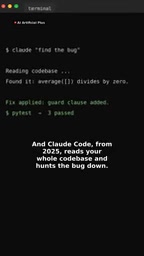
The video points out that Claude Code in 2025 further expands the capability boundary—it reads the entire codebase and proactively traces bugs to their root. Usage is simplified to: you describe the problem, the AI finds the fix, you approve, and the problem disappears.
Whole-codebase retrieval is the core difference at this stage. Real bugs often span multiple files and involve non-obvious dependencies. Tools that can traverse the context of the entire project have a structural advantage in locating such problems.
"Whole-codebase retrieval" relies on code indexing and context retrieval techniques, rather than stuffing the entire project into the model's context window at once. The actual approach usually includes: syntactically or semantically chunking the repository (e.g., by function, class, or file), building a vector index or symbol index, then retrieving the most relevant fragments based on the user's problem description and feeding them to the model; at the same time, gradually narrowing the scope using deterministic tools such as grep, file tree traversal, and dependency analysis. This approach enables the tool to handle "distributed" bugs such as cross-file call chains and inconsistencies between configuration and implementation. Its effectiveness is limited by retrieval quality—if the key code isn't recalled, the model can't judge no matter how powerful it is. This also explains why performance on large legacy projects is often less stable than on well-structured, well-documented new projects.
What Is Changing in the Developer's Role
The video's core claim is "stop fixing bugs, start building." It sounds like a slogan, but it points to a specific division of labor: AI takes on the repetitive labor of locating and fixing, while developers direct their attention toward architecture design, feature innovation, and product judgment.
The premise of this division is that developers retain the "approval" step. The workflow in the video explicitly includes a human review step: AI proposes the fix, and the human makes the final decision. This design preserves control, but it also means that code review skills become more critical—as AI-generated modifications increase, the responsibility for judging whether a fix is correct falls entirely on the developer.
The Distance Between Reality and Narrative
It should be noted that this is a short video of under a minute; it presents a directional narrative of tool evolution, not a comprehensive capability assessment. The video doesn't address the accuracy of AI fixes, the applicability to complex legacy projects, or the debugging costs brought by incorrect fixes. These gaps don't negate the evolutionary trend itself, but they remind readers: the video describes an "ideal usage scenario," and actual results depend on project complexity, test coverage, and team standards.
From completion to Agent repair, the direction of this evolutionary line is clear—AI is taking on more and more of the mechanical work that originally belonged to developers. But the more proactive the tools, the more important human judgment becomes. The premise of stopping bug fixing is that you are capable of judging whether the AI fixed it correctly.
One-line Summary
AI coding tools have evolved from code completion to autonomous whole-codebase repair, with the developer's role shifting toward review and building.
Paragraph Summary
Using a short video of under 60 seconds as a thread, the article outlines the three-stage evolution of AI coding tools: in 2022, GitHub Copilot achieved real-time code completion, solving the efficiency problem of "writing" but not understanding the causes of bugs; in 2023, Cursor's Agent could formulate plans, edit files, and run tests, forming a suggestion—modification—verification loop, shifting the developer's focus from writing code to reviewing code; in 2025, Claude Code can read the entire codebase and trace cross-file bug roots. The video advocates "stop fixing bugs, start building," letting AI handle repetitive locating and fixing while developers focus on architecture and product judgment. The article also notes that this narrative retains a human approval step, and that the short video doesn't address practical issues such as accuracy and applicability to legacy projects—the more proactive the tools, the more critical human judgment becomes.
Related articles

A 19-Year-Old's Rental Horror Story: Ceiling Collapse, Bug Infestation, and the Lessons It Taught Me
At 19, my first off-campus rental brought bug infestations, no heat, a collapsed ceiling, and a ruined laptop with no renter's insurance. Here are the hard-won lessons for first-time student renters.

Veda Nurse's Cranial Nerve Exam: Why ASMR Role-Play Is Going Viral
Bilibili creator Veda's cranial nerve exam ASMR video goes viral, blending humor and sensory triggers through nurse role-play. This article analyzes its unique appeal and the audience psychology behind ASMR role-play.

LG Cinebeam AI Review: 120-Inch Giant Screen + 3000 Lumens, a New Choice for the Living Room Theater
LG Cinebeam AI projector review: 3000 ANSI lumens, 4K, 100 inches from about 8 cm and 120 inches from about 18 cm. Built-in webOS, AI Concierge voice recommendations, AI Sound Pro 11.1.2 virtual surround, and Game Optimizer—positioned for fixed living room installation, complementing the portable Cinebeam S.