From Demo to Production: A Complete Guide to Engineering Enterprise AI Agents

A practical guide to bridging the engineering gap between demo-ready and production-grade AI Agents.
This guide addresses why AI Agents that work in demos often fail in production, and presents a five-pillar engineering methodology—task decomposition, tool management, state persistence, error recovery, and result validation—along with end-to-end observability, to help enterprise teams build reliable, maintainable, and deliverable Agent systems.
Why a Demo-Ready Agent Isn't Production-Ready
In the wave of AI Agent development, an uncomfortable reality is dawning on more and more engineering teams: an Agent that runs smoothly in a demo environment is separated from stable delivery in an enterprise production environment by an entire, often overlooked, engineering gap.
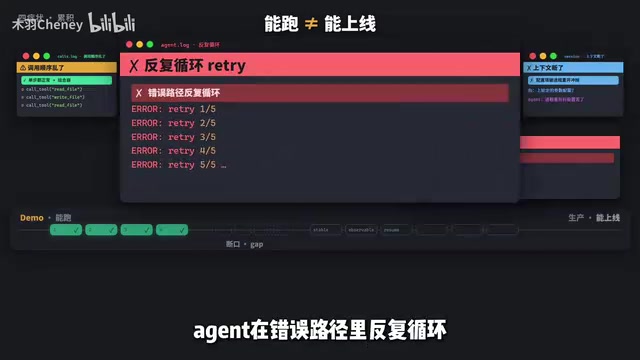
This Bilibili public course on enterprise Agent engineering tackles exactly this pain point. The core message hits home: everything looks fine when testing individual tasks, but the moment you plug into real business scenarios, problems erupt all at once. As tools multiply, call sequences become chaotic. As task chains grow longer, context breaks. As workflows get more complex, the Agent can end up looping endlessly down the wrong path, stuck in a deadlock.
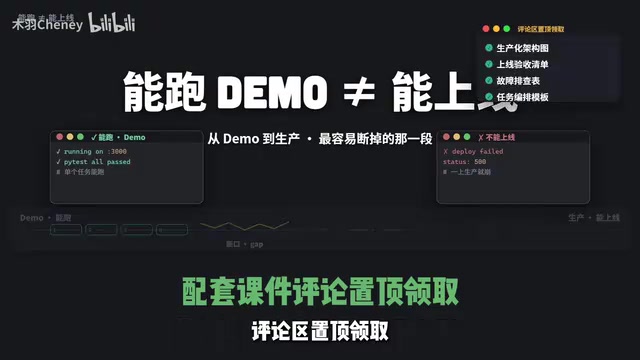
Even more frustrating is the lack of observability. Observability is a concept originating from control theory, referring to the ability to infer a system's internal state from its external outputs. In traditional software engineering, observability is typically built on three pillars: Logs, Metrics, and distributed Traces. But for AI Agent systems, the observability challenge far exceeds that of traditional microservices — because an Agent's decision-making path is non-deterministic, meaning the same input can produce entirely different tool call chains and reasoning processes. This means traditional APM (Application Performance Monitoring) tools often fall short. Teams need specialized LLM call chain tracing solutions like LangSmith or Phoenix to record the input/output of every Prompt, Token consumption, model confidence scores, and the full context of tool invocations.
When results go off track, teams often can't pinpoint which step caused the deviation. The demo runs like a dream, but once deployed in production — there's no stability, no observability, and no ability to sustain continuous operation. This isn't a model capability problem; it's a missing engineering architecture problem.
The Core of Production Readiness: Building a Complete Pipeline, Not Swapping Models
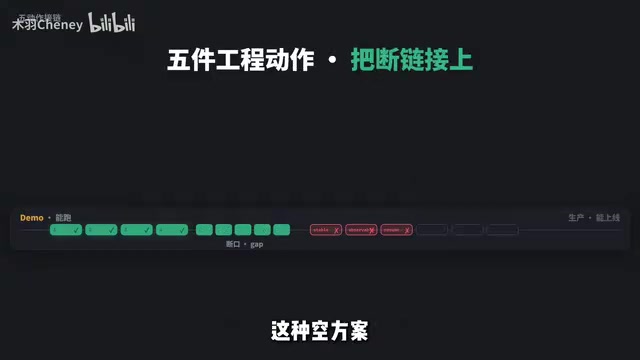
Facing the chaos of Agents going haywire upon launch, many teams' first instinct is to "switch to a more powerful model." But this course makes it clear: that's a non-solution. The real answer lies in building a complete production pipeline for enterprise Agents.
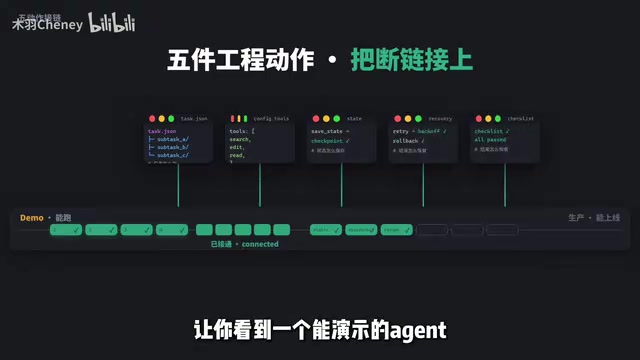
Task Decomposition: Breaking Big Goals into Controllable Subtasks
The first lesson for production-grade Agents is task decomposition. Real business scenarios often involve complex, long-chain tasks. Dumping a massive goal directly onto an Agent almost inevitably leads to context fragmentation and path drift.
The right approach is to break tasks into controllable subtask units, each with clear inputs, outputs, and acceptance criteria. This reduces the blast radius of single-step failures and makes the overall workflow trackable and debuggable. The Agent task orchestration space has already developed a multi-layered technology ecosystem: LangGraph provides state-graph-based Agent orchestration with support for conditional branching, loops, and human-in-the-loop nodes; CrewAI and AutoGen focus on multi-Agent collaborative orchestration; while Microsoft's Semantic Kernel and AWS's Bedrock Agents offer more enterprise-grade integration solutions. The shared design philosophy across these frameworks is to transform Agent execution from "free reasoning" to "controlled orchestration" — preserving model flexibility while constraining execution paths through predefined state machines or DAGs (Directed Acyclic Graphs), striking a balance between determinism and flexibility.
Tool Management: The Core Mechanism for Solving Call Chaos
As the number of tools an Agent connects to grows, tool registration, selection, and call sequencing become critical variables for stability. The course highlights "tools multiply, call sequences go haywire" as a classic failure mode.
Function Calling is the primary way to extend Agent capabilities. Mechanisms like OpenAI's Function Calling and Anthropic's Tool Use enable models to invoke external APIs and tools in a structured manner. But in production environments, tool proliferation creates a combinatorial explosion problem: when available tools exceed 20-30, the model's tool selection accuracy drops significantly, and hallucinated calls can occur — invoking nonexistent tools or passing incorrect parameters. Industry approaches include dynamic tool routing (exposing only relevant tool subsets based on current task context), tool description optimization (precise Schema definitions and examples), and introducing an Orchestration Layer to constrain call sequences rather than relying entirely on the model's autonomous decisions.
A production environment requires a well-defined tool management mechanism, including:
- Clear permission boundaries for tools
- Call priority settings
- Arbitration logic for tool conflicts
State Persistence: The Lifeline for Long-Running Task Context
Context management for long-running tasks is the most underestimated aspect of Agent engineering. Short conversations in the demo phase never expose context fragmentation issues, but once intermediate state is lost in a production long-running workflow, the entire task collapses.
The root cause of context fragmentation lies in the Context Window limitations of large language models. Even though mainstream models have expanded context windows to 128K tokens or longer, in production long-running tasks, accumulated conversation history, intermediate results, and tool call records can quickly exceed window capacity. More critically, as context grows longer, the model's attention to middle information drops significantly — this is the well-documented "Lost in the Middle" phenomenon. Therefore, production-grade Agent systems typically need external state storage mechanisms, such as session state management via Redis or databases, long-term memory retrieval through vector databases, and Checkpoint mechanisms to support resuming tasks from breakpoints after interruptions.
How to persistently save task state and how to resume execution after interruptions — these are essential milestones on the road from Demo to production.
Error Recovery and Result Validation: Production Lifelines
Error Recovery: Planning Ahead for Inevitable Failures
The defining characteristic of production environments is that "things will go wrong." The difference is that mature systems can gracefully degrade and auto-recover, while Demo-level Agents simply crash or fall into infinite loops.
In distributed systems engineering, error recovery is a well-established discipline. Netflix's Hystrix circuit breaker pattern and Exponential Backoff retry strategies are classic practices. But AI Agent error recovery faces unique challenges: errors include not only deterministic failures like network timeouts and API rate limiting, but also "soft errors" where the model produces substandard output. Soft errors can't be detected via HTTP status codes and require Output Validators. Additionally, Agent loop execution is a typical risk — when an Agent repeatedly attempts a subtask but can never satisfy the conditions, without a maximum iteration limit and deadlock detection mechanism, the system will spin into an infinite loop and rapidly burn through the Token budget.
Building an error recovery mechanism means doing three things well:
- Pre-define failure paths: Define possible failure scenarios for every step in advance
- Design retry strategies: Create differentiated retry plans for different error types — deterministic failures can be retried immediately, while soft errors may require Prompt adjustment or switching to a fallback model
- Timely interruption and rollback: Automatically detect when an Agent enters an error loop and roll back to a safe state, while preserving complete logs of the fault scene for subsequent analysis
Result Validation: The Foundation of Observability
The final piece is result validation. An Agent system capable of continuous delivery must have clear acceptance criteria to determine whether each step's output meets expectations.
This isn't just quality assurance — it's the foundation of observability. Only when every step is verifiable can you quickly pinpoint "which step led the result astray" when problems arise. In practice, result validation typically operates at multiple levels: format validation (does the output conform to the expected data structure), semantic validation (is the content consistent with the task objective), and business rule validation (does the output satisfy business constraints). Some teams also adopt an "LLM-as-Judge" approach, using another model to evaluate Agent output quality, forming an automated quality feedback loop.
Practical Value for Teams at Different Stages
The value of this Agent engineering methodology is that it serves two types of teams at different stages:
- Teams just starting with Agents: Can proactively avoid the classic trap of "hitting a wall right after the demo works," establishing production-mindset thinking from the initial architecture design rather than scrambling right before launch. The key is to introduce the skeleton of state management and observability from the very first version — even a crude initial implementation costs far less than a later-stage refactor.
- Teams already working on enterprise projects: Can obtain a set of production-readiness assessment criteria and implementation paths to systematically strengthen existing projects. A common prioritization for retrofitting is: first add observability (know where problems occur), then add error recovery (self-heal when problems occur), and finally optimize task orchestration (improve overall stability and efficiency).
According to the course, four supporting practical documents have been compiled: a production architecture diagram, a go-live acceptance checklist, a troubleshooting table, and a task orchestration template — all ready for teams to apply directly to their own projects.
Conclusion: Engineering Is the True Differentiator for Agents
Model capability is no longer the primary bottleneck for Agent technology. What truly separates the leaders from the rest is engineering execution. Whether an Agent can move from a demo environment to production depends on whether it has a complete pipeline built from task decomposition, tool management, state persistence, error recovery, and result validation — with end-to-end observability woven throughout.
This bears a striking resemblance to the history of software engineering — twenty years ago, web applications went through the same evolution from "just make it work" to systematic DevOps and SRE practices. Today's AI Agents stand at the same crossroads. Teams that complete their engineering foundation first will gain a true competitive moat — not because their models are more powerful, but because their systems can run reliably in the real world.
For any team serious about deploying Agents into real business operations, "switching to a more powerful model" can never replace solid engineering. Stable operation, observability, debuggability, and deliverability — these are the real thresholds for enterprise-grade Agents.
Related articles
OpenCodex and CodexBar: Solving Two Key Pain Points — Model Switching and Quota Tracking in Codex
Discover OpenCodex and CodexBar — two tools that solve Codex's model switching and quota tracking pain points, enabling tool-model decoupling and centralized quota visibility.
How Ramp Rebuilt Its GTM Orchestration System with AI Agents: From Intent to Automated Execution
Deep dive into how Ramp built an AI-driven GTM orchestration system from scratch — covering unified CDP, unstructured data, skill libraries, and MCP tooling for intent-to-execution automation.
Kilo Code Lands on JetBrains: A Deep Dive into the Open-Source AI Coding Agent
Kilo Code for JetBrains is a fully native, open-source AI coding Agent supporting IntelliJ IDEA, PyCharm and more, featuring parallel Agents, 500+ models, and inline GitHub PRs.