From Demo to Production: Curing LLM Pipeline Drift with DSPy and MLflow

DSPy modularizes prompt engineering while MLflow tracks versions, together eliminating silent LLM pipeline drift in production.
This article covers a hands-on workshop addressing why prompt chains that work in development frequently degrade silently in production. It focuses on two tools used together: DSPy, which replaces handwritten prompts with declarative signatures and modules and supports data-driven systematic optimization, and MLflow, which handles experiment tracking and version management to ensure every iteration is reproducible and comparable. The key methodological shift is building task-specific evaluation datasets to quantify degradation as measurable metric drops rather than vague intuition. The article also clarifies that DSPy is not a LangChain replacement but a reliability layer beneath your existing prompt logic.
Why Your Prompt Chain Breaks in Production
Putting together a working demo by chaining a few prompts can take just a few hours. But when the input data distribution shifts, or a product manager asks "why did changing one tiny prompt break the output?" — that's a completely different engineering challenge.
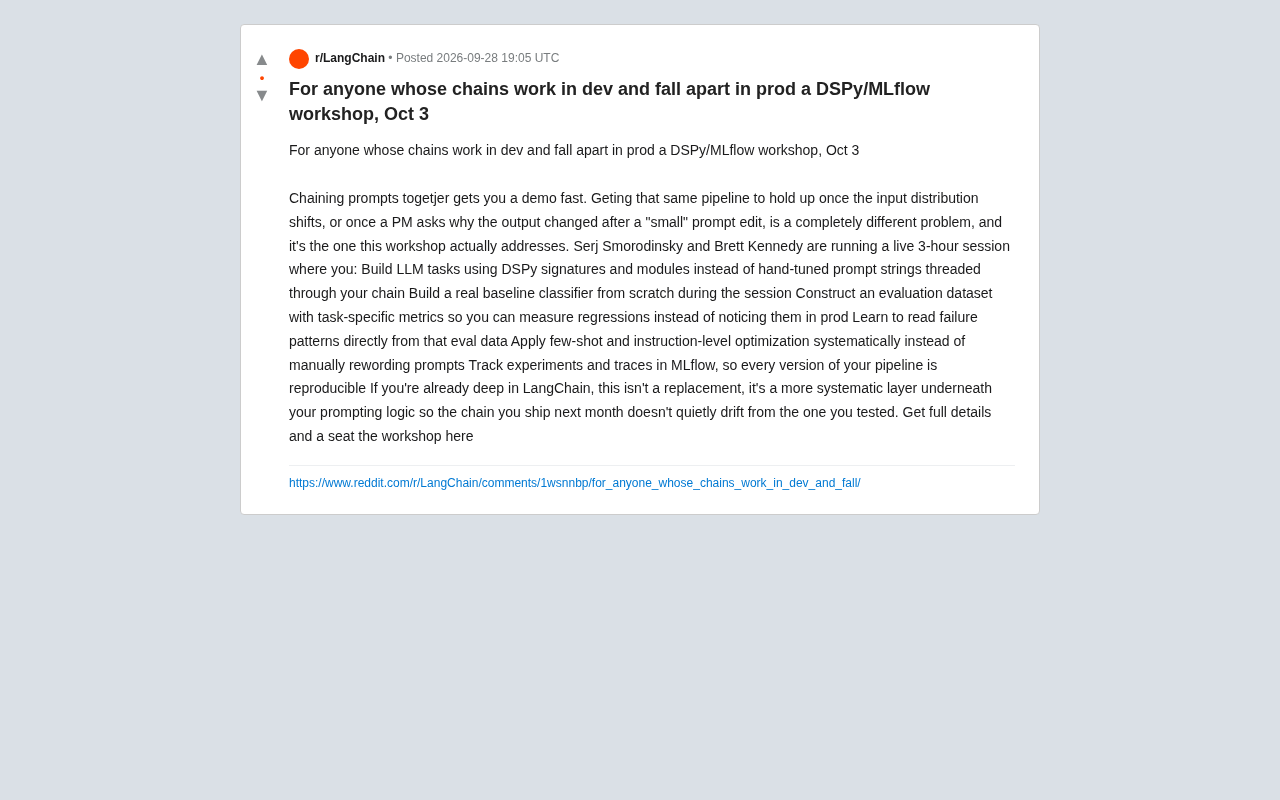
Hand-tuned prompt strings often work fine in development, but once deployed to real-world scenarios, they tend to suffer subtle, hard-to-detect performance degradation. This "works in dev, falls apart in prod" dilemma is a recurring pain point for many LLM application teams. A recent hands-on workshop on DSPy and MLflow, presented by Serj Smorodinsky and Brett Kennedy, took direct aim at this problem.
DSPy: Turning Prompt Engineering into Programmable Modules
Traditional prompt chains have a fundamental flaw — they rely on handwritten prompt strings that are threaded throughout the pipeline. These strings are brittle and hard to maintain; even a minor change in one place can trigger a cascade of downstream effects, with no systematic way to measure the impact.
DSPy proposes a different paradigm. Instead of having developers manually stitch together prompts, it uses signatures and modules to define LLM tasks. This means you describe the structure and intent of inputs and outputs, not the specific wording. The framework then compiles these declarative definitions into actual prompts, elevating prompt engineering from "mystical word-tweaking" to "programmable software engineering."
In the workshop, participants build a real baseline classifier from scratch, experiencing firsthand how to construct LLM tasks using DSPy's modular approach rather than hardcoding prompts into a chain. The key value here is that when requirements change, you adjust a structured definition — and the underlying optimization is handled systematically by the framework.
A Signature in DSPy is a declarative interface, expressed as something like question -> answer or context, question -> rationale, answer. Developers simply declare the names and types of input/output fields (with optional natural language descriptions), and the framework automatically compiles these into prompts tailored to the specific LLM at runtime. A Module works similarly to PyTorch's nn.Module — it's a nestable, composable unit of reasoning. Built-in options like dspy.Predict, dspy.ChainOfThought, and dspy.ReAct are predefined modules, and developers can combine multiple modules into more complex pipelines. This design allows the same business logic to seamlessly switch between underlying models (say, from GPT-4 to Claude) without rewriting any prompts, since prompt generation logic is managed uniformly by the framework.
Using Evaluation Datasets to Make "Degradation" Measurable
The most dangerous thing in production isn't the error itself — it's not knowing the error has occurred. Many teams only "notice" model output degradation once it's already happening in production, by which point it's often too late.
One of the workshop's core components is building an evaluation dataset with task-specific metrics. With such a dataset, regression issues shift from "reactively discovered in production after the fact" to "proactively measured ahead of time." You can read failure patterns directly from the evaluation data, understanding exactly which types of inputs the model struggles with — rather than relying on guesswork and case-by-case debugging.
The critical methodological shift here is turning the vague sense that "things feel worse" into a concrete metric drop. Only when you can measure degradation can you actually control it.
Systematic Optimization: Moving Beyond Manual Prompt Tweaking
Manually rewriting prompts is a daily reality for most teams — but this approach is neither reproducible nor scalable. DSPy supports systematic optimization at both the few-shot example and instruction levels. Rather than relying on engineers to iteratively tweak phrasing through trial and error, the framework automatically searches for better prompt configurations based on evaluation data.
The significance of this kind of optimization lies in being data-driven and repeatable. Under the same evaluation criteria, the optimization process can be logged, compared, and reproduced — something that's nearly impossible with manual prompt tuning.
DSPy's optimizers (formerly called Teleprompters) are the core mechanism behind systematic optimization. The commonly used BootstrapFewShot automatically selects high-quality input-output examples from training data to dynamically build a few-shot example pool. MIPRO (Multi-prompt Instruction PRoposal Optimizer) goes further, generating candidate prompt variants at the instruction level and finding the optimal combination through Bayesian search. The entire optimization process uses developer-defined evaluation metrics as the feedback signal — similar to hyperparameter search in machine learning, except the search space consists of prompt phrasing and example selection rather than model weights. This means the optimization results are fully transparent and auditable: you can inspect exactly which examples the framework selected and what instructions were generated, rather than facing an unexplainable black-box output.
MLflow: Making Every Version Reproducible
The other half of engineering reliability comes from experiment tracking. The workshop uses MLflow to log experiments and track traces, ensuring every version of the pipeline is reproducible.
This addresses a very real collaboration challenge: when a PM asks "what exactly changed and what was the impact?", you can produce clear version records and metric comparisons rather than vague answers. When every iteration is documented, the team can maintain a firm understanding of system behavior even as it continuously evolves.
MLflow's tracing capabilities in LLM pipelines go well beyond traditional ML experiment logging. Its Tracing feature automatically captures the full context of every LLM call — including the actual prompt text sent to the model, the raw response returned, token usage, and latency. When used with DSPy, MLflow records the inputs and outputs of each module in a complete inference chain as a nested span tree, making it easy to pinpoint which intermediate node produced an erroneous output. On the version management side, MLflow's Model Registry can archive specific DSPy program snapshots (including optimized prompt configurations) alongside their corresponding evaluation metrics. This gives teams a reliable basis for rolling back or comparing different optimization strategies, putting an end to the chaotic situation of "not knowing which version was actually deployed."
It's Not a LangChain Replacement
The presenters were careful to clarify one positioning point: if you're already deeply invested in LangChain, DSPy is not a replacement — it's a more systematic layer that sits beneath your prompt logic.
In other words, LangChain handles orchestration and chaining, while DSPy fills in the foundational guarantee of "keeping those chains from silently drifting." The chain you deploy next month should behave consistently with the version that passed your tests today — that's precisely the kind of determinism that the DSPy + MLflow combination aims to deliver.
For any team that has been burned by "works fine in dev, breaks in prod," this complete methodology — spanning declarative modeling, quantified evaluation, systematic optimization, and version tracking — is well worth a serious look.
Related articles

Gaussian Process Bandit Optimization: Exploration Strategies and Inference Regret Guarantees
Cumulative regret guarantees in Bayesian optimization fail to reflect final recommendation quality. This article examines a new study that provides inference regret guarantees for Gaussian process bandit optimization through exploration query strategies and fill distance analysis, validated on hyperparameter optimization and control tasks.

The Most Detailed Codex Guide on Bilibili: From Installation to Real-World Practice
The most detailed Codex guide on Bilibili: from app store installation to daily work mode configuration, with a real coffee shop project demonstrating file organization, data extraction, dashboard creation, and other practical tasks. Learn to use Plan Mode and desktop pets to leverage Codex efficiently.

Appearance Compensation in Volume Rendering: Why RGB Accuracy Cannot Guarantee Density Correctness
Volume rendering research reveals that volumetric data perfectly reproducing external RGB views may still contain density errors: appearance compensation can double central density and keep external rays unchanged even when L2 error exceeds 14.52%. Density recovery depends on appearance capacity, spatial resolution, and measurement design.