From Frontend Engineer to AI Agent Developer: A Complete High-Paying Skill Tree Breakdown

A complete skill-tree roadmap for frontend engineers transitioning to high-paying AI Agent development.
As pure frontend jobs shrink, AI Agent development has become the salary divide. This article maps a clear transition path for frontend engineers: solid TypeScript, framework, and engineering fundamentals as the base, plus AI team productivity and Agent core concepts (MCP, Tool Calling, Context Engineering) as the salary-defining ceiling.
Why Frontend Engineers Must Pivot to AI Agent Development
Pure frontend roles are rapidly shrinking—and this is not fearmongering. When more and more job descriptions include requirements like "AI combined with frontend," "agent development experience," and "leveraging AI tools for productivity," it signals a fundamental shift in market direction.
For frontend engineers with three to five years of experience, this shift is especially noticeable. When they first entered the field, the market was decent; now they find that pure frontend opportunities are dwindling and salary ceilings are getting lower. Instead of joking about "getting laid off and becoming a delivery driver," it's better to seriously map out a viable path forward.
According to one frontend advancement instructor on Bilibili, if your goal is to land a "frontend combined with AI" position paying 30K–50K within three months, the key is not blindly cramming interview trivia, but rather how you invest in your skill tree—what to learn at each stage, what to prioritize, and how to avoid pitfalls. These are the core questions.

The Complete Profile of a High-Paying Candidate
The instructor offered a very specific "candidate profile" that can be broken down into two major sections: frontend fundamentals and AI capabilities.
Frontend Fundamentals: From the Three Core Technologies to Engineering
This is the foundation. While it's no longer the main focus of evaluation, none of it can be skipped:
- The three core technologies: HTML, CSS, and—emphatically—TypeScript (note: not JavaScript). In today's hiring standards, TypeScript is already a default requirement.
- Frameworks: React or Vue, either or both. You should be able to independently build component libraries and clearly explain their principles and source code implementation.
- Engineering: Engineering configuration based on Webpack or Vite, plus a foundation in compilation principles.
- Team infrastructure: Building component libraries, chart libraries, and utility libraries; frontend monitoring (stability assurance); and frontend AI productivity capabilities.
Interestingly, the instructor specifically pointed out that "frontend AI-related productivity" is now considered part of infrastructure—AI capability is no longer a bonus point but a baseline requirement.
Why TypeScript instead of JavaScript? TypeScript is a superset of JavaScript introduced by Microsoft in 2012. Its static type system dramatically improves the maintainability and development experience of large projects. As frontend engineering scales up, TypeScript adoption has grown exponentially over the past three years—according to Stack Overflow's 2024 Developer Survey, TypeScript has ranked among the top five "most loved programming languages" for several consecutive years, with near-100% adoption among frontend teams at leading internet companies.
Worth understanding in depth is the natural synergy between TypeScript and AI code generation tools: type definitions are essentially a machine-readable specification. When you declare precise parameter and return types for a function, the AI model can use these as constraints to generate implementation code that better matches business intent, rather than guessing blindly. Interfaces and type aliases act as a translation layer between human intent and machine understanding, while generics give AI-generated code greater reusability and adaptability. This explains why AI coding assistants like GitHub Copilot and Cursor achieve significantly higher code-completion accuracy in TypeScript projects than in comparably sized pure JavaScript projects.
At a deeper level, TypeScript's type system shares common ground with formal methods—it lifts part of a program's semantics from runtime to compile time, enabling both static analysis tools and AI models to reason about program behavior without executing the code. This "static analyzability" is the fundamental reason TypeScript's value multiplies in the era of AI-assisted development: type information provides models with clear semantic boundaries, allowing them to reason in a far richer semantic space when generating, completing, or refactoring code—rather than relying on statistical probability for fuzzy guesses. In the AI era, writing good TypeScript is not just an engineering standard but a best practice for providing the clearest possible context to your AI collaborator.
Additionally, micro-frontends, large-frontend architectures, server-side rendering (SSR), and server-side development capabilities based on Node.js / Nest.js are all indispensable parts of a complete tech stack.
AI Capabilities: The True Salary Divide
The instructor repeatedly emphasized that AI team productivity and AI Agent development are the two decisive factors in whether you can command a high salary today.
"You can prepare a bit less on other things and it's fine, but AI team productivity and Agent development—these two you absolutely must master."
Even if you have no prior experience, that's okay—when the entire industry is aggressively embracing AI, keeping pace matters more than sitting on the sidelines.
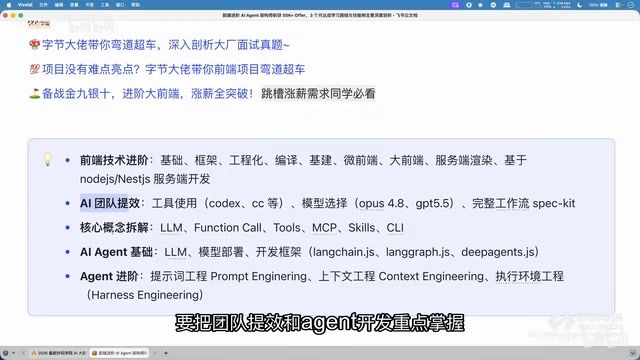
AI Team Productivity: Solidifying the R&D Workflow
The core of AI team productivity is not simply "occasionally using an AI tool," but rather fixing and streamlining the entire R&D workflow into reusable standard practices.
Scenario-Based Model Selection Strategy
A key practical question: which model to use for which stage, to both save on tokens and ensure quality? The instructor offered selection advice based on real-world experience:
- Copywriting: Doubao aligns better with the Chinese language context;
- Solution design and architecture planning: Claude (4.x series) is recommended;
- Complex code generation and autonomous task execution: The GPT-5 series is more stable;
- Repetitive, batch "grunt work": DeepSeekAd V4 stands out for cost-effectiveness.
This "choose the model by scenario" mindset is precisely the practical insight many engineers lack. Blindly using the most expensive model isn't necessarily worthwhile, while relentlessly pursuing low cost may compromise quality.
The Economics Behind Model Selection Understanding why different models suit different scenarios requires examining three dimensions: training data composition, inference architecture, and pricing mechanism. Take DeepSeek as an example: it uses the MoE (Mixture of Experts) architecture, activating only a portion of parameters during inference, thereby dramatically lowering per-inference cost while maintaining high capability—giving it a significant price advantage for high-volume, low-complexity tasks. The core idea of MoE is to split the model into multiple "expert" subnetworks, routing and activating only a few of them per inference. Compared to traditional dense models, this can reduce inference compute requirements by 60%–80% without sacrificing performance on specific tasks.
The MoE architecture was not pioneered by DeepSeek—Google's Switch Transformer (2021) and the Mixtral series were important predecessors—but DeepSeek pushed further on engineering optimization, with fine-tuned sparse activation rates and routing algorithms making its cost advantage especially pronounced. Notably, there is a significant gap between a MoE model's "total parameter count" and "activated parameter count"—DeepSeek-V3 has 671 billion total parameters but activates only about 37 billion per inference, which is the fundamental reason its inference cost is far lower than comparably sized dense models. The Claude series, meanwhile, is specially optimized for long-document comprehension and structured output; its ultra-long context window (up to 200K tokens for the Claude 3 series) makes it naturally suited for architecture design scenarios requiring precise adherence to complex instructions, albeit at correspondingly higher inference cost.
Token economics awareness is one of the key traits distinguishing an AI engineer from an AI user: in production environments, token cost can directly affect a product's commercial viability. For an AI application handling 100,000 requests per day, the cost gap between flagship and cost-effective models can exceed 10x. Therefore, precisely selecting models by scenario—rather than uniformly using flagship models—is a cost-control skill every engineer must possess.
From Rule-Driven to Harness Engineering
At the workflow implementation level, you can proceed with a rule-driven approach—for example, using Spec Kit or a similar spec-driven solution to translate requirement specifications into executable development instructions.
A further direction is Harness Engineering: distilling your team's existing working methods into reusable Skills, and encapsulating established development processes into corresponding agents to achieve standardization and automation. This is also the mainstream evolutionary direction for team engineering over the next year or two.
Spec-Driven Development: Helping AI Truly Understand Requirement Intent Spec-Driven Development is not a new concept born of the AI era, but it has gained new life since the proliferation of large models. Its core idea: before writing any code, describe the system's expected behavior using structured, formal language—including input/output specifications, boundary conditions, business constraints, and acceptance criteria. In traditional software engineering, specs primarily served communication and alignment between human developers; in AI-assisted development, high-quality spec documents directly become the model's "task manual," enabling AI to autonomously generate and validate code within a defined constraint framework, rather than making creative guesses based on vague natural-language descriptions.
The difference in collaboration efficiency between spec-and-AI is essentially the difference between "deterministic constraints" and "open-ended creation." When a spec clearly defines constraints like "the function must return within 200ms" or "return a standard error object rather than throwing on exceptions," the AI-generated code is not only more aligned with expectations but also easier to validate through automated testing. This shares the same philosophy as Test-Driven Development (TDD): first define "what is correct," then make the implementation satisfy that definition. In AI-assisted development, specs are not only the source of test cases but also the cognitive anchor for model reasoning—they translate vague business intent into formal constraints the model can clearly follow. Notably, writing quality specs is itself an engineering skill, requiring developers to have a clear understanding of business boundaries and the abstraction ability to convert natural-language requirements into structured constraints—precisely one of the high-value tasks AI cannot yet fully replace. Toolchains like Spec Kit engineer this concept into practice, using standardized templates and validation mechanisms to turn accumulated team business knowledge into structured assets that AI can directly consume.
AI Agent Development: The Hard Skill You Can Show Off in Interviews
If team productivity is internal cultivation, then Agent development is the "technical muscle" you flex. Interviewers typically focus on:
- Have you actually done an Agent development project?
- Have you had hands-on experience with model deployment?
- Have you extensively used mainstream large models (GPT, Claude Code, Gemini abroad; Doubao, Tongyi Qianwen, DeepSeek domestically)—can you clearly articulate their pricing and core differences?
Core Concepts You Must Master for Agent Development
At the AI business and tooling level, the following concepts form the foundational cognitive framework for Agent development—and the key dividing line between "knowing how to use AI" and "being able to build AI":
- Model: Understanding the capability boundaries and applicable scenarios of different models
- Tool Calling: The core mechanism for enabling models to interact with external systems
- MCP (Model Context Protocol): A standardized protocol for managing model context
- Skill: Reusable atomic capability units
- Context Engineering: Engineering methods for managing and optimizing model inputs
A Deep Dive into Tool Calling Tool Calling is the core infrastructure of modern AI Agent architectures. The principle: developers pre-define a set of function interfaces (e.g., querying a database, calling an API, executing code), and provide the function signatures in a structured format (typically JSON Schema) to the model. During reasoning, if the model determines it needs external capabilities, it outputs a structured call instruction containing the function name and parameters. The application layer then actually executes it and returns the result to the model, forming a closed loop of "perceive → decide → act → feedback." OpenAI first standardized this mechanism in 2023, and mainstream model providers like Anthropic and Google subsequently followed suit, evolving parallel tool calling capabilities that allow models to issue multiple tool requests in a single reasoning pass, greatly improving the execution efficiency of complex tasks.
Understanding the design philosophy of Tool Calling helps you use it better: its essence is upgrading large models from "knowledge retrievers" to "task orchestrators." The model itself performs no side-effect operations; it only decides "which tool to call and what parameters to pass," while actual execution is handled by the application layer. This "separation of decision and execution" architecture gives Agent systems good auditability and controllability—you can insert human approval nodes before tool execution, and implement permission controls at the tool layer, without modifying the model's own behavior.
From an engineering implementation standpoint, the reliability of Tool Calling is far more complex than it appears. Challenges a production-grade Agent must handle include: tool execution timeouts and retry strategies, scheduling and result merging for parallel tool calls, graceful degradation when tools return errors, and preventing the model from getting stuck in invalid tool-call loops (i.e., the Agent freeze problem). Frontend engineers have a natural advantage here—asynchronous programming, Promise chains, error boundaries, and other frontend idioms are highly isomorphic to the engineering implementation of Tool Calling. Understanding Tool Calling means more than just knowing how to call an API; it means being able to design a robust tool execution layer, which is the core engineering capability for delivering trustworthy Agent applications.
Why Is MCP Important? MCP (Model Context Protocol) is an open protocol released by Anthropic in late 2024, aimed at solving the fragmentation of integration between AI applications and external data sources and tools. Before MCP, every AI application had to develop separate adaptation layers for different data sources (file systems, databases, APIs, etc.), which was extremely costly to maintain—an AI application integrating 10 tools often required maintaining 10 different sets of adaptation code, and as the number of tools grew, complexity exploded at an N×M rate. By defining a standardized client-server architecture, MCP enables AI models to access arbitrary external resources in a unified way—developers only need to implement an MCP Server once for it to be callable by all MCP-supporting AI clients.
MCP's architecture draws on the successful experience of LSP (Language Server Protocol)—LSP, introduced by Microsoft in 2016, defined a unified communication protocol between editors and language toolchains, thoroughly solving the N×M integration problem where "every editor needed a separate plugin for every programming language" and fueling the ecosystem prosperity of modern editors like VS Code. MCP is doing the same thing for the relationship between AI applications and data sources. Looking at protocol design details, MCP uses JSON-RPC 2.0 as its communication foundation and supports two transport modes, stdio and HTTP+SSE—the stdio mode suits local tool integration, while the SSE mode suits cloud service deployment. This flexibility lets an MCP Server run as a local plugin for desktop applications or be deployed as a microservice in the cloud for shared team use. For frontend engineers, an MCP Server is essentially a Node.js service following a specific protocol; its development barrier is low but its strategic value is immense: mastering MCP Server development means being able to build reusable AI capability foundations for your team—whether connecting to internal enterprise databases, interfacing with business APIs, or encapsulating domain-specific operational tools, one development effort can be invoked by all AI toolchains. Mainstream AI development tools like Claude Desktop, Cursor, and Windsurf now natively support MCP, and the ecosystem is rapidly forming. Engineers who master MCP Server development early will gain a first-mover advantage in AI infrastructure development.
Context Engineering: An Underrated Core Competency Context Engineering is one of the most important emerging concepts in the AI engineering field in 2025. Its essence: the output quality of a large model depends largely on the quality of the context fed into it, rather than the model's parameter scale itself. Authorities like Andrej Karpathy (former Tesla AI director, OpenAI co-founder) have explicitly stated that "context engineering" is replacing "prompt engineering" as a more accurate description of the skill—it's not just writing a good prompt, but systematically designing all the information the model receives throughout the entire task execution cycle.
The engineering practice of context engineering spans multiple layers: prompt engineering is the entry layer, including system prompt design, few-shot example selection, and instruction format optimization; RAG (Retrieval-Augmented Generation) is the advanced layer, dynamically injecting the most relevant content from external knowledge bases into the context via vector retrieval to solve the model's knowledge cutoff and private-data access problems—vector databases (such as Pinecone, Weaviate, Chroma) and embedding models are the core infrastructure of this layer; conversation history management is the stability layer, including history compression, summary generation, and key state retention to prevent token overflow or the "forgetting" of critical information (i.e., attention dilution) in long conversations; tool result formatting directly affects the model's understanding of tool return values—the same data returned as a table versus as JSON can produce vastly different model comprehension effects.
In Agent development, how to convey the most valuable information within a limited token window—without losing critical state or incurring wasteful consumption—directly determines the Agent's execution stability and task success rate. Worth noting is a dimension of context engineering that's easily overlooked: negative information filtering. Research shows that overly long or noisy context not only increases cost but also dilutes the model's attention on critical information, producing the "Lost in the Middle" effect—where the model's utilization of information in the middle of the context is significantly lower than at the beginning and end. Therefore, a context engineer must know not only "what to include" but equally "what to exclude." This capability is becoming one of the scarcest roles on AI teams, its core value lying in converting unstructured business knowledge into a structured information flow that models can efficiently consume.

Professional Identity Reconstruction: From Frontend Engineer to Agent Engineer
The instructor offered a rather forward-looking judgment: over the next year or two, the boundary between frontend and backend roles may gradually blur or even disappear.
"In the future there will be no frontend positions—just Agent engineers."
The reason we still habitually define ourselves as "frontend" is largely path inertia. And roles that were originally technical consulting will evolve into FDE (Forward Deployed Engineers)—the engineers who implement and deploy AI solutions on the ground.
What Kind of Role Is an FDE? The Forward Deployed Engineer role was first systematically defined and practiced at scale by Palantir. Palantir is known for deploying complex data analytics platforms for governments and large enterprises, and the core challenge of its business is: how can a general-purpose data platform be rapidly customized and implemented across vastly different client scenarios? Palantir's solution was to cultivate the FDE, a hybrid role—possessing deep engineering capabilities while being able to embed directly into client business scenarios to rapidly customize and deliver general-purpose technology products. Unlike traditional pre-sales engineers or consultants, an FDE can independently complete the full pipeline from problem diagnosis and solution design to code implementation and production validation, without repeatedly relaying messages between the "business side" and the "technical side." This "integration of technology and business" delivery model enables Palantir to maintain a strong competitive advantage in the highly fragmented government-and-enterprise client market. Palantir's hiring data shows that competition for its FDE positions is even fiercer than for software engineers, because hybrid talent is far scarcer than single-skill specialists.
In the AI era, the FDE role is being deeply reinterpreted: an AI FDE needs the full-pipeline ability to identify client business pain points, design AI solutions, rapidly build Agent prototypes, and deliver validation. For an AI FDE, a frontend engineer's cross-layer perspective (simultaneously understanding the user interface, interaction logic, and data flow) becomes a unique advantage—they can better perceive how AI capabilities land at the product interface layer than pure backend engineers, and can more quickly turn ideas into demonstrable prototypes than pure product managers. This "start from user experience, extend to engineering implementation" mindset aligns closely with the "rapid prototype validation" iteration rhythm of AI products. Domestic tech giants and AI startups have already begun heavily recruiting such hybrid talent, with salary ranges generally 20%–50% higher than traditional frontend or backend engineers. For frontend engineers looking to transition, FDE is a high-value path to monetize existing engineering experience combined with AI capabilities.
AI won't simply "replace" a given role; it will restructure the definition and skill requirements of roles. For frontend engineers, rather than fretting over the decline of pure frontend opportunities, it's better to proactively complete the identity upgrade from "interface developer" to "agent builder."
Summary: Prioritizing the Skill Tree
The core value of this skill tree lies in providing a clear order of priority: a solid foundation of TypeScript + frameworks + engineering is the bedrock, while AI team productivity and Agent development determine your salary ceiling.
Frontend engineers who want to achieve a salary leap would do better to focus their energy on the following directions rather than grinding through interview trivia: hands-on model selection, solidifying R&D workflows, landing Agent projects, and deeply mastering core concepts like MCP, Tool Calling, and Context Engineering. The market's direction is clear—the sooner you complete the transition, the sooner you'll secure your high-paying ticket in.
Key Takeaways
Related articles

Chain of Thought Isn't Just for AI: How Humans Can Use CoT to Improve Thinking Quality
Chain of Thought isn't just a prompt trick for large models. Starting from a Hacker News discussion, this article analyzes why CoT works for human thinking too, breaks down actionable ways to transfer it, and highlights the key differences between human CoT and machine CoT.
Cloudflare Teams Up with OpenAI: Closi…
Cloudflare Teams Up with OpenAI: Closing the Loop from Vulnerability Discovery to Defense with AI
Cloudflare uses OpenAI Daybreak to investigate security vulnerabilities and generate reviewable remediation plans, while developers use Codex to boost coding efficiency and quality.

Orca Multi-Agent Orchestration in Practice: A Guide to Parallel Collaboration with Claude and Codex
Orca is Stable AI's free open-source agent workbench supporting 34 agents like Claude Code and Codex in parallel. Learn its Git worktree isolation, multi-model orchestration, and mobile management.