From Frontend to Agent Development: A Complete 6-Week Systematic Learning Path

A 6-week roadmap for frontend developers to systematically learn AI Agent development.
This article breaks down a 6-week systematic learning path for frontend engineers looking to transition into AI Agent development. It covers Agent core architecture (planning, memory, tool use), the ReAct reasoning paradigm, multi-agent collaboration, RAG integration, lightweight deployment strategies, and hands-on project practice, providing a clear roadmap from foundational concepts to production-ready applications.
Why Agent Development Is Becoming the Mainstream AI Track
As large model capabilities continue to evolve, simple conversational AI can no longer meet complex business needs. AI Agents—systems capable of autonomous planning, tool invocation, and task execution—are becoming the new focal point in the tech world. The concept of AI Agents originates from the "intelligent agent" theory in artificial intelligence research, traceable back to Stuart Russell and Peter Norvig's classic definition in the 1990s: an entity that can perceive its environment through sensors and act upon it through actuators. Today's AI Agents specifically refer to autonomous intelligent systems built on Large Language Models (LLMs)—they not only understand natural language instructions but can also autonomously decompose tasks, call external tools, and dynamically adjust strategies based on feedback. Compared to traditional chatbots, the biggest difference with Agents is their "closed-loop execution capability": they don't just offer suggestions—they actually get things done. Since 2023, the explosive popularity of OpenAI's Function Calling, AutoGPT, BabyAGI, and similar projects has marked the transition of Agents from academic concepts to engineering practice. An increasing number of developers, especially frontend engineers, are viewing Agent development as a key career pivot.
However, the reality is that many people hit numerous pitfalls when entering the field. According to the Bilibili tutorial referenced here, the problem isn't the track itself—90% of people simply start off in the wrong direction. The three most common mistakes include: blindly following trends without identifying practical use cases, failing to build truly usable Agents, and simply copying existing templates without understanding them. These mistakes ultimately lead to wasted time and effort.

For frontend developers, Agent development is actually a naturally fitting direction—frontend developers already excel at interaction design and user experience, and the core value of Agents lies precisely in "efficient human-AI collaboration." Understanding this point matters more than blindly learning technical details.
Detailed Breakdown of the 6-Week Systematic Learning Path
This tutorial organizes the Agent development learning process into six weeks, forming a complete loop from foundations to hands-on practice. This progressive structure is especially friendly for beginners starting from scratch.

Week 1: Building the Foundation — Understanding Agent Core Architecture
The first phase focuses on building a complete knowledge framework and understanding the core architecture and components of Agents. This includes three key modules:
-
Planning: How an Agent breaks down complex tasks into executable sub-steps. Technically, Agent planning typically relies on the LLM's Chain-of-Thought reasoning capability, progressively decomposing a high-level goal into a sequence of executable subtasks. Common planning strategies include top-down Task Decomposition, feedback-based dynamic Re-planning, and tree-based search with backtracking mechanisms (Tree of Thoughts). For example, when a user asks an Agent to "research competitors and generate an analysis report," the Agent needs to autonomously plan steps like "identify competitor list → search information for each → extract key data → comparative analysis → generate report." The quality of planning directly determines whether an Agent can efficiently complete complex tasks.
-
Memory: Management mechanisms for short-term and long-term memory. An Agent's memory system draws from human memory models in cognitive science—short-term memory (also called working memory) corresponds to the LLM's Context Window, i.e., the amount of information the model can "remember" within a single conversation, limited by the token cap (e.g., GPT-4 Turbo's 128K tokens). Long-term memory is implemented through external storage like vector databases (e.g., Pinecone, ChromaDB), which can store user preferences, interaction history, and lessons learned. More advanced memory mechanisms like "Reflexion" enable Agents to self-evaluate past behavior and write experiences into long-term storage, allowing continuous evolution in subsequent tasks.
-
Tool Use: How to enable Agents to call external APIs, databases, or functions. Tool use is the key capability that upgrades an Agent from a "language model" to an "execution engine." Its technical foundation is the Function Calling mechanism introduced by OpenAI in 2023, which allows large models to output function call requests in structured JSON format. Building on this, frameworks like LangChain and LlamaIndex further abstract the concepts of Tool and Toolkit, allowing developers to wrap search engines, code executors, database queries, and other capabilities as standardized tools. In 2024, Anthropic's Model Context Protocol (MCP) further attempted to establish a unified standard for Agent tool invocation, lowering the barrier to tool integration even further.
These three components constitute the essential difference between an Agent and an ordinary chatbot. Only by understanding this architecture can subsequent learning go beyond the surface.
Week 2: Mastering Agent Core Operating Principles
Week 2 dives deep into Agent operational principles and industry challenges. The most critical part is mastering mainstream reasoning paradigms, such as ReAct (Reasoning + Acting)—a classic pattern that alternates between "reasoning" and "acting," enabling Agents to think and execute simultaneously.
ReAct was jointly proposed by Princeton University and Google Research in 2022, published at ICLR 2023. The core idea is to have the large model alternate between "Thought" and "Action" during task execution: the model first reasons in natural language about what should be done, then executes a specific action (such as searching or calculating), and then continues reasoning about the next step based on the observed results (Observation). This alternating pattern elegantly solves two key problems: pure reasoning (like Chain-of-Thought) is prone to hallucinations and cannot access real-time information; pure action (like traditional automation scripts) lacks flexible judgment capability. After ReAct, the industry developed advanced paradigms including Reflexion (adding self-reflection), LATS (incorporating Monte Carlo Tree Search), and Plan-and-Execute (separating planning from execution), but ReAct remains the best introductory framework for understanding how Agents work.
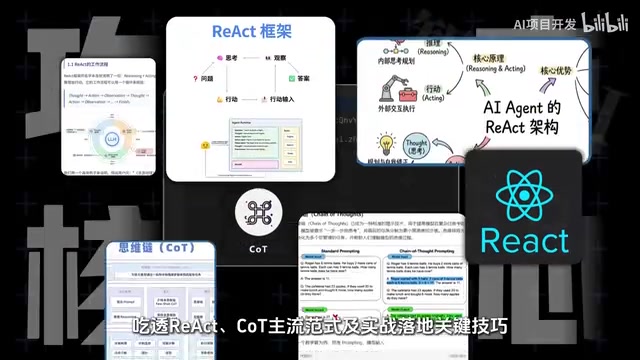
Understanding the practical implementation techniques of these paradigms is the dividing line between "being able to call APIs" and "being able to design Agents." This phase determines whether developers can truly grasp the thinking logic behind Agents.
Week 3: Multi-Agent Collaboration and Performance Tuning
A single Agent's capabilities are ultimately limited—truly complex scenarios often require Multi-Agent collaboration. Multi-Agent system research has a long history in AI, but Multi-Agent collaboration in the era of large models has taken on an entirely new form. Representative frameworks include Microsoft's AutoGen, CrewAI, and MetaGPT, all built on the core concept of having multiple Agents with different role assignments (e.g., product manager, programmer, tester) collaborate through dialogue and protocols to accomplish complex tasks that a single Agent cannot handle.
Typical Multi-Agent architecture patterns include: hierarchical (one main Agent directing multiple sub-Agents), egalitarian (Agents reaching consensus through discussion), and pipeline (tasks passing sequentially between Agents). However, Multi-Agent systems also face significant challenges: communication overhead between Agents, role conflicts, circular dialogues, and cost inflation. In practice, not every scenario requires multiple Agents—over-engineering can actually reduce system reliability and controllability, making the choice of appropriate architectural granularity crucial.
Week 3 focuses on these multi-Agent collaboration patterns and various tuning techniques, with emphasis on solving common output deviation issues in real-world applications, enabling Agents to respond to requirements accurately and efficiently.
From RAG Integration to Real-World Project Deployment
Week 4: Deep Integration of RAG and Agents
Week 4 combines RAG (Retrieval-Augmented Generation) with Agents. RAG was first proposed by Meta AI (formerly Facebook AI Research) in 2020. Its core mechanism is to retrieve relevant document fragments from an external knowledge base before the large model generates an answer, injecting them as context into the Prompt so the model generates responses based on real data. This approach effectively addresses two major pain points of large models: outdated information due to knowledge cutoff dates, and the hallucination problem where models confidently generate incorrect information.
The RAG tech stack typically includes: document parsing and Chunking, text Embedding (commonly using models like OpenAI's text-embedding-3, BGE, etc.), vector similarity retrieval (based on cosine similarity or approximate nearest neighbor algorithms), and Re-ranking of retrieval results. When RAG is combined with Agents, the Agent can dynamically decide when to retrieve and what content to retrieve based on task needs, achieving smarter knowledge acquisition—this is also known as Agentic RAG, which is more flexible than traditional RAG and can handle complex scenarios like multi-hop reasoning and compound queries. By proficiently using lightweight tools, developers can adapt Agents to various real-world business scenarios, bridging the gap from technology to business implementation.
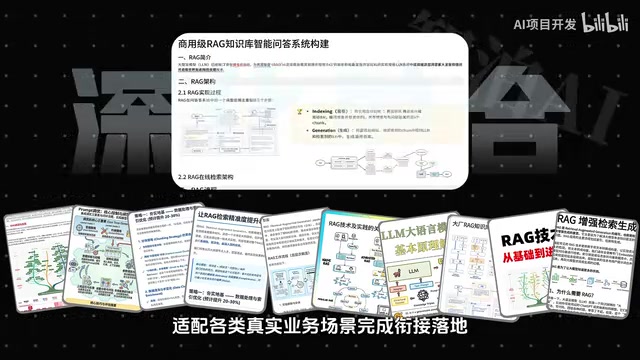
This step is where many learners get stuck—the gap between a technical demo and a truly usable product often comes down to deep integration of RAG with specific business scenarios.
Week 5: Lightweight Deployment and Industry Customization
Week 5 enters the skill expansion phase, focusing on mastering lightweight deployment methods for Agents, along with industry-specific scenario customization and compatibility optimization techniques.
Lightweight deployment is the critical step in transforming a technical prototype into a production-grade application. Traditional large model deployment often requires high-performance GPU servers, which are expensive and complex to maintain. Lightweight deployment strategies span multiple layers: at the model level, quantization techniques (such as GPTQ, AWQ, GGUF formats) can compress model precision from FP16 to INT4/INT8, dramatically reducing memory and compute requirements; alternatively, calling cloud APIs (such as OpenAI, Claude, Qwen, etc.) avoids the complexity of local deployment entirely. At the application architecture level, Serverless architecture enables on-demand scaling, while Docker containerization ensures environment consistency. For frontend developers, combining familiar deployment platforms like Vercel and Cloudflare Workers with full-stack frameworks like Next.js enables rapid development of complete applications with both frontend interfaces and backend Agent logic.
Different industries (e.g., e-commerce, education, finance) have vastly different Agent requirements—the ability to deliver proper customization directly determines an Agent's practical value.
Week 6: Multi-Scenario End-to-End Practice
The final week is the hands-on integration phase. Learners need to independently complete multi-scenario Agent projects, connect with real business requirements, and achieve technical deployment. This "project-driven learning" approach helps developers weave the knowledge from the first five weeks into a complete skill set.
Practical Advice for Frontend Developers Transitioning to Agent Development
This entire tutorial closely follows mainstream AI industry trends, providing beginners with a clear path for advancement. However, it's important to be realistic—any tutorial is merely a "map." Real capability comes from building things with your own hands and continuous trial and error.
For frontend engineers, transitioning to Agent development comes with several natural advantages:
- Familiarity with frontend interaction enables better design of Agent user interfaces
- Engineering mindset helps with system architecture design
- Proficiency with API calls accelerates the learning of tool integration
That said, it's worth noting that tutorials marketed as "zero to hero in X days" often exaggerate in their marketing copy—"7 days from beginner to expert" is more of an attention-grabbing headline than reality. Agent development is a technical direction that requires sustained investment. It's best to treat this as a systematic learning framework reference rather than a shortcut to mastery. True expertise still requires continuous refinement through real-world projects.
Key Takeaways
Related articles

EPA Policy Controversy: Power Facilities Serving Data Centers May Circumvent Pollution Regulations
The EPA's policy interpretation sparks controversy as power facilities for AI data centers may bypass current pollution laws. Analysis of the regulatory gap, community concerns, and the clash between tech progress and environmental protection.

Cursor Hidden Markup Controversy: Cached Tokens Charged 12.5x Surcharge
A Cursor enterprise power user exposes hidden markups in its Luna pricing: cached tokens charged a 12.5x surcharge. Detailed breakdown of the Cursor Tax billing logic and its real impact on users.

Should You Feel Anxious About Staying at One Company for 4-5 Years? The Stability vs. Growth Dilemma
Should you leave after 4-5 years at one company? Learn to distinguish external noise from real needs, with three self-assessment questions to guide your decision.