From IT Support to AI Engineer: A Real NCA-GENL Certification Journey and Lessons Learned

An IT support pro's honest NCA-GENL study journal — including a 40% Trustworthy AI score as a hard-earned warning.
A Reddit user who spent five years in IT support shares his complete NCA-GENL certification experience, including a candid score breakdown revealing only 40% on Trustworthy AI. The account covers Transformer fundamentals, NVIDIA-specific tools like NeMo and TensorRT, effective 7-week study strategies, and why you should never skip the modules that seem boring.
From IT Support to AI Engineer: A Real Path to Transition
A Reddit user shared his complete experience of passing the NVIDIA NCA-GENL certification — a firsthand account that carries real reference value for non-traditional candidates looking to break into AI.
What Is NVIDIA NCA-GENL?
NVIDIA Certified Associate - Generative AI LLMs (NCA-GENL) is a generative AI certification launched by NVIDIA in 2023. It validates candidates' competency in large language model applications, the NVIDIA AI tool stack, and responsible AI practices. Unlike the TensorFlow Developer Certificate or AWS Machine Learning Specialty, NCA-GENL explicitly emphasizes hands-on familiarity with NVIDIA's own ecosystem. It serves as an entry-level credential for AI practitioners within NVIDIA's certification framework and is an important stepping stone toward the NCP (NVIDIA Certified Professional) path.
Notably, NVIDIA is deliberately replicating the success of Cisco's CCNA structure — building a tiered certification system from Associate to Professional to Expert that fosters developer loyalty while giving enterprise clients a quantifiable benchmark for talent capability. NCA-GENL functions as the "entry ticket" in this system, establishing a baseline for developers in the NVIDIA ecosystem.
The candidate's background is highly relatable: not a machine learning engineer by training, but someone who spent five years in IT support at a logistics company. The transition from IT support roles (Help Desk, System Administrator, etc.) toward AI engineering is a notable structural trend in today's tech talent market. According to the World Economic Forum's 2023 Future of Jobs Report, IT support roles do face automation pressure — but AI-related job demand is expanding at over 30% annually.
Data from the McKinsey Global Institute suggests that by 2030, roughly 375 million workers globally will need to reskill across functional boundaries. IT support professionals have a unique advantage on this migration path: they sit at the intersection of technology and business, with an intuition for translating abstract system problems into concrete solutions. This skill — especially during the critical transition from POC (proof of concept) to production — is often more practically valuable than a purely algorithmic background. Certifications play a key role in this transition, serving as an "ability signal" that compensates for the inherent disadvantage non-traditional candidates face in résumé screening. IT support professionals also bring real-world business problem-solving instincts, familiarity with enterprise IT infrastructure (which is highly relevant to AI deployment environments), and cross-functional communication skills — soft skills that are equally indispensable in AI engineering.
About a year ago, driven by concern that his role might be automated away, he decided to pivot toward AI. Late-night Python study sessions, several half-finished video courses, and a great deal of confusion — this is a portrait many career changers will recognize. NCA-GENL was his first AI certification, and he completed the exam via online proctoring through Certiverse.
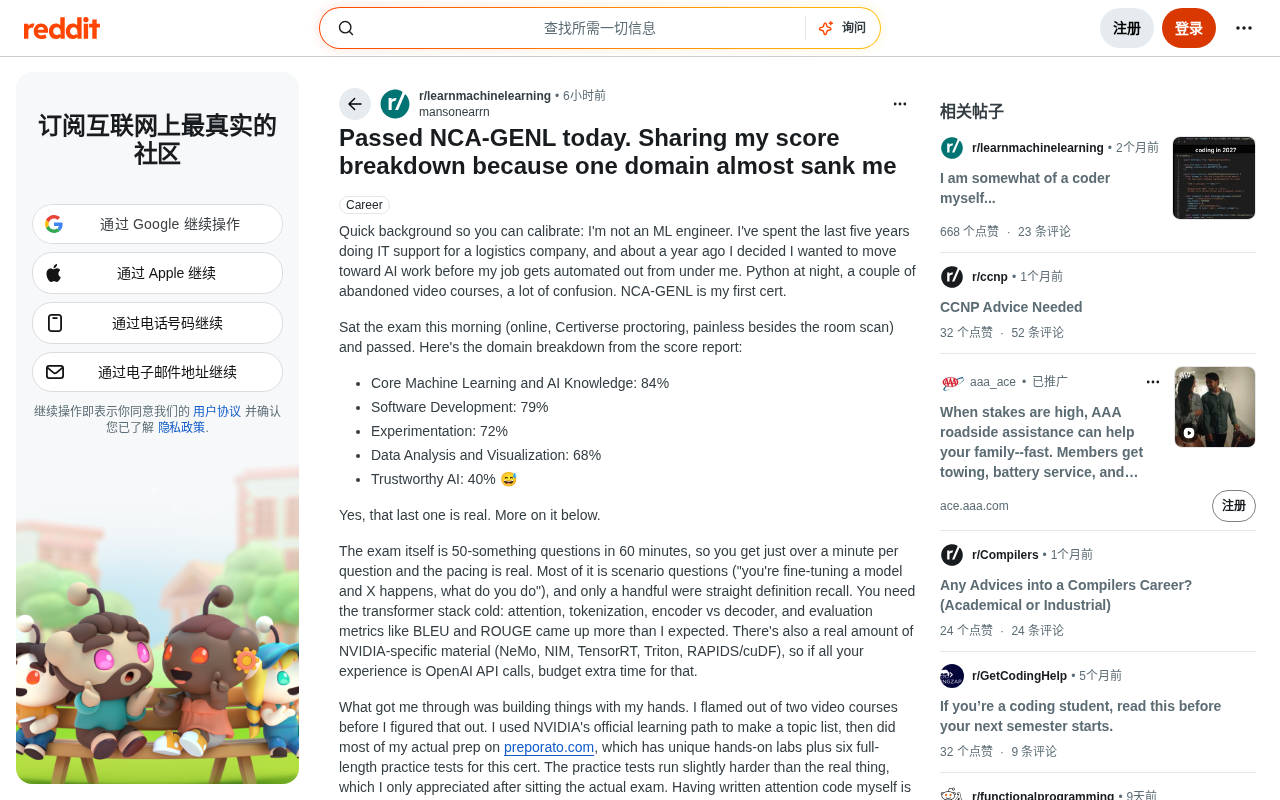
An Honest Scorecard
He publicly shared his score breakdown by domain, and one number stands out immediately:
- Core Machine Learning & AI Knowledge: 84%
- Software Development: 79%
- Labs: 72%
- Data Analysis & Visualization: 68%
- Trustworthy AI: 40% 😅
That 40% is not a typo. He openly admitted that if his scores in other modules had been any weaker, this dismissal of Trustworthy AI would likely have cost him the certification entirely. This is the most important lesson in the entire article.
NCA-GENL Exam Format and Key Content Breakdown
The Time Pressure Is Real
According to this candidate, the exam contains 50+ questions with a 60-minute time limit — just over a minute per question on average. The pace is not forgiving, and it requires candidates to be genuinely fluent with the material rather than working things out slowly.
In terms of question types, the vast majority are scenario-based (e.g., "You're fine-tuning a model and encounter situation X — what do you do?"), with very few pure definition-recall questions. This means memorizing concepts alone is far from sufficient; you must understand the reasoning behind them and how they apply in real-world situations.
Core Topics: The Transformer Stack and the NVIDIA Ecosystem
The Transformer architecture, introduced by Vaswani et al. in the 2017 paper Attention Is All You Need, fundamentally transformed the NLP landscape. Its revolutionary nature lies in completely abandoning the RNN/LSTM dependence on sequential order, instead using Positional Encoding to retain sequence information while replacing step-by-step recurrence with parallel self-attention computation. This design allows training to fully exploit GPU parallel computing capacity, fundamentally removing the bottleneck between model scale and training efficiency.
The core of the Self-Attention mechanism allows the model to dynamically weigh the relevance of all other tokens in a sequence when processing each one, capturing long-range dependencies. Multi-Head Attention allows the model to simultaneously capture different types of semantic relationships from multiple subspaces — syntactic dependencies, coreference resolution, topical associations — analogous to how different filters in a convolutional neural network capture different visual features. The Encoder maps input sequences to contextual representations, suited for classification and comprehension tasks; the Decoder autoregressively generates output sequences, suited for text generation. Modern large language models (such as the GPT series) almost universally use a Decoder-only architecture, with Masked Self-Attention ensuring that autoregressive generation doesn't leak future token information.
He specifically emphasized that all of this Transformer-related knowledge needs to be second nature: attention mechanisms, tokenization, the difference between encoders and decoders, and evaluation metrics like BLEU and ROUGE — the latter appearing far more often than he expected.
BLEU (Bilingual Evaluation Understudy), proposed by IBM in 2002, was originally designed for machine translation. Its core idea is to compute n-gram overlap between machine-generated and reference translations, with a brevity penalty to prevent models from inflating precision scores with extremely short outputs. ROUGE (Recall-Oriented Understudy for Gisting Evaluation) focuses on recall and is better suited for evaluating content coverage in summarization tasks. It's worth noting that both metrics have well-documented limitations in correlating with human judgment — a high BLEU score does not necessarily mean a fluent, natural translation. In practice, automated metrics are typically combined with human evaluation or LLM-as-Judge approaches. Understanding the boundaries of these metrics is a prerequisite for designing reliable evaluation systems, and it's a typical entry point in the exam for testing real-world judgment.
The exam also includes a substantial portion of NVIDIA-proprietary technology content. NVIDIA has built a complete proprietary tool ecosystem across the full AI stack — a strategic move aimed not just at technical lock-in, but at extending GPU hardware advantages into the software layer:
- NeMo: An open-source framework for LLM pre-training and fine-tuning, providing an end-to-end pipeline from data processing to model deployment
- NIM (NVIDIA Inference Microservices): An enterprise-grade inference microservices platform that packages optimized models in containerized form
- TensorRT: NVIDIA's high-performance deep learning inference optimizer, delivering significant latency reductions through techniques like operator fusion (merging multiple computation layers to reduce memory access overhead) and mixed-precision inference (FP16/INT8 quantization) — capable of 2–10x performance improvements
- Triton Inference Server: An open-source model serving framework supporting concurrent inference across TensorFlow, PyTorch, ONNX, TensorRT, and other frameworks, maximizing GPU utilization through Dynamic Batching
- RAPIDS/cuDF: GPU-accelerated data processing libraries that can speed up data preprocessing by orders of magnitude
He specifically warned: if your entire experience is limited to calling the OpenAI API, make sure to budget extra study time for this section. NVIDIA certification naturally emphasizes its own ecosystem, and the deep integration of these tools creates a clear knowledge gap for developers who are only familiar with general-purpose LLM APIs.
What Actually Works for NCA-GENL Preparation
Hands-On Practice Beats Passive Learning
This candidate admitted he abandoned two video courses before realizing that "actually building things" was the genuinely effective learning approach. His method: use the NVIDIA official learning path to map out a knowledge checklist, then use a platform with hands-on labs and full practice exams to study systematically.
He specifically noted that the practice questions he used were slightly harder than the actual exam — and that this "overtraining" is exactly what made him feel comfortable in the real test environment.
Because he had personally coded an attention mechanism, the core machine learning section posed no challenge at all. This reinforces a principle that has been validated repeatedly: in technical learning, implementing something yourself builds far deeper understanding than watching tutorials repeatedly.
A Realistic Study Timeline
The full preparation took about 7 weeks, at roughly one hour per evening. For someone with a full-time job making a career transition, this is a manageable commitment — and it demonstrates that NCA-GENL is far from out of reach. Python, as the lingua franca of AI, has a learning curve that's relatively accessible for IT professionals with scripting experience, while the certification framework provides this group with a structured path for validating their skills — helping to offset the signaling disadvantage of lacking a formal academic background.
The Biggest Lesson: Don't Underestimate the "Boring" Modules
The central warning of this entire account is that 40% Trustworthy AI score. He candidly admitted that because Trustworthy AI accounted for only 10% of the exam weight and the content "read like compliance homework," he essentially skipped it.
Trustworthy AI is not a purely academic concept — it's a critical threshold for AI systems moving from the lab into production. The rapid rise in its importance is fundamentally driven by a sudden surge in regulatory pressure: the EU AI Act came into force in 2024, classifying AI systems by risk level and requiring high-risk systems (such as credit scoring, recruitment screening, and medical diagnosis assistance) to meet strict transparency, accountability, and bias mitigation requirements, with fines of up to 7% of global annual revenue for non-compliance. The NIST AI Risk Management Framework (AI RMF) provides a practical methodology centered on the four functions of Govern, Map, Measure, and Manage.
The core engineering content covered in this module includes:
Guardrails: Typical architectures include an input filtering layer (blocking injection attacks and non-compliant prompts), an output auditing layer (detecting harmful content and factual errors), and a dialogue flow control layer (ensuring model behavior conforms to predefined policies). NVIDIA NeMo Guardrails implements these controls using Colang — a domain-specific language designed for defining conversational flows — and can integrate with any LLM backend. It is one of the leading frameworks in this space.
Bias Evaluation: Covers identifying and mitigating systematic discrimination in training data and model outputs, carrying both legal and ethical significance in high-risk applications such as hiring and credit decisions.
Hallucination Handling: The problem of LLMs generating factually incorrect content in a fluent, confident tone. The mainstream mitigation approaches include RAG (Retrieval-Augmented Generation) — which anchors model outputs by dynamically injecting content from external knowledge bases at inference time, with effectiveness highly dependent on vector database retrieval quality and chunking strategy — as well as fact-verification post-processing pipelines.
His conclusion is blunt and clear: "Go read the boring documentation." In an era of accelerating AI adoption, Trustworthy AI is no longer an optional add-on — it is a critical threshold determining whether a product can actually reach production. The exam's emphasis on this content directly reflects how seriously the industry takes responsible AI practices.
Four Takeaways for AI Career Changers
The value of this account lies in its honesty and candor. It offers several clear lessons:
- A non-traditional background is no barrier to entering AI — consistent effort and the right learning approach are what matter.
- Hands-on practice is the shortest path to solid understanding — writing code is more effective than watching videos.
- NVIDIA-specific ecosystem knowledge cannot be ignored — general API experience won't fully cover the exam's content.
- Don't neglect a module just because it has low weight — "soft knowledge" like Trustworthy AI is often the hidden weakness that determines success or failure.
For readers considering the NCA-GENL certification or planning an AI career transition, this firsthand study account may be more grounded and useful than any official guide.
Key Takeaways
Related articles

Automate Job Search with AI Agents and Residential Proxies for Precise Matching
Build an AI Agent with MCP and residential proxies to bypass recruitment site anti-scraping and geo-restrictions, scrape thousands of DevOps jobs, then have Claude score and rank each against your resume. Includes proxy comparison experiments, project structure, and cost analysis—filtering only, no auto-submission.

The AI Task Assistant That Knows When to Back Off: A Cure for Activation Struggles
One Small Step is an AI assistant for task initiation struggles, using agentic decisions for guilt-free reminders, timely retreat, and cross-platform task management. The developer shares real test results on 13 tasks and architectural trade-offs.

FastAPI: A High-Performance Python Framework and a Production-Ready API Development Powerhouse
FastAPI is a high-performance web framework based on Python type hints, supporting async and automatic OpenAPI docs. With over 100k GitHub stars, this article analyzes its core strengths, production readiness, and selection advice.