From RAG to Agentic AI: Building Intelligent Workflows That Actually Think

How to evolve from passive RAG to accountable Agentic AI workflows using LangGraph and Flowise.
This article explores upgrading traditional RAG systems into Agentic AI workflows capable of autonomous planning and decision-making. LangGraph's State, Node, Edge, and Conditional Routing concepts transform black-box Q&A into transparent, traceable flowcharts. A Query Classifier routes tasks to specialized agents — Retriever, Summarizer, Extractor, and Comparator — while an Evidence Validator and Guardrails enforce source-backed, hallucination-resistant outputs. Flowise enables no-code visual assembly of the entire system, and MCP Server integration connects agents to live databases and external APIs.
From Passive Retrieval to Active Decision-Making
Traditional RAG (Retrieval-Augmented Generation) systems behave like a dutiful librarian — they can locate answers within documents, neatly and passively. Ask a question, get an answer. That's it. But truly intelligent applications demand more: AI that can plan, use tools, and make autonomous decisions.
This is the core value of Agentic AI Workflows. To borrow a vivid analogy: if RAG is a by-the-book librarian, Agentic AI is more like a sharp detective squad — it has its own plan, knows how to use tools, and can judge what to do next based on context. This leap from "retrieval Q&A" to "autonomous action" is one of the defining directions in real-world AI deployment today.
LangGraph: The Brain Behind the Agent
For AI to plan and execute effectively, it needs a clear orchestration logic underneath. LangGraph serves as the "brain" of these workflows, and its operating principles break down into four fundamental concepts:
- State: Stores memory so the agent maintains context across multi-step tasks.
- Node: Represents a concrete work step, such as retrieval, summarization, or extraction.
- Edge: Defines the transition order between nodes, determining workflow direction.
- Conditional Routing: Selects different execution paths based on different conditions.
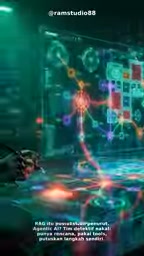
The significance of this structure is that it transforms an otherwise black-box "one question, one answer" interaction into an observable, controllable flowchart. Every step's action and the conditions that drive it forward become transparent and traceable — which is the technical foundation that makes agents "trustworthy."
LangGraph is an open-source framework developed by the LangChain team, purpose-built for constructing graph-based, multi-step AI workflows. Unlike traditional linear LangChain chain calls, LangGraph uses a Directed Graph model that allows workflows to include loops, branches, and conditional jumps — exactly the properties agent behavior requires. Built on Python, its underlying state machine design borrows from functional programming's immutable state management: each node receives the current state, processes it, and returns an updated state, making the entire process reproducible and debuggable. LangGraph integrates natively with LangSmith (LangChain's observability tool), allowing developers to trace the input, output, and latency of every step — critical for diagnosing abnormal agent behavior in production environments.
A Well-Organized Agent Team
When a query enters the system, it first encounters the Query Classifier — the "gatekeeper" that assesses the difficulty of the question. Simple questions get answered directly; complex ones are broken into subtasks and routed to the most capable specialist agent.
This agent team operates with clear division of labor:
- Retriever: Extracts relevant information from documents.
- Summarization Agent: Condenses lengthy content into key points.
- Extraction Agent: Pulls specific facts from text.
- Comparison Agent: Performs detailed side-by-side comparisons of multiple pieces of information.

This "divide and conquer" design breaks complex tasks into manageable subtasks, with each agent focused on what it does best — significantly improving the quality and reliability of the overall output.
Taming Hallucinations: Validation and Guardrails
One of the biggest obstacles to deploying AI applications is hallucination — where models confidently fabricate facts. This workflow addresses the problem with two lines of defense.
The first is the Evidence Validator. Every answer must pass its review before being delivered: unsupported claims are rejected outright, and every stated fact must be backed by a verifiable source.

The second is the Guardrail — a strict supervisor that enforces three hard rules: the AI must not fabricate; it must honestly say "I don't know" when it doesn't; and it must always cite sources. Through this mechanism, the model is constrained to operate only within the bounds of what can be substantiated, dramatically reducing the risk of confabulation. This is the core of making AI outputs "accountable."
The root cause of hallucination lies in how large language models generate text: they predict the next most likely token rather than "looking up" facts from a knowledge base. When training data is insufficient or a question exceeds the model's knowledge boundary, it tends to "complete" responses with content that sounds plausible but is factually wrong. In enterprise scenarios, this is especially dangerous — incorrect legal citations, financial data discrepancies, or inaccurate medical information can all have serious consequences. The evidence validator and guardrail mechanism essentially insert a "fact-anchoring" layer between the model's generated output and the final user response. By requiring every claim to map to a specific passage in the source documents, they reframe the model's role from "knowledge generator" to "information integrator" — reducing free-form fabrication at a structural level.
No Code Required: Visual Building with Flowise
Notably, this entire complex workflow doesn't require writing code from scratch. The approach demonstrates building the full system visually through Flowise — drag, drop, and connect nodes to complete agent orchestration.

Paired with an MCP Server (Model Context Protocol Server), the AI can also connect to databases, APIs, and various external tools — and you can even build your own custom MCP Server. This means agents are no longer confined to static documents; they can interact in real time with live data and real-world systems.
MCP (Model Context Protocol) is a standardized protocol proposed and open-sourced by Anthropic in late 2024, designed to address the fragmented, piecemeal integration of AI models with external tools and data sources. Before MCP, every tool (databases, APIs, file systems, etc.) required a separately developed adapter layer for each AI framework — an expensive maintenance burden. MCP defines a unified client-server communication specification: AI applications act as MCP Clients, and tools expose their capabilities as MCP Servers, communicating through a standardized interface. This allows the same MCP Server to be reused by any MCP-compatible AI framework, dramatically reducing the integration cost of connecting agents to real-world data systems. A growing library of open-source community-contributed MCP Servers is already available, covering common scenarios like GitHub, databases, and browser automation.
Conclusion: From Obedient Chatbot to Accountable AI Assistant
The journey from RAG to Agentic AI is fundamentally a shift from AI as a "passive tool" to AI as an "active collaborator." It's no longer just a chatbot that answers whatever you ask — it's an AI assistant that thinks, works, and takes responsibility for its own outputs.
For developers looking to build genuinely useful document intelligence or enterprise-grade AI applications, mastering state management, agent specialization, evidence validation, and guardrail mechanisms are essential prerequisites for building reliable agent systems. And with visual tools like Flowise, the barrier to walking this path keeps getting lower.
Related articles

ChatGPT Space Launches: Team Collaboration and New Pages Features Explained
ChatGPT Space is OpenAI's new team collaboration feature with Pages, real-time collaboration, and Slack/Google Drive sync. We break down its privacy design, multi-platform integration, and the full workflow from conversation to document.

Migrating Apache Spark UDFs to GPU Acceleration with AI Agents
NVIDIA developer blog explains how AI Agents rewrite Apache Spark UDFs for GPU acceleration, covering migration criteria, agent rewriting and verification workflows, plus pitfalls like result consistency and CPU-GPU transfer overhead.

Zed Editor v0.40.4-rc2 Released: Usage Credits Now Available Without Upgrading
Zed editor releases v0.40.4-rc2, allowing users to use usage credits for AI features without upgrading to a paid plan, lowering the trial barrier.