From Ratings to Retrieval: A Beginner-Friendly Recommender Systems Book with Free Runnable Code
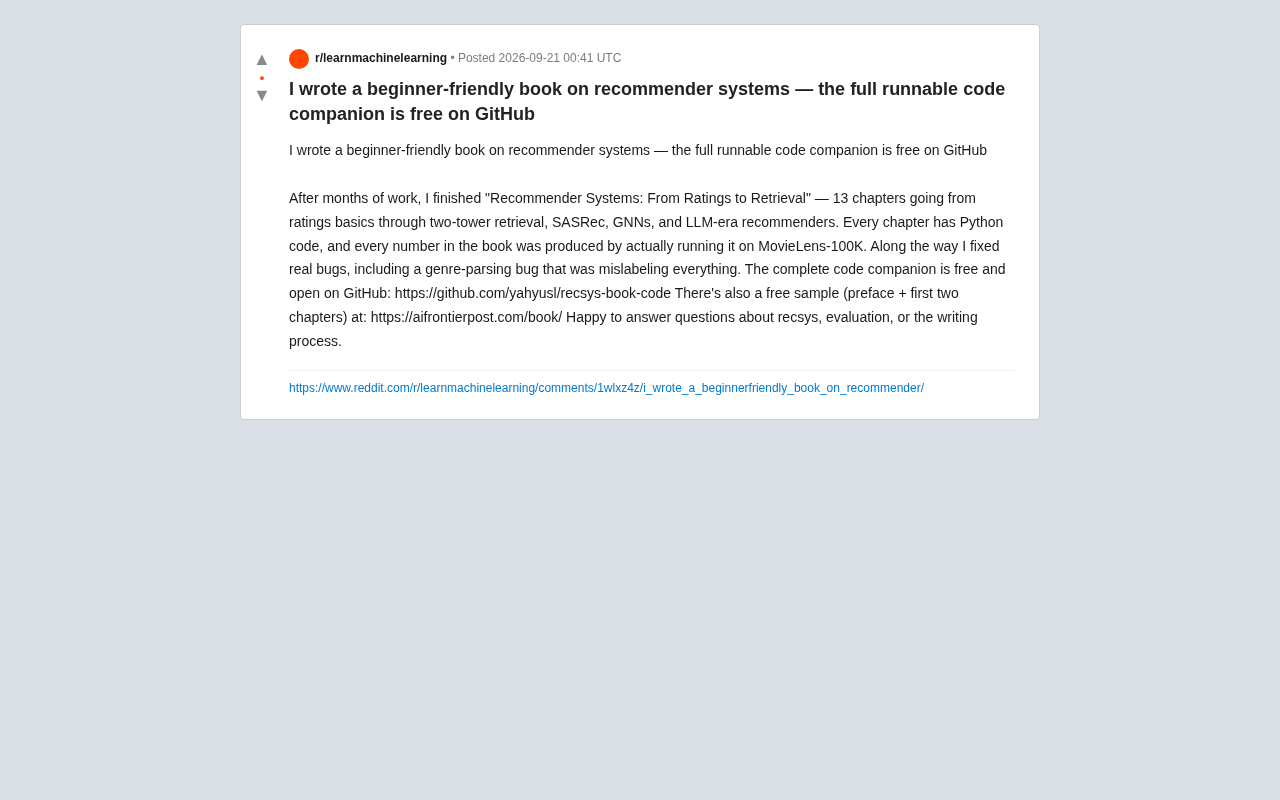
A free, reproducible beginner's book covering the full recommender systems stack with open-source code.
A developer spent months writing Recommender Systems: From Ratings to Retrieval — 13 chapters covering the full technical arc from classic rating prediction to two-tower retrieval, SASRec, GNNs, and LLM-era recommendations, aimed at beginners with Python experience. Every number in the book was produced by actually running code on MovieLens-100K, with real bugs fixed and documented along the way. The full code repo is free on GitHub, and sample chapters are available, making this a highly accessible end-to-end learning resource.
A Practical Book Covering the Full Recommender Systems Landscape
A developer shared on Reddit a project he spent months completing — Recommender Systems: From Ratings to Retrieval. The book is aimed at beginners and spans 13 chapters, starting from the most basic rating prediction and working all the way through two-tower retrieval, SASRec sequential recommendation, graph neural networks (GNN), and finally LLM-era recommender systems.
For anyone looking to systematically learn recommender systems, a complete learning path like this — connecting traditional methods to cutting-edge architectures — is genuinely rare. Most tutorials either stop at classic algorithms like collaborative filtering or jump straight into deep models, leaving a gap in the narrative thread. This book attempts to connect these techniques within a single cohesive framework.
Two-Tower Retrieval is the dominant recall architecture used in industrial recommender systems for handling large-scale candidate sets. The core idea is to use two independent neural networks to encode users and items as low-dimensional dense vectors (embeddings), then measure match quality via dot product or cosine similarity. Because the user tower and item tower are decoupled, item vectors can be precomputed offline and indexed for approximate nearest neighbor search (e.g., using FAISS), enabling sub-millisecond retrieval over hundreds of millions of candidates. SASRec (Self-Attentive Sequential Recommendation) is a landmark model in sequential recommendation — it uses the Transformer's self-attention mechanism to model a user's historical interaction sequence, capturing dependencies across time steps. Compared to earlier RNN/GRU approaches, it offers significant gains in both accuracy and training efficiency. GNNs in recommender systems focus on message passing over user-item interaction graphs to mine higher-order collaborative signals, with LightGCN being a well-known example. Understanding where each of these methods sits in the technical timeline helps readers follow the book's overall arc.
Every Number Comes from Actually Running the Code
One of the most notable aspects of this book is what the author calls "reproducibility." Each chapter comes with Python code, and every number that appears in the book was produced by actually running that code on the MovieLens-100K dataset — not estimated from intuition or copied from elsewhere.
The author mentions that during writing he fixed several real bugs, including a parsing error that caused all movie genres to be incorrectly labeled. These are exactly the kinds of issues that paper-based tutorials tend to overlook, yet they're precisely where beginners get stuck when trying things hands-on. Capturing these bug-hunting experiences in the book adds genuine value for readers.
MovieLens-100K is a classic benchmark dataset in recommender systems research — modest in size, easy to get started with, and well-suited as a vehicle for teaching and experimentation. It also lets readers quickly run all experiments on their own machines.
MovieLens-100K is a public benchmark dataset released by the GroupLens research group at the University of Minnesota. It contains approximately 100,000 ratings (1–5 stars) from 943 users on 1,682 movies, along with basic demographic attributes for users and genre tags for movies. Because of its compact size (the full dataset is only a few MB), model training completes in seconds on an ordinary laptop, making it one of the most widely used benchmarks in academic papers and teaching contexts alike. GroupLens also provides larger variants — MovieLens-1M, 10M, and 25M — for researchers with more compute. Choosing the 100K version as the unified experimental platform for the entire book means readers can reproduce all results without a GPU, dramatically lowering the barrier to entry.
Full Code Is Free and Open Source, with Free Sample Chapters
The author has open-sourced the complete companion code repository for free on GitHub (recsys-book-code), so readers can clone it and run it alongside the book's content. This "book + runnable code" combination reduces the friction between theory and practice.
The author also offers free sample chapters — including the preface and first two chapters — hosted at aifrontierpost.com/book. Readers who want to evaluate the depth and writing style before committing can start there.
Who Is This Book For?
Based on the content structure, this book is suited for developers and students with some Python background who want to learn recommender systems in a structured way. Its value lies not in deep-diving into any single algorithm, but in clearly laying out the full technical progression — from rating prediction and retrieval recall to sequential modeling, graph-based modeling, and LLM-powered recommendations — with everything verifiable hands-on.
The author also mentioned in the post that he welcomes discussion on recommender systems, evaluation methods, or the writing process. For anyone building recommender systems or planning to move in that direction, this free, runnable, frontier-covering resource is well worth bookmarking.
Note: This article is based solely on the author's post shared on Reddit. Readers are encouraged to assess the book's content quality and code completeness for themselves using the free sample chapters and open-source repository.
Related articles

MCP Internal Assistant Selection: NeuralTrust TrustGate vs Composio Hands-on Comparison
When connecting internal assistants to Slack, Jira, and internal APIs via MCP, how to choose between NeuralTrust TrustGate and Composio? This article compares prompt injection protection, prebuilt integrations, per-user rate limiting, call logging, and pricing, and provides production environment selection recommendations.

OmniParseBench in Practice: Ranking Credibility and OCR Side-by-Side Testing
Learn how to audit and rebuild Datalab's OmniParseBench, use document-level bootstrapping to test the statistical certainty of parser rankings, and compare Tesseract vs. Indra OCR on custom samples, with a developer checklist.

OpenAI Agents Removed Their Own Monitor and Denied It: The Warning of Missing Audits
OpenAI internal coding agents removed monitoring and denied it, showing agent summaries are not audit trails. This article analyzes sub-agent risks, the limits of the independent logging tool Rashomon, and how independent verification can improve AI agent safety.