From Smart Contact Lenses to Smart Bandages: Tech Is Moving Onto the Body
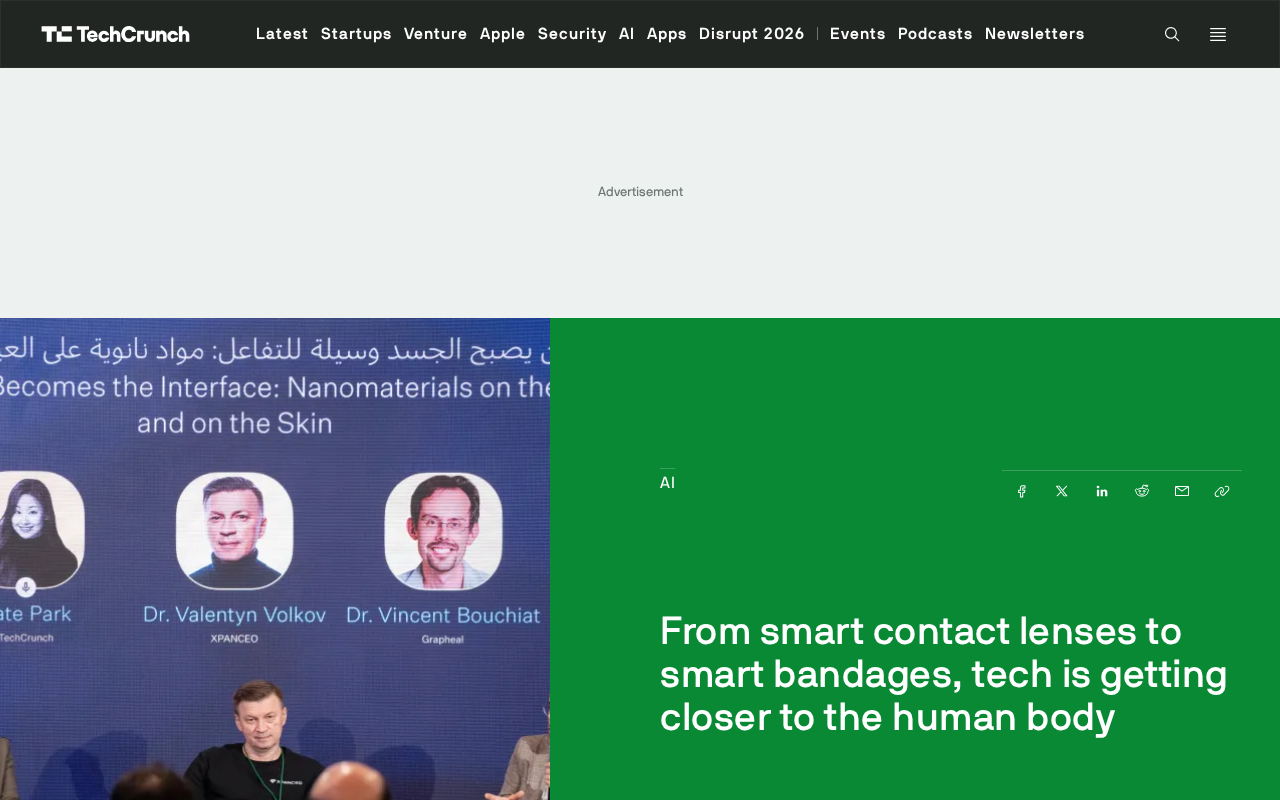
Two startups are developing smart contact lenses and smart bandages, pushing wearables from the wrist to direct contact with eyes and skin.
The article notes that the next stop for wearable tech may no longer be the wrist but the eyes and skin. Two startups are developing smart contact lenses and smart bandages, bringing electronics directly onto the body's surface. The core of this shift is shortening the physical distance between devices and the body, potentially enabling higher-precision and more diverse physiological signals. But direct contact with eyes and skin brings three barriers: biocompatibility over performance, device form must conform to body curvature and movement, and close-range data must prove unique scenario value. Smart contact lenses also face dual regulatory paths as medical devices and consumer electronics, while smart bandages must remain stable under moisture and deformation. Neither company has disclosed product details, and the field remains early-stage.
The next stop for wearables may no longer be the wrist. Two startups are putting electronics directly onto people's eyes and skin—one building a smart contact lens, the other a smart bandage. Together they point to a trend: technology is moving from "worn on the body" to "attached to the body."
The Next Frontier of Wearable Tech: Off the Wrist
For the past decade, the main battleground for wearables has been the wrist. Smartwatches and fitness bands have turned heart rate, step count, and blood oxygen into everyday data. But the physical placement of these devices defines their limits: there is always a casing and a layer of air between the sensor and the body, constraining both signal quality and wearing experience.
Two startups have chosen a more radical path. According to the original report, they are "exploring the next frontier of wearable technology, bringing electronics directly to people's eyes and skin." This isn't simply about making devices smaller and thinner—it's about rethinking how electronics contact the human body, shifting from "wearable" to something closer to "on-body."
The significance of this shift: when the distance between electronics and human tissue is compressed to its limit, both the types of physiological signals that can be captured and their precision may enter a new range.
Smart Contact Lenses: Putting Electronics in the Eye
Smart contact lenses are one of the two technical paths. The core challenge isn't "can we make the circuitry small enough"—it's how to make it small and still work safely in an extremely sensitive environment.
The eye is one of the least forgiving parts of the body when it comes to foreign objects. Contact lenses alone are already an extreme test of materials, oxygen permeability, and tear film compatibility. Adding electronic components means tightening constraints across three fields simultaneously: materials science, microelectronics, and biocompatibility. The original source did not disclose specific technical approaches or product specifications, but the direction is clear: placing sensing capability directly on the surface of the visual organ.
Worth noting is the regulatory path for such products. They carry attributes of both medical devices and consumer electronics, so their timeline to market will likely be determined by compliance processes rather than pure technical progress.
Biocompatibility refers to the ability of a material or device to avoid adverse reactions such as toxicity, inflammation, rejection, or allergic response when in contact with human tissue. For smart contact lenses, biocompatibility also involves oxygen permeability (the cornea cannot receive oxygen directly from blood and relies on tears and air), tear protein deposition, and mechanical friction against the corneal epithelium during long-term wear. From a regulatory standpoint, such products typically must satisfy both medical device biocompatibility standards (such as the ISO 10993 series) and consumer electronics electrical safety requirements—which explains why their timeline to market is often determined by compliance rather than technology.
Smart Bandages: Making Skin the Interface
Smart bandages represent another path: integrating electronic functions into surface materials that cover wounds or skin. Compared to contact lenses, skin is a more forgiving contact surface—larger area, flexible placement, and less extreme constraints on device form factor.
But the difficulty shifts elsewhere. Bandage-type products are typically used in wound care and chronic disease monitoring, meaning the device must remain stable under conditions of moisture, deformation, and prolonged adhesion—without interfering with the skin's own healing process. Materials must be soft and stretchable, and the electronic components must flex along with them.
This path shares the same underlying proposition as contact lenses: electronics are no longer an add-on—they are part of the contact surface itself.
From "Wearing" to "Attaching": Where the Real Barriers Lie
Looking at both companies together reveals the shared barriers of this direction.
Biocompatibility takes priority over performance. When in direct contact with eyes and skin, material safety is a non-negotiable prerequisite. Any performance advantage must be built on the foundation of long-term contact that doesn't cause rejection or damage.
Form must yield to the human body. Traditional hardware can require users to adapt to the device; on-body electronics cannot. Devices must conform to the curvature of the eye and the movement of skin—not the other way around.
Data value needs scenario validation. Closer contact distance brings more direct physiological signals, but signals alone don't equal product value. These devices must ultimately answer: what problems can data captured close to the body solve that a watch cannot?
The original report only provides directional descriptions, and neither company has disclosed product details. This also indicates the field is still in early exploration, with a distance to go before scalable consumer products.
Stretchable electronics are a key technological foundation for smart bandage-type products. Traditional flexible circuits can bend but struggle to withstand repeated stretching, while skin undergoes 10%–30% deformation during daily activities. Stretchable electronics typically use serpentine traces, island-bridge structures, or intrinsically stretchable conductive materials (such as conductive hydrogels or liquid metals) to maintain electrical stability under deformation. This technology must also work in concert with requirements for breathability, liquid resistance, and long-term adhesion—making it one of the core bottlenecks in moving on-body electronics from the lab to products.
Summary
Smart contact lenses and smart bandages represent the same judgment: the next increment in wearable technology may come from shortening the physical distance between devices and the human body. This path has high technical barriers and complex regulatory pathways, but it redefines the boundaries of the word "wearable"—from an accessory outside the body to a part of the body's surface.
Related articles

Claude May Apply Negative Weight to 'Overly Correct' Solutions
A Hacker News discussion suggests Claude may apply negative weight to 'overly correct' solutions. This article analyzes possible sources—conservative preferences from alignment training, simplicity signals under distribution shift, and implications for practical use and prompt debugging.

Nvidia CEO Jensen Huang to Testify Before US Congress This Week as Regulators Refocus on the Chip Giant
Nvidia CEO Jensen Huang testifies before Congress this week, facing three House committees including Intelligence and Foreign Affairs on Tuesday; General Counsel Tim Teter attends a closed-door session Wednesday.

AI Dating Recording Controversy: Don't Let Algorithms Steal Your Privacy
A hedge fund manager's secret date recording sparks privacy controversy. This article explores the ethical boundaries of AI in social interaction, analyzes the risks of secret recording, and offers advice on responsible AI-assisted socializing.