From Traditional Development to AI Agents: Six Mindset Shifts That Challenge Everything You Know

Six mindset shifts every experienced engineer must make to stop fighting AI agents and start building them effectively.
Counterintuitively, seasoned engineers often struggle most when building AI Agents because the paradigm fundamentally inverts their hard-won instincts. This article maps six essential shifts: replacing booleans with text and context; delegating control flow to the LLM at runtime; treating errors as new inputs rather than restart triggers; replacing unit tests with large-scale Evals; designing semantically self-describing APIs for agents; and adopting a "build to delete" disposable software mindset. The core thesis: letting go of control and embracing uncertainty is the defining skill for developers in the AI era.
Why Experienced Engineers Struggle Most with Agent Development
A counterintuitive pattern is spreading through the AI Agent development community: the more battle-hardened the engineer, the harder they tend to fall when building agents. You'd expect seasoned professionals to pick up new technologies fastest — but in practice, forcing traditional software development patterns onto agent systems usually ends in frustration.
The reason is simple: agents fundamentally upend the mental models engineers have spent over a decade building. In traditional software development, you're like a hypervigilant traffic cop — monitoring every signal, every lane, even the speed of each vehicle. Building agents requires a completely different mindset: you're a relaxed dispatcher who shouts "get to London" and lets go. The agent figures out whether to take a train, catch a flight, or pilot a miniature submarine. You evaluate the outcome, not the route.

This surrender of control is exactly what makes veteran engineers most uncomfortable. This article maps out six core dimensions of this mindset shift, helping you transition smoothly from traditional software development to agent-based systems.
Text Is the New State: Goodbye, Boolean Logic
The first shift is accepting that text has become the new state — which means letting go of rigid boolean values and fixed data structures.
In a traditional approval system, you'd get two cold buttons on a screen: approve or reject. Pure boolean logic. But agents understand semantics and subtext. You can hand an agent a plain sentence like: "Plan approved, but focus heavily on the US market and skip California entirely." The agent doesn't need a boolean — it digests the context embedded in that sentence and acts accordingly, unlocking a level of personalization that was previously impossible.
Consider a cooking app: you normally prefer Celsius, but today you want to bake a pizza using Fahrenheit. The old way meant going into the database and changing a hardcoded unit=celsius value. Now it's a single prompt — "use Fahrenheit today" — and the agent adapts based on context. Text and context are the new primitives.
Let Go of Control: Stop Fighting the Model
One of the most common mistakes experienced engineers make is trying to force AI into rigid, pre-scripted, step-by-step workflows.
Consider a classic customer service flow: a user says "I want to cancel my subscription," the system immediately jumps to step two, stamps them as a "churned customer," and robotically walks through the cancellation script. But the moment a user adds, "Unless you can give me 20% off — then I might stay," the old system completely breaks down. It has no idea how to deviate from its preset script.

User intent is inherently dynamic and unpredictable. Hand the steering wheel to the model: when a user changes their mind, the model can negotiate in real time, offer alternatives, and handle unexpected situations gracefully — without you writing hundreds of lines of code to cover every edge case.
The underlying concept here is the question of who owns control flow. In traditional software engineering, control flow is explicitly defined by the developer through conditional branches, state machines, or flowcharts — every branch has a corresponding code path. In agent architectures, control flow is delegated to the large language model (LLM) to decide dynamically at runtime. This pattern is sometimes called "LLM as Router." Based on the current conversational context, user intent, and available tools, the model autonomously decides which function to call next, which flow node to jump to, or even whether to ask the user a clarifying question. The tradeoff is reduced predictability; the payoff is dramatically better coverage of long-tail edge cases without exhaustive if-else code.
Errors Are Just New Inputs: Ditch the Hard Reset
The third shift is internalizing that errors are just new inputs — treating them the same way modern programming languages treat errors and return values.
In traditional development, HTTP requests are cheap. If a task crashes at minute 14, the answer is simple: restart from scratch. Retries cost almost nothing. In agent systems, never do this — running agents burns real compute costs, and the model is carrying a large, accumulated context window.
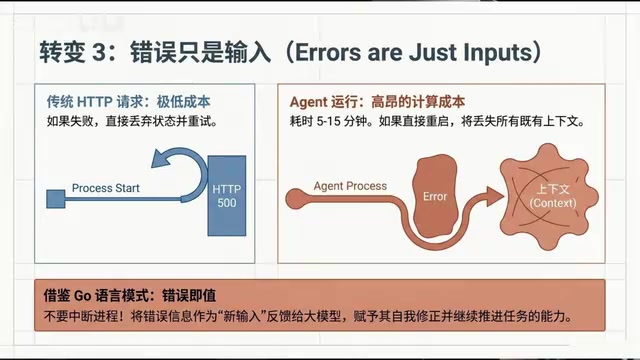
If an error occurs at minute 14, the right move is to feed that error back to the model as new input: "That path didn't work — find a different route around it." This saves compute costs and, more importantly, preserves the accumulated context so the task can keep moving forward. This tolerance for uncertainty is exactly what agent development demands.
From Unit Tests to Evals: Embrace Uncertainty
This one makes a lot of veteran engineers visibly uncomfortable: the unit tests you could write in your sleep are largely obsolete in this new world.
The old logic was deterministic: feed input A into code B, get output C — write an assertion and call it tested. But feed input A to an agent, and even across 100 runs, the intermediate steps and final outputs may all differ. This non-determinism can genuinely unsettle engineers who've spent their careers in full control.
More critically, we can no longer settle for "does this feature work at all?" If an agent succeeds perfectly one time in ten but crashes or produces garbage the other nine, it has no business anywhere near production. The testing focus has shifted: we need to measure reliability at scale, not single-run assertions.
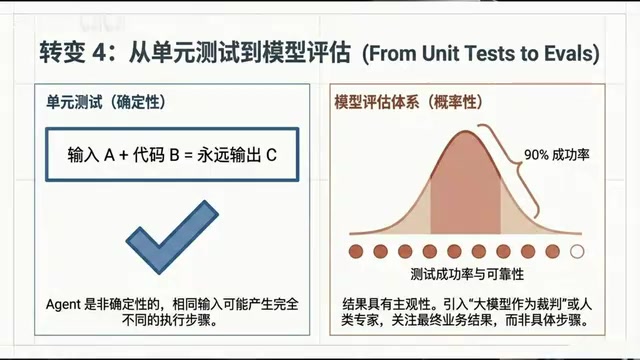
Agent outputs are often deeply subjective. Ask an agent to summarize a research report — no unit test can tell you whether that summary is actually good. This is where evaluation mechanisms come in: either bring in human domain experts to score the output, or use a more capable model as a judge to objectively assess quality.
This new testing paradigm for AI systems is commonly called Evals and represents one of the most active research areas in LLM application engineering today. Unlike deterministic unit test assertions, Evals typically take several forms: scoring against annotated datasets by comparing model output to gold-standard answers; "LLM-as-Judge," where a more capable model (e.g., GPT-4o) scores the output of the model under test against predefined criteria; and human annotation, where domain experts conduct blind evaluations. Core metrics shift from binary pass/fail to statistical measures like Pass@k, Consistency, and Robustness. Major organizations including OpenAI and Anthropic now treat Evals capability as a critical threshold for whether an AI application is ready for production.
Build APIs Designed for Agents
Agents are getting smarter every day, but backend APIs remain unchanged — and that friction is a real problem.
A backend engineer with ten years of experience sees delete_item and instantly knows what it does. But an agent doesn't have your decade of business context. It can only read the function signature and documentation. This means tools and interfaces must be self-describing and semantically clear: parameters and docs written explicitly enough that the agent genuinely understands what will happen when it calls this endpoint. Bridging this gap is a critical step in making agents actually reliable.
The engineering practice behind this is typically called Tool Definition or Function Calling. Major LLM platforms (such as OpenAI's Function Calling and Anthropic's Tool Use) require developers to declare each callable tool's name, parameter types, and natural language description in a structured JSON Schema format. Models rely on these descriptions to understand the semantics of a tool — not on naming conventions or implementation details. This means the traditional backend "convention over configuration" approach (like RESTful verb conventions) fails completely with agents. A good tool definition needs to read like an operations manual for a new employee: clearly stating what the tool does, what it doesn't do, what side effects it has, and when it should NOT be called. The quality of these descriptions directly determines how accurately the agent invokes its tools.
Build to Delete: The Disposable Software Mindset
If you want to survive this AI wave, one final principle needs to be internalized at a bone-deep level: build to delete. Here's a quick summary of the survival rules:
- Trust the model: let it run, but always have a verification layer
- Preserve semantics: forget rigid booleans — context and meaning are everything
- Design for recovery: when errors happen, don't reach for the restart button; design for graceful recovery
- Embrace Evals: let go of the assertion mindset and adopt systematic, comprehensive evaluation
Software is disposable. That sounds harsh, but it's also liberating. In this era of rapid AI advancement, the perfect code you stayed up all night writing today may be entirely rewritten by a smarter model tomorrow. Given that reality, why cling to old baggage? Releasing the need for control and embracing uncertainty — that may be the most essential skill for developers in this new era.
Related articles

Amphibious Transforming Drone: Beyond 100x Power Savings, What Are the Real Needs?
Is the amphibious transforming drone just a gimmick? Starting from the 100x power difference of the M4 Morphobot, explore real application scenarios and thesis topic ideas, analyzing boundary conditions where pure drones and pure ground robots both fail.

Warhound Raises $200 Million: Genetically Engineered "War Dogs" Paired with Anduril Gear
Warhound raises $200M, backed by Ben Lamm and Palmer Luckey, to genetically engineer dogs for military and law enforcement use and equip them with Anduril gear. This article analyzes its technology direction, funding logic, and ethical controversy.

Claude API Comes to Google Cloud: IAM Integration and SDK Access Guide
Anthropic hosts the full Claude API on Google Cloud with IAM-controlled permissions and unified billing. This guide covers the Vertex AI and Anthropic-hosted entry points, IAM role configuration, and SDK access.