From Voice Memos to GitHub Issues and PRs: ElevenLabs Scribe in Action
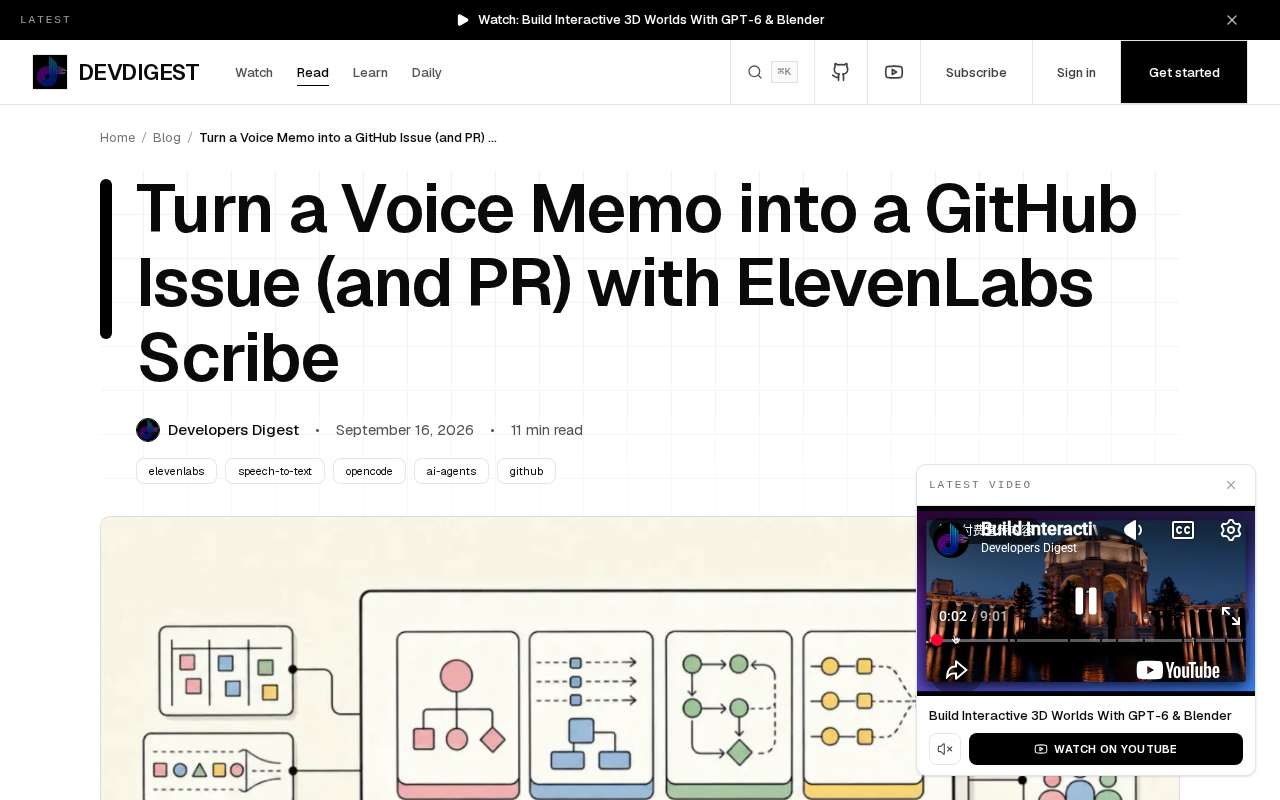
Turn voice memos into GitHub Issues and PRs automatically using ElevenLabs Scribe and a headless coding agent.
This article presents an automated development workflow centered on ElevenLabs Scribe: developers record a natural-language voice memo, Scribe transcribes it accurately, and a headless coding agent formats the text into a structured GitHub Issue. A webhook mechanism can then trigger the agent to auto-generate a Pull Request. This three-stage pipeline bridges the gap between spontaneous ideas and trackable engineering tasks — especially covering the blind spot of capturing thoughts when developers aren't at their computers. The article also notes that transcription accuracy and agent-generated code reliability still require human review; automation output should be a starting point, not an endpoint.
Spotted a bug on your walk home — how do you capture it? Most people jot a quick note in a memo app, then never look at it again. The problem is that kind of "draft capture" lacks structure and rarely translates into an actionable development task. ElevenLabs Scribe offers a different path: turning spoken ideas into structured GitHub Issues, and even going further to generate Pull Requests.
The Complete Pipeline: From Voice to Structured Task
The core idea is to chain three stages into a single automated pipeline. First, you record a voice memo on your phone — just describe the bug or feature request in plain language. Second, the ElevenLabs Scribe API transcribes the audio, converting your speech into text. Third, a headless coding agent takes that transcription and formats it into a properly structured GitHub Issue.
The value of this workflow lies in bridging the gap between "capturing an idea" and "landing it in engineering." Traditional memos preserve raw thoughts. This pipeline turns every voice recording directly into a trackable, assignable, actionable item in your repository's workflow.
Scribe's Role in the Pipeline
ElevenLabs Scribe is the critical converter in this chain. It accurately transcribes audio into text — and the quality of this step directly determines whether the downstream agent correctly interprets your intent. Compared to typing manually in a noisy environment, voice input has a much lower barrier: you can capture tasks while walking, commuting, or any time typing isn't convenient.
Transcription accuracy is especially important because technical descriptions often contain proper nouns, variable names, and domain-specific terminology. High-quality speech recognition reduces misinterpretation by the downstream agent, preventing the generated Issue from drifting away from your actual intent.
A headless coding agent is an AI programming assistant that runs autonomously in the background without a graphical interface. Unlike code completion tools that require real-time developer interaction, a headless agent can independently complete an entire task chain — reading requirements, searching the codebase, locating relevant files, generating diff patches, and submitting a PR — all without anyone sitting at a screen. Current examples in the industry include Devin, SWE-agent, and GitHub Copilot Workspace. These agents typically use tool-calling capabilities to execute shell commands, read and write files, and run tests, simulating a human developer's workflow inside a sandboxed environment.
Adding a Webhook Agent to Auto-Generate PRs
If generating an Issue is the baseline capability of this workflow, connecting a webhook agent is the advanced mode. Via webhook, the system can automatically trigger a coding agent after an Issue is created, having it attempt to produce a Pull Request directly from the description.
This means the journey from "I thought of a bug on my walk" to "a fix PR appears in the repo ready for review" requires almost no human intervention. Developers only need to review the agent-generated code — not start from scratch understanding the requirement, locating the problem, and writing a patch. This pattern combines the convenience of voice input with the execution power of an automated agent, forming a relatively complete closed loop.
A webhook is an event-driven HTTP callback mechanism: when a specific event occurs in a system (like GitHub), it proactively sends a POST request to a pre-registered URL, carrying detailed event data. Compared to traditional polling, webhooks don't require the client to repeatedly check for status updates — they have lower latency and consume fewer resources. In this workflow, as soon as a GitHub Issue is created, it immediately notifies the coding agent service. The agent then receives the Issue's title, description, and metadata, and begins analyzing the codebase to attempt a fix. This "event-as-trigger" pattern is the key infrastructure enabling a fully unattended closed loop.
The Real-World Impact of This Kind of Workflow
For individual developers and small teams, this approach reduces the probability of ideas slipping through the cracks. The thoughts most likely to be forgotten are precisely those that surface when you're away from your computer — and voice capture covers exactly that blind spot.
Zooming out, this reflects a broader trend: AI programming tools are evolving from "helping write code" toward "participating in the entire development lifecycle." Capabilities that were once separate — speech transcription, task structuring, code generation — are being combined into end-to-end automated pipelines. That said, real-world use still requires attention to transcription accuracy, the reliability of agent-generated code, and whether auto-generated PRs conform to project standards. Human review remains essential. The agent's output should be treated as a starting point, not a finished product.
Related articles
Automattic Executives Signed Reciprocal Severance Agreements During Mullenweg's Brief Ouster
Automattic's CFO and General Counsel signed reciprocal severance agreements during Matt Mullenweg's brief ouster, covering one year's salary and accelerated equity vesting, raising corporate governance concerns.
H3 Singularity Optimization: 40% Speed Boost With Better Image Quality
A Reddit user's Minimax Singularity workflow tip: insert an RTX upsampler before H3 Latent for 40%+ speed gains and better quality. Covers parameters, 12-bit output, and more.
Glyph: A Multi-Strategy Agent System for Automated Enterprise Data Catalog Annotation
Glyph is a multi-strategy LLM agent system for enterprise data catalogs that automates column description generation and sensitivity ontology tagging, grounding outputs in pipeline source code to improve accuracy.