From Zero to AI Career: A Complete Breakdown of a 3-Month Self-Study Roadmap

A 3-month AI self-study roadmap for beginners, from foundations to CV, NLP, and data mining branches.
A practical 3-month AI self-study roadmap for complete beginners: quickly cover Python, math, and machine learning basics, then master deep learning and PyTorch, and finally choose a branch by data type—CV, NLP, or data mining—to reach entry-level intensity for career switching.
Why You Need a Roadmap with "Clear Intensity"
For beginners with no background who want to break into the AI field, the biggest source of confusion is usually not "what to learn," but rather "to what depth" and "in what order." The tutorials out there are either overly complex—making you plow through several thick math textbooks—or scattered and disorganized, leaving you unsure of what you can actually do after finishing them.
This article is compiled from an AI self-study roadmap shared by a Bilibili content creator. The core idea is to learn by doing, prioritize what to study, and clearly define the time and intensity of each stage. This roadmap covers the full pipeline—from essential foundations to deep learning frameworks, and then to the three major branches of computer vision, natural language processing (NLP), and data mining. The goal is to reach an entry-level intensity suitable for career switching or combining AI with research in roughly three months.
Below, we'll break down this roadmap layer by layer and add some practical suggestions.
Stage One: Essential Foundations (About Half a Month)
The essential foundations are divided into three parts: math, Python, and machine learning. The most crucial mindset here is "don't get overly bogged down in the basics."
Python: Get Through the Syntax in Three Days
It's recommended not to spend too much time on Python—three days to grasp the basic syntax is enough. The logic behind this: programming skills are honed through actual projects. In the early stages, you only need to be able to read code and write simple scripts. Real progress will happen naturally later, as you tackle algorithms and run projects.
Math: Prioritize Understanding Concepts, Don't Grind Through Problems
Math also gets just three days, with a very clear attitude—in the early stages, you only need to understand the concepts. Don't buy thick books, and don't obsess over deriving formulas.
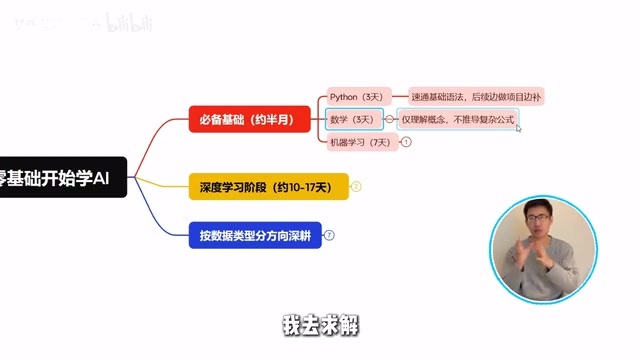
This advice is quite pragmatic for career switchers starting from scratch. The core goal is: when someone mentions a mathematical term, you know roughly what it means and where it's used. The most commonly used concepts in linear algebra, probability theory, and calculus will be reinforced repeatedly as deep learning progresses—far more efficient than grinding through textbooks from the very start.
Machine Learning: Just Study Four Classic Algorithms
The machine learning section offers a very restrained checklist: linear regression, logistic regression, tree models, and ensemble algorithms. This takes about a week, and it's not recommended to go through every traditional algorithm.
These four algorithms are the bedrock of machine learning: linear regression and logistic regression help you build a basic understanding of the "model—loss—optimization" cycle, while tree models and ensemble algorithms (like Random Forest and XGBoost) are the workhorses for structured-data tasks in industry. Master these four, and you'll grasp the core ideas of machine learning.
Stage Two: Deep Learning (About Two to Three Weeks)
After building the foundations, you move into deep learning. This stage is divided into two parts: "algorithm principles" and "framework hands-on practice."
Core Algorithms: Neural Networks, CNNs, Transformers
It's recommended to spend about a week getting through these core algorithms: neural networks, convolutional networks (CNNs), and Transformers.
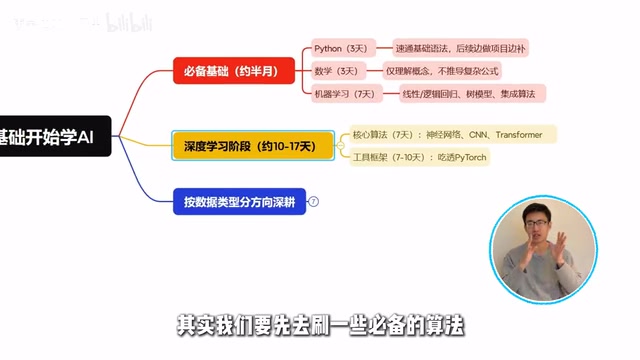
This selection is very representative. Neural networks are the foundation, CNNs are classics in the vision field, and Transformers are the absolute core of today's era of large models—whether you go into vision or NLP later, there's no getting around Transformers. Compared with the old approach of learning all the way through RNNs and LSTMs, focusing directly on Transformers now is a choice that better fits the current landscape.
Framework: Master PyTorch in One to Two Weeks
After the algorithm principles, you'll need to spend one to two weeks mastering the PyTorch framework. PyTorch is already the mainstream deep learning framework in both academia and industry. Being able to independently build, train, and debug a model with it is the key leap from "understanding the theory" to "being able to do it."
Stage Three: Choosing a Branch—By "Data Type," Not "Field"
The most insightful point in this roadmap is the logic for choosing a branch. It particularly emphasizes: don't choose your direction by field—choose it by the type of data you'll be working with.
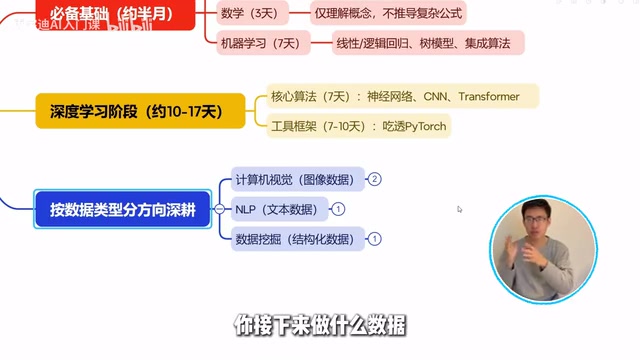
The specific mapping is as follows:
- Image data → Computer Vision (CV)
- Text data → Natural Language Processing (NLP)
- Structured data → Data Mining
This perspective is more grounded than "which AI field do I want to work in." At work, you ultimately face specific data forms. Choosing your tech stack based on data allows your learning path to better align with actual job requirements.
How to Approach Each of the Three Branches
Computer Vision: Tackle Projects by Usage Priority
The vision direction offers a project checklist ordered by frequency of use rather than difficulty:
- Object detection (most widely used—do this first)
- Image segmentation
- Action recognition
- Pose estimation
- Object tracking
- Expand if you have time: diffusion models, vision large models
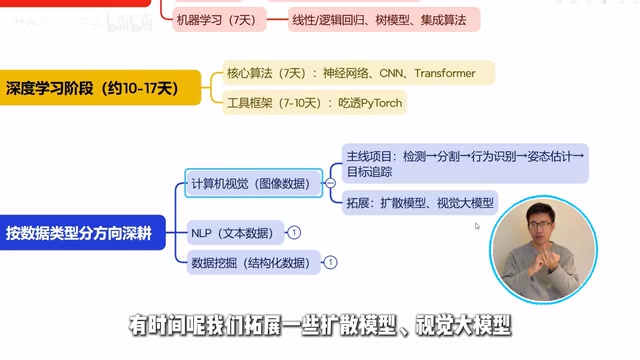
Putting "object detection" first is very pragmatic, because it has the widest application in scenarios like security, autonomous driving, and industrial quality inspection, and it's also the most commonly tested skill in interviews and real projects. Diffusion models and vision large models, as extensions, correspond to the current hot AIGC direction.
NLP: Jump Straight into the Transformers Library
The NLP learning path has changed the most. Nowadays, you no longer need to start from traditional basics to learn NLP—you can go straight to learning Hugging Face's Transformers library.
The advanced path afterward is: large model fine-tuning → quantization → deployment → knowledge base (RAG) → agents (Agent).
This pipeline is essentially the standard skill stack for today's large-model application engineers. From fine-tuning to adapt models to specific tasks, to quantization and deployment for solving real-world efficiency, and then to knowledge bases and agents as application-layer capabilities—it completely covers the closed loop from algorithm to product, making it the NLP learning path closest to today's job market.
Data Mining: Expand into Time Series and Graph Neural Networks
The data mining direction is relatively brief. After mastering the machine learning basics, it's recommended to expand into time series models and graph neural networks (GNNs). The former corresponds to time-series forecasting scenarios in finance and operations, while the latter is widely used in areas like social networks, recommendation systems, and risk control.
The Value and Limitations of This Roadmap
The biggest strengths of this 3-month roadmap are that it's goal-oriented, disciplined in pacing, and closely tied to employment. It repeatedly emphasizes "learn by doing," "prioritize what you study," and "don't get overly bogged down in the basics"—all of which are very friendly to beginners who are short on time and eager to switch careers. In particular, jumping straight into Transformers for NLP and choosing a direction by data type reflect an accurate read of the current technology landscape.
Of course, it's worth being realistic: what you achieve in three months is an "entry-level, usable" level, not mastery. The math foundation is heavily compressed and will still need to be filled in over the long term—especially for those aspiring to do research or dive deep into algorithm study. Moreover, simply following the roadmap is far from enough. Real ability comes from independently completing end-to-end projects, hitting pitfalls, and debugging repeatedly.
For beginners, the most practical approach is: first use this roadmap to build a knowledge framework, then pick one branch to dive deep into, and as soon as possible use a complete project to test and consolidate what you've learned.
Related articles
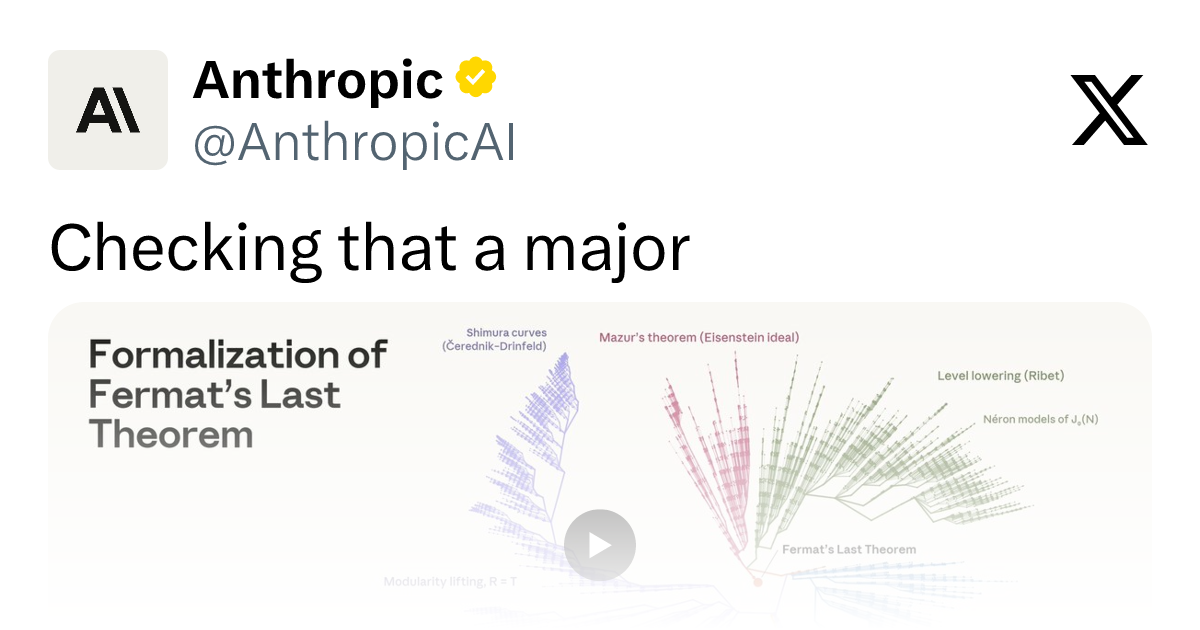
Claude Completes First Formal Proof of Fermat's Last Theorem: A Record-Breaking 13 Million Lines of Lean Code
Anthropic's Claude completes the first formal proof of Fermat's Last Theorem in over 13 million lines of Lean code — the largest ever — plus 29,000+ subsidiary theorems, opening new paths for AI-assisted math verification.

Microsoft Copilot Enters the NFL: How AI Is Supporting On-Field Decision-Making
Microsoft Copilot and Excel are entering NFL sidelines and booths, helping Seahawks analysts and coaches with real-time game decisions. Here's what it means for AI in pro sports.
Microsoft Copilot Goes Autopilot: From Assistant to Autonomous Long-Running Task Execution
Microsoft is evolving Copilot into autonomous Autopilots powered by Opal and Windows 365 cloud PCs, enabling end-to-end completion of long-running tasks without human intervention.