From Zero to LLM Application Engineer: Breaking Down a 19-Stage Full-Stack Course

A 19-stage layered LLM full-stack course covering RAG, Agent, and multimodal learning tracks.
The "LLM Application Development Complete Edition" course on Bilibili organizes 19 learning stages into multiple tracks — full-stack fundamentals, interaction, RAG, Agent, multimodal, and more — built around a single large-scale AI project. Its layered design lets beginners start at Stage 00 while Python developers jump straight to Stage 01. The curriculum progresses from Prompt Engineering and multi-turn dialogue through RAG knowledge bases and autonomous Agents, culminating in image and voice multimodal applications. Using a hands-on, line-by-line coding approach, it's suited for career-changers, Python engineers expanding into AI, and developers seeking a systematic grasp of RAG and Agent architectures.
A Full-Stack LLM Course for Learners at Every Level
Building large language model (LLM) applications is rapidly becoming a core skill upgrade for software engineers. A creator on Bilibili known as 花菜 has launched a comprehensive course called "LLM Application Development Complete Edition," which ties together scattered concepts through a single large-scale AI full-stack project. The tech stack covers FastAPI, Vue3, LangChain, RAG, Agent, and Harness.
The course's standout feature is its layered design: the entire curriculum is broken into 19 stages, with consideration for learners at different skill levels. Complete beginners start at Stage 00 to build up full-stack engineering fundamentals, while those who already know Python can jump straight to Stage 01: "LLM Programming Basics." This structure turns the course into an adaptive learning path rather than a one-size-fits-all sequence.
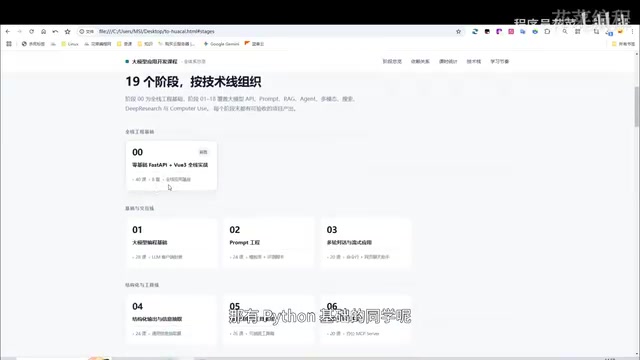
How 19 Stages Form Multiple Learning Tracks
Rather than laying out chapters in a flat list, the course organizes its 19 stages into multiple "tracks." The logic behind this chain-like structure is to slice LLM application development by capability dimension, giving learners a clear sense of where they stand within the broader knowledge map.
The tracks can be summarized as follows:
- Full-Stack Engineering Foundation Track: Laying the engineering groundwork — a prerequisite for all application development that follows.
- Basics & Interaction Track: Covers LLM programming fundamentals, Prompt Engineering, multi-turn dialogue, and streaming applications.
- Structured Output & Adversarial Track: Dives into structured outputs and related handling.
- RAG Track: Retrieval-Augmented Generation — a key technology for enterprise-grade knowledge base applications.
- Agent Track & Agent Application Track: From the principles of autonomous agents to real-world deployment.
- Multimodal Track: Includes image-based and voice-based applications.
- Automation & Capstone Track: Integrates automation across the full project and wraps everything up.

This track-based approach offers a clear advantage: it decouples "learning syntax" from "building applications." Many beginners get stuck in the gap between tutorials and real-world practice. The progressive chain — from interaction to RAG to Agent — mirrors how technical complexity scales up in actual projects.
The Technical Evolution from Interaction to Multimodal
Worth noting is the deliberate ordering of technical difficulty. The course starts with the most fundamental LLM calls and Prompt Engineering, then transitions to multi-turn dialogue and streaming applications — the bread and butter of any conversational product.

Beyond that, RAG and Agent form the technical core of the course. RAG addresses the "knowledge boundary" problem of LLMs, enabling applications to answer questions based on private data. Agent gives applications the ability to autonomously plan and invoke tools. These two areas represent the hottest — and most engineering-intensive — directions for LLM deployment today.
The course concludes with multimodal capabilities, bringing in image and voice applications. Multimodal represents an expansion of LLM applications beyond text, evolving toward richer input and output modalities.

RAG (Retrieval-Augmented Generation) is currently one of the most mainstream deployment patterns for enterprise LLM applications. The core idea: before querying an LLM, first retrieve relevant passages from an external knowledge base (such as company documents or databases), then pass those passages as context along with the question. This allows the model to answer questions beyond its training data. The approach avoids the high cost of frequent fine-tuning and also addresses the "hallucination" problem — the model generates answers grounded in retrieved evidence rather than fabricating them. Agent takes things further: it gives LLMs a "plan-act" loop, enabling autonomous task decomposition, external tool invocation (search engines, code executors, APIs, etc.), and strategy adjustment based on intermediate results. RAG focuses on knowledge retrieval augmentation; Agent focuses on autonomous task execution. The two are often used together, forming the core architectural paradigm of modern LLM application engineering.
A "Line-by-Line Coding" Teaching Approach
The course emphasizes a hands-on teaching style — the instructor commits to walking learners through the code line by line from start to finish. In a field like LLM application development, where engineering practice is intense and concepts can be abstract, pure theory rarely translates into hands-on ability. A line-by-line implementation approach effectively lowers the barrier to getting started.
That said, based on publicly available materials, the course currently focuses more on introducing the framework and learning path. The depth of each stage, code quality, and completeness of the final project will need to be evaluated through actual study. For engineers looking to systematically enter full-stack LLM development, the FastAPI + Vue3 + LangChain combination covers both frontend/backend and core AI capabilities — a reasonably complete foundation for practical project work.
LangChain, part of the course's tech stack, is currently the most widely used framework for LLM application development. It provides high-level abstractions for model calls, prompt management, memory modules, RAG pipelines, and Agent tool chains, dramatically lowering the engineering barrier to building LLM applications from scratch. FastAPI is a modern, async Python web framework that can build high-performance API services with minimal code — a mainstream choice for LLM backend services when paired with LangChain. Harness is a CI/CD and automated testing platform. Its inclusion in the capstone stage is intended to complete the full engineering loop from development to deployment — something relatively rare in similar AI courses, reflecting the curriculum's emphasis on production-grade engineering practices.
Who Is This Course For?
The course casts a fairly wide net in terms of audience: complete beginners looking to transition into AI development, engineers with Python experience who want to fill gaps in LLM application skills, and developers who want a systematic understanding of the RAG and Agent tech stack can all find an appropriate entry point within the 19 stages. The key is to choose a starting point based on your current skill level — and avoid spending time revisiting material you've already mastered.
Related articles

iPhone Duo Review Controversy: Why Apple's First Foldable Is Said to 'Should Be Called an iPad'
The Vergecast debates the iPhone Duo review controversy: is a 7 fair? Why are apps struggling? Why critics say it 'should be called an iPad'? We unpack Apple's first foldable's positioning mismatch and first-gen compromises, plus AI security flaws and agentic shopping.
Meta vs. Publishers: The AI Data Battle Over Terms of Service Changes and the Future of the Internet
Meta changed its business account terms to allow AI training on linked website data, sparking backlash from publishers and creators. Industry groups demanded negotiations, forcing Meta to remove 'training' wording and delay the effective date. The dispute reveals the deeper battle over data authorization and the future of the internet in the AI era.

When Outside Xbox Meets Blood on the Clocktower: A Legion Match in Minecraft
Outside Xbox guests Ellen and Mike play Minecraft Blood on the Clocktower in a Legion game. How can three good players fight an evil majority amid information noise? This article breaks down Legion mechanics, information-role mind games, and the endgame reversal.