From Zero to Playable in 6 Weeks: Opus 5.5 + Godot in Practice

Zero-background developer uses Claude Code and Godot to turn sketches into a playable prototype in six weeks.
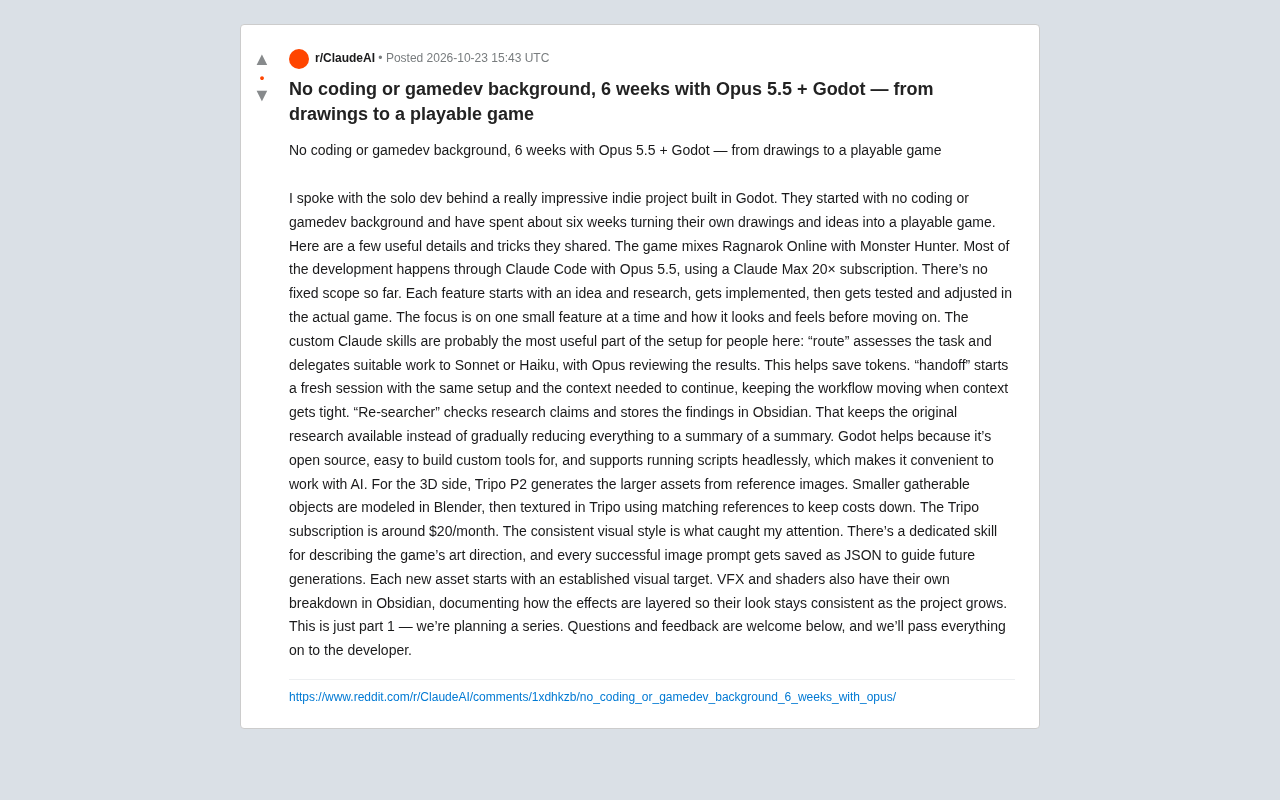
A developer with no programming or game dev background spent about six weeks using Claude Code (Opus 5.5, Claude Max 20×) and Godot to turn hand-drawn sketches into a playable prototype blending Ragnarok Online and Monster Hunter gameplay. The workflow relies on custom skills: route for model dispatch, handoff to counter context degradation, and Re-searcher to preserve research in Obsidian. Art consistency comes from a style skill and JSON prompt library; 3D assets use Tripo P2 and Blender.
A solo developer with no programming or game development background turned their hand-drawn sketches and ideas into a playable prototype in about six weeks. The project blends gameplay from Ragnarok Online and Monster Hunter, with Claude Code paired with Opus 5.5 (on a Claude Max 20× subscription) as the primary development driver. The original share comes from Reddit, and the author notes this is only part one of a series, with more updates to follow.
From Zero to Playable: What 6 Weeks Produced
This project has no fixed scope. Every feature starts with an idea and research, then gets implemented and tested and adjusted inside the actual game. The developer focuses on doing one small feature at a time — first seeing "what it looks like and how it feels" — before deciding whether to push further.
This approach differs noticeably from a traditional game development process. Usually people write a design doc, lock down a framework, and then gradually fill in content; here it's more like high-frequency trial and error assisted by AI, replacing documentation-driven reasoning with playability feedback. For someone without a coding foundation, this lowers the barrier to entry and avoids getting stuck in the abstract design phase.
Where Art Style Consistency Comes From
What really makes this project stand out is its visual consistency. The developer built a dedicated skill to describe the game's art direction, and every successful image prompt is saved as JSON to guide subsequent generation. Every new asset has its visual target defined before work begins. VFX and shaders also get their own breakdowns in Obsidian, recording how effects are layered so the look doesn't drift as the scale grows.
At its core, this process turns "art direction" from human intuition into a searchable asset library — an approach worth borrowing for indie developers without an art team.
Here, "skill" refers to a reusable instruction module in AI coding agents like Claude Code: typically stored as a Markdown file containing role definitions, operational steps, and constraints, which the agent automatically loads and executes on relevant tasks. Unlike a one-off prompt, it solidifies repeatedly used working methods into a callable asset. Likewise, "saving prompts as JSON" means storing effective image-generation prompts by structured fields (style, material, lighting, camera) for easy retrieval, reuse, and batch fine-tuning, thereby maintaining a consistent visual language across multiple rounds of generation.
Three Custom Claude Skills Are the Core
The most reference-worthy part of the whole workflow is the three custom skills.
route: Dispatching Models by Task Complexity
"route" evaluates the task and assigns appropriate work to Sonnet or Haiku, with Opus reviewing the results. This saves tokens while preserving quality. For developers running projects on high-end models long-term, this design directly controls costs.
Claude's model family is currently divided into three tiers: Opus, Sonnet, and Haiku. Opus is the most capable but has the highest per-token cost; Sonnet balances capability and cost; Haiku is the lightest, fastest, and cheapest. "Token cost" refers to billing based on the number of input and output tokens, with long contexts and long outputs significantly amplifying expenses. Delegating simple tasks (formatting, naming, small boilerplate snippets) to Haiku/Sonnet and letting only Opus handle architecture decisions and code review is a common cost-optimization strategy in AI-assisted development — at the price of extra dispatch logic and quality safeguards.
handoff: Start a New Session When Context Fills Up
"handoff" opens a new session with the same configuration and the context needed to continue. When context is nearly full, the workflow doesn't break. This is very practical for long-iteration projects, since context degradation in long sessions is a common pain point.
An LLM's context window is the upper limit on the total tokens a single session can hold, including system prompts, conversation history, file contents, and model output. As the conversation accumulates toward that limit, the model's attention to early information gets diluted, causing "context degradation" — forgetting earlier agreements, repeating mistakes, or ignoring key constraints. The handoff approach is to structure the current progress, established decisions, and to-dos into a handoff document, then restart in a new session with a condensed context — resetting the window without losing critical state. This is a common engineering technique in long-cycle AI collaboration projects.
Re-searcher: Preserving Research Conclusions
"Re-searcher" verifies assertions in research and saves conclusions to Obsidian. This way the original research is preserved rather than gradually shrinking into "a summary of a summary." This skill addresses a hidden problem in AI-assisted development: after multiple rounds of conversation, early conclusions get repeatedly compressed and distorted.
Why Godot and These Tools
Godot was chosen for very concrete reasons: it's open source, easy to build custom tools for, and supports headless script execution — all of which make it smoother to collaborate with AI. Headless execution means the AI can directly run scripts to verify, rather than manually clicking through the editor each time.
For 3D assets, larger assets are generated by Tripo P2 from reference images; smaller collectibles are modeled in Blender, then textured in Tripo with matching reference images to keep costs down. The Tripo subscription is about $20 per month. This combination separates "generation" from "manual control," keeping costs in check while ensuring key assets don't get out of hand.
Godot is an MIT-licensed open-source game engine supporting 2D and 3D, with scripting primarily in GDScript and optionally C#. Its headless mode means running the engine from the command line without opening a graphical interface — useful for running tests, importing assets, and executing build scripts, making it ideal for AI to call directly and read output for automated verification. Compared to Unity and Unreal, Godot's editor extension and plugin system is lighter, and you can write custom tool panels in GDScript alone, which significantly lowers the barrier to "tailoring tools specifically for AI workflows."
Takeaways Worth Borrowing
The value of this case isn't the "made a game in 6 weeks" gimmick, but the reusable AI-assisted development workflow it demonstrates: using skills to manage model division of labor, using handoff to counter context degradation, using Obsidian to preserve research, and using a JSON prompt library to lock in art style. The developer also notes there's no fixed scope — it's all about validating feel one feature at a time.
One note: these details come from a single interview share, so the actual results and reproducibility still need verification from more developers. The author mentions this is only part one of a series; if more implementation details are released later, this kind of workflow will be even more valuable as a reference.
One-line Summary
A developer with zero background used Claude Code plus Godot to turn hand-drawn sketches into a playable prototype in six weeks.
Paragraph Summary
A developer with no programming or game dev background spent about six weeks using Claude Code (Opus 5.5, Claude Max 20× subscription) and the Godot engine to turn their own hand-drawn sketches into a playable prototype, blending gameplay from Ragnarok Online and Monster Hunter. The project uses a no-fixed-scope iterative approach — building one small feature at a time and immediately validating feel. The core method is a set of custom skills: route dispatches Sonnet/Haiku by complexity with Opus reviewing to save tokens, handoff starts a new session with carried-over state when context nears its limit, and Re-searcher verifies assertions and preserves conclusions in Obsidian. Art consistency is maintained through a skill describing the art direction, successful prompts saved as JSON, and breakdown records of VFX and shaders. 3D assets are generated by Tripo P2 for large items, with small items modeled in Blender and then textured, at about $20/month. The author stresses this is only part one, and results still await verification from more developers.
Related articles

Transitioning from Traditional Development to LLM Application Development: Avoiding the Three Hurdles 90% of Courses Don't Teach
Traditional backend developers transitioning to LLM application development face three real hurdles—model capability boundaries, requirement judgment, and effect evaluation—not math. This article breaks down the core engineering skills 90% of courses don't teach and offers a practical transition path.
LLM WIKI in Practice: Making Agents Truly Understand Enterprise Business — Building a Troubleshooting Agent from Scratch
Inaccurate agent responses stem from a lack of business understanding. Based on a real order customer service troubleshooting agent case, this article explains how LLM WIKI builds a business knowledge base from codebases, uses incremental updates, and connects to agents via MCP server to achieve business understanding and troubleshooting with zero documentation.

A Computer Science PhD's Take: AI Career Planning for New Graduates — Algorithm vs. Application Development
A CS PhD advises new graduates on AI careers: try algorithm roles first but don't fixate; application development has more openings. Focus on LLM fine-tuning/deployment and agent frameworks (MetaGPT, LangChain), and watch AI + industry implementation to broaden job paths.