Frontend to AI Full-Stack: Salary Gains, Skill Roadmap, and Transition Advantages Explained

Breaking down salary truth, reusable advantages, and a three-stage learning path for frontend-to-AI-full-stack transitions.
Based on a popular Bilibili tutorial and BOSS Zhipin data, this article analyzes the feasibility of frontend developers transitioning to AI full-stack. It reviews 2,000+ positions showing salaries starting at 12K RMB/month, 20-40K for experienced developers, and 500K annually for tech leads, with AI agent roles growing at 107% CAGR—though the data needs cross-validation. It highlights the natural advantage of reusing existing frontend skills in AI product experience delivery, outlines a three-stage learning path (LLM fundamentals, RAG projects, multi-agent orchestration), and cautions against "7-day mastery" claims.
Title
Frontend to AI Full-Stack: Salary Gains, Skill Roadmap, and Transition Advantages Explained
Meta Description
Based on a popular Bilibili tutorial and BOSS Zhipin job data, this article breaks down the real salary ranges for frontend developers transitioning to AI full-stack, a three-stage skill learning roadmap, and the natural advantages frontend developers have in AI application deployment, along with key considerations for the transition.
Article Content
Amid the AI wave, frontend developers face a critical choice: keep competing in traditional business areas, or leverage their existing tech stack to break into AI application deployment. A popular Bilibili tutorial claims it can help frontend developers complete the transition in a short time, but setting aside marketing rhetoric, what are the real salary figures, skill requirements, and learning paths for frontend-to-AI-full-stack transitions? Based on the recruitment data disclosed in that tutorial and industry observations, this article breaks down the feasibility and key milestones of this transition path.
1. Real Salaries and Demand for AI Full-Stack Positions
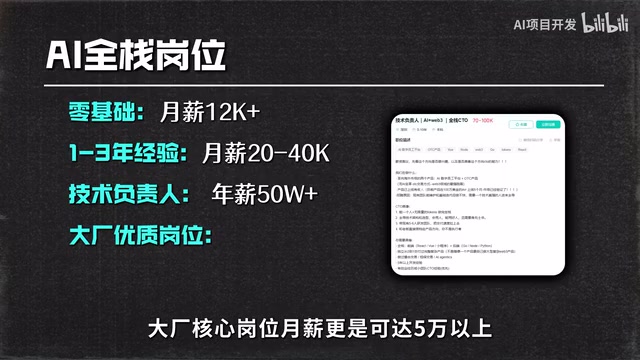
The tutorial author reviewed over 2,000 AI full-stack positions on BOSS Zhipin and presented a set of attractive figures: frontend newcomers transitioning from zero background start at 12,000 RMB per month in AI full-stack roles; after 1-3 years of AI deployment experience, salaries stabilize at 20,000-40,000 RMB; technical leads who can independently manage AI project deployment typically earn 500,000 RMB annually, with core positions at major tech companies reaching over 50,000 RMB per month.

Behind these numbers is a key judgment: what enterprises lack most in AI deployment is not model training talent, but practical developers who can connect AI interaction, project launch, and user experience refinement end to end. The tutorial cites data showing that AI agent positions have a compound annual growth rate of 107%, with the talent gap continuing to widen. It should be noted that these salary ranges come from a single recruitment platform sample and actual levels will vary by city, company size, and personal project experience—but the trend of "strong demand for AI application-layer developers" is consistent with publicly observed industry trends.
2. The Natural Advantage of Frontend Transition: Change Direction, Not Tech Stack
The tutorial repeatedly emphasizes one point: the biggest advantage of frontend-to-AI-full-stack transition is "changing direction without changing tech stack." Existing engineering capabilities, component encapsulation experience, and interaction development skills can all be reused—there's no need to abandon existing积累 to grind through low-level algorithms, nor to learn backend from scratch.
Compared to pure algorithm or backend developers who can only call APIs and don't understand user experience, frontend developers excel at interaction refinement and deployment optimization for AI products, capable of producing production-grade commercial projects—which is exactly what enterprises urgently need. Meanwhile, solid JS programming and logical thinking make frontend developers learn AI workflows and tool calling more efficiently than zero-background practitioners. This judgment is reasonable: the competitive focus at the AI application layer is shifting from "model capability" to "product experience," and frontend happens to stand at the last mile of experience delivery.
3. Three-Stage Learning Roadmap: From Fundamentals to Multi-Agent
The tutorial divides the learning path into three stages, with the core approach being project-driven throughout and discarding empty theory.
Stage 1: Solidify LLM Application Fundamentals
Thoroughly understand LLM application principles, prompt engineering, and the core logic of function calling; master AI API integration, frontend AI component encapsulation, and LangChain basics; complete the mindset shift from traditional frontend to AI frontend; and be able to develop basic agent functionality. The key at this stage is not understanding the model's internal structure, but learning to integrate model capabilities into existing frontend engineering systems.
Function calling is the core mechanism for LLMs to interact with external systems. Developers pre-declare a set of available functions to the model (such as checking weather, querying databases, sending emails), and after understanding user intent, the model outputs structured call requests (function names and parameters). The application side executes them and returns results, and the model then generates a final answer based on the results. It upgrades LLMs from "only able to chat" to "able to get things done," and is the foundational capability for agents, RAG, and automated workflows. For frontend developers, the significance of understanding function calling is: AI application frontends no longer just render text, but need to handle intermediate states of tool calls, loading feedback, and error fallbacks—which is exactly an extension of frontend engineering capabilities.
LangChain is an open-source development framework for building LLM applications, providing modular components such as prompt templates, model call wrappers, tool integration, memory management, retrieval-augmented generation (RAG), and agent orchestration. It supports a JS/TS version (LangChain.js) that can seamlessly integrate into Node and frontend engineering systems. The framework's value lies in abstracting repetitive work like "prompt assembly, multi-turn context management, and tool scheduling" into reusable chains and agents, letting developers focus on business logic. When learning LangChain, note that its abstraction layer is relatively thick—it's recommended to first manually implement the basic call flow before using the framework, to avoid only knowing how to call APIs without understanding the underlying interactions.
Stage 2: Core Practical Projects
Focus on chain-of-thought invocation, tool integration, long/short-term memory mechanisms, and RAG knowledge base deployment; build commercial projects such as AI Q&A, enterprise knowledge bases, and AI content generation using Vue/React. The tutorial claims these projects fully match enterprise hiring standards and can be directly written into resumes.

RAG (Retrieval-Augmented Generation) is the mainstream approach for enabling LLMs to answer questions based on private knowledge. Its process: split enterprise documents into chunks and vectorize them into a vector database; when a user asks a question, first vectorize the question and retrieve the most relevant chunks; then insert these chunks as context into the prompt, and let the LLM generate an answer. RAG solves the problems of LLM knowledge expiration, inability to access internal materials, and easy hallucination, and is standard in scenarios like enterprise knowledge bases, customer service Q&A, and document assistants. For frontend developers, RAG deployment involves extensive interaction work such as document upload parsing, streaming answer rendering, and citation source display—a typical scenario where frontend capabilities translate directly into value.
Chain-of-Thought refers to guiding models through prompts to reason step by step and explicitly output intermediate thinking processes, thereby improving accuracy on complex tasks. In engineering practice, chain-of-thought is often combined with tool calling to form agent workflows of "plan first, execute next, summarize last," and is a key concept in the transition from Stage 2 to Stage 3.
Stage 3: Advanced Elevation
Learn multi-agent collaboration, task decomposition, and workflow orchestration; achieve integrated frontend-backend AI deployment; independently develop high-end projects such as automated office tools and code generation tools, targeting mid-to-high-end AI full-stack positions.
Multi-Agent collaboration refers to decomposing complex tasks and having multiple specialized agents (such as planners, executors, and reviewers) collaborate to complete them. Common patterns include supervisor-worker scheduling, debate-style cross-validation, and pipeline-style relay. Complementing this is workflow orchestration: organizing model calls, tool execution, conditional branches, and human confirmation nodes into observable, retryable processes. This layer of capability corresponds to mid-to-high-end AI full-stack positions in enterprises, requiring developers to not only write prompts but also possess system design, state management, and exception handling capabilities—exactly the strengths that senior frontend developers have accumulated in complex single-page applications and engineering practices.
4. A Rational Perspective: Claims That Need Discounting
The tutorial's marketing title contains obvious exaggeration—phrases like "from beginner to expert in 7 days" and "10x better than paid courses" are not rigorous. The skill density across the three stages is considerable; from prompt engineering to RAG to multi-agent collaboration, reaching a project level worthy of a resume in any one area requires weeks of sustained practice, not short-term cramming.
Salary data also needs cross-validation. Figures like 12,000 starting, 20,000-40,000, and 500,000 annual salary come from a single recruitment platform sample and don't distinguish between cities and position levels—suitable as directional reference rather than promises. For frontend developers, a more pragmatic approach is to treat this roadmap as a skill map: first build up LLM API integration and RAG deployment capabilities, then validate your transition progress with real projects, rather than being pushed along by the "high-salary opportunity" narrative.
The transition window does exist, but what determines success is still project quality and engineering capability, not the exaggeration level of course titles.
One-line Summary
Breaking down the salary truth, reusable advantages, and three-stage learning path for frontend-to-AI-full-stack transitions, with a reminder to view marketing rhetoric rationally.
Paragraph Summary
Based on a popular Bilibili tutorial and its disclosed recruitment data, this article analyzes the feasibility of frontend developers transitioning to AI full-stack. It first reviews over 2,000 positions on BOSS Zhipin, noting that AI full-stack salaries start at 12,000 RMB per month, experienced developers earn 20,000-40,000, technical leads earn 500,000 annually, and AI agent positions have a 107% CAGR—but emphasizes the data comes from a single platform sample and needs cross-validation. It then explains the natural advantage of "changing direction without changing tech stack": engineering, component encapsulation, and interaction capabilities can be directly reused, giving frontend developers an edge over pure algorithm backgrounds in AI product experience delivery. The learning path is divided into three stages: LLM application fundamentals and prompt engineering, RAG and commercial project practice, and multi-agent collaboration and workflow orchestration. Finally, it reminds readers that "7-day mastery" claims are unreliable, each stage requires weeks of practice, and the roadmap should be treated as a skill map rather than a high-salary promise.
Related articles

Chain of Thought Isn't Just for AI: How Humans Can Use CoT to Improve Thinking Quality
Chain of Thought isn't just a prompt trick for large models. Starting from a Hacker News discussion, this article analyzes why CoT works for human thinking too, breaks down actionable ways to transfer it, and highlights the key differences between human CoT and machine CoT.
Cloudflare Teams Up with OpenAI: Closi…
Cloudflare Teams Up with OpenAI: Closing the Loop from Vulnerability Discovery to Defense with AI
Cloudflare uses OpenAI Daybreak to investigate security vulnerabilities and generate reviewable remediation plans, while developers use Codex to boost coding efficiency and quality.

Orca Multi-Agent Orchestration in Practice: A Guide to Parallel Collaboration with Claude and Codex
Orca is Stable AI's free open-source agent workbench supporting 34 agents like Claude Code and Codex in parallel. Learn its Git worktree isolation, multi-model orchestration, and mobile management.