Frontiers of Computer Vision: Diffusion Model Safety, Scientific AI, and Why Visual Agents Fail

Exploring diffusion model safety, production CV systems, scientific AI, and why visual agents fail at long-chain tasks.
This article analyzes four cutting-edge computer vision topics from an upcoming technical meetup: robust concept protection against diffusion model misuse, building production-ready CV systems with data-centric approaches, scaling AI from pixels to planetary science, and understanding why computer-use agents catastrophically fail at multi-step tasks due to error accumulation and lack of world models.
A Technical Meetup Focused on the Frontiers of Computer Vision
On August 27, a monthly virtual AI, Machine Learning, and Computer Vision technical meetup is set to take place. These community-driven knowledge-sharing events are often excellent windows into the latest research trends in the field. This meetup, co-organized by the well-known visual data platform Voxel51, brings together researchers from Lehigh University, Ohio State University, and industry to present on hot topics including diffusion model safety, building real-world vision systems, scientific AI, and agent failure modes.
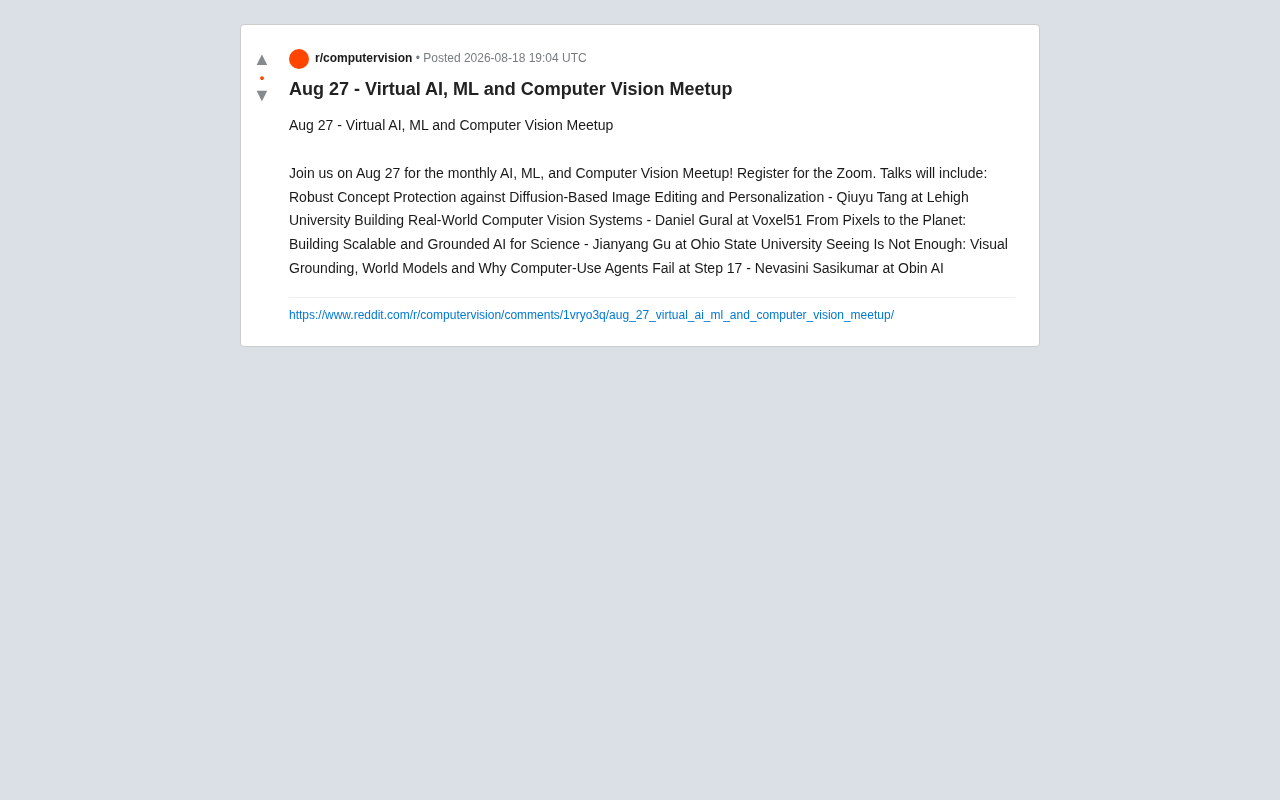
Though these four talks may seem disparate, they collectively outline several major threads in current computer vision research: safety and misuse prevention for generative models, engineering the transition from lab to production, scaling AI for scientific research, and the capability boundaries of multimodal agents. Let's break down the technical context behind each topic.
The Double-Edged Sword of Diffusion Models: Concept Protection and Image Editing Defense
Qiuyu Tang from Lehigh University will present on "Robust Concept Protection against Diffusion-Based Image Editing and Personalization."
This topic strikes at the core contradiction of the diffusion model era. Diffusion Models are a class of generative models based on probability theory, with their core idea drawn from non-equilibrium thermodynamics—the forward process gradually adds Gaussian noise to data until it becomes pure noise, while the reverse process learns to progressively restore clear images from noise. In 2020, DDPM (Denoising Diffusion Probabilistic Models) established the foundational framework for modern diffusion models. Later, Latent Diffusion Models moved the diffusion process into a compressed latent space, dramatically reducing computational costs. Models like Stable Diffusion now allow anyone to easily edit, repaint, or even "personalize" the generation of specific people or styles.
Fine-tuning techniques like DreamBooth and LoRA require only a few sample images to teach a model someone's face or an artist's style—while offering creative convenience, this also raises serious concerns about portrait misuse and artistic style theft. Specifically, DreamBooth is a personalization technique proposed by Google in 2022 that fine-tunes an entire diffusion model using only 3-5 images of a specific subject paired with a rare-word identifier. LoRA (Low-Rank Adaptation), originally from parameter-efficient fine-tuning methods for large language models, adds low-rank decomposition matrices alongside attention layers, reducing trainable parameters by hundreds of times and enabling model customization on consumer-grade GPUs. These two techniques have dramatically lowered the barrier to generating AI images of specific people or styles, sparking widespread debate about copyright and privacy protection.
So-called "concept protection" is essentially a proactive defense mechanism. Researchers add adversarial perturbations imperceptible to the human eye to original images, causing obvious distortion or failure when these images are used for diffusion model fine-tuning or editing. Technologies like Glaze and PhotoGuard are becoming important defense lines against AI misuse. Glaze, developed by the SAND Lab team at the University of Chicago, specifically protects artists' styles from being learned by AI models—it computes style-level adversarial perturbations that cause the style features extracted by AI to deviate from the true style. PhotoGuard, proposed by the MIT team, targets image editing scenarios by applying perturbations at either the encoder level or the diffusion process level, causing severely distorted outputs after editing.
"Robustness" is the key challenge—attackers can attempt to remove protective perturbations through JPEG compression, Gaussian blur, adversarial purification, and other methods. Therefore, protections must remain effective after the image has undergone common processing like compression, cropping, and noise addition to have practical value. Designing perturbation strategies that are robust against these post-processing operations is the core challenge of this research direction.
From Lab to Production Line: Building Real-World Computer Vision Systems
Daniel Gural from Voxel51 will present "Building Real-World Computer Vision Systems." As a core team member of the FiftyOne open-source tool, Voxel51 has long focused on visual data management, visualization, and quality optimization.
This topic touches on an industry consensus: model algorithms are no longer the biggest bottleneck for deploying computer vision—data is. In real production environments, engineers face persistent data-level problems such as annotation errors, class imbalance, missing long-tail scenarios, and difficulty covering edge cases. A model that performs excellently on benchmark datasets often fails repeatedly when deployed to actual business applications, with the root cause typically being the gap between training data and real-world distributions.
Engineering Practices for Data-Centric AI
The concept of Data-Centric AI was formally proposed and vigorously promoted by Andrew Ng in 2021. Its core proposition is: given that model architectures are already mature enough today, systematically improving data quality yields better real-world performance gains than tuning models. Specific practices include identifying and correcting annotation errors, balancing class distributions, discovering data blind spots, and managing data versions.
This is precisely the philosophy Voxel51 advocates. FiftyOne, their core open-source tool, provides a visual interface for browsing and analyzing computer vision datasets, supporting multiple task types including object detection, semantic segmentation, and classification. It integrates embedding visualization (using t-SNE/UMAP dimensionality reduction to view sample distributions), model evaluation (examining prediction errors sample by sample), dataset slicing, and more. Through visual analysis of model predictions, engineers can quickly identify which samples the model gets wrong and why, then supplement or correct data in a targeted manner. This workflow is crucial for pushing CV systems into production environments and serves as a key bridge between academic research and industrial deployment.
From Pixels to the Planet: Scalable AI for Science
Jianyang Gu from Ohio State University will present "From Pixels to the Planet: Building Scalable and Grounded AI for Science."
This topic represents an important direction in AI for Science. AI for Science is a major paradigm shift in scientific computing in recent years, referring to the use of artificial intelligence to accelerate scientific discovery. Computer vision technology is being widely applied in earth science, climate monitoring, ecological conservation, astronomical observation, and other fields—from satellite remote sensing image analysis and species identification to large-scale environmental change tracking. For example, NASA and ESA satellites generate petabytes of image data daily, far beyond what traditional manual analysis can handle, making AI-driven automated analysis an essential requirement.
These applications face two core challenges:
- Scalability: Scientific data volumes are often enormous. Global-scale image data requires models and infrastructure capable of efficiently processing massive datasets. This isn't just a computational power issue—it also involves data storage, distributed training, inference efficiency, and other systems engineering challenges.
- Groundedness: Scientific applications demand extremely high reliability. Model outputs must establish verifiable correspondences with the real physical world rather than producing "hallucination"-style erroneous conclusions. Similar to the hallucination problem in large language models, in scientific scenarios an incorrect prediction could lead to wrong policy decisions, necessitating rigorous uncertainty quantification and embedding of physical constraints.
Elevating AI from pixel-level recognition to planet-scale scientific insights requires substantial work on model generalization, cross-domain adaptation, and result trustworthiness. Representative foundational model work in scientific domains has begun to emerge, including the Prithvi geospatial foundation model from IBM and NASA's collaboration, Meta's Segment Anything for universal segmentation, and Google's SatMAE for remote sensing pretraining. How to maintain both strong general capabilities and domain-specific precision requirements in scientific scenarios is a central challenge today.
Why Visual Agents Fail at Step 17: The Gap Between Seeing and Understanding
Perhaps the most thought-provoking talk comes from Nevasini Sasikumar of Obin AI: "Seeing Is Not Enough: Visual Grounding, World Models and Why Computer-Use Agents Fail at Step 17."
"Computer-Use Agents" are one of the hottest directions right now—from Anthropic's Computer Use to various GUI Agents, people expect AI to look at screens, click and operate, and complete complex tasks just like humans. Since 2024, this direction has experienced explosive growth: Anthropic released Claude Computer Use, allowing AI to directly see screenshots and simulate mouse and keyboard operations; OpenAI's Operator and Google's Project Mariner are similar products. Representative academic works include CogAgent, SeeClick, and OS-World. These agents typically employ a "screenshot-reason-act" loop: at each step, they capture the current screenshot, use a multimodal large model to understand the screen content, and decide on the next action.
However, the reality is that these agents are extremely prone to collapse when executing multi-step, long-chain tasks. In the OSWorld benchmark, even the strongest models can only complete about 12-15% of real computer tasks, far below the human success rate of 72%, exposing a severe capability gap.
Why "Step 17"? Error Accumulation and Agent Failure
"Step 17" is a vivid metaphor: an agent may smoothly complete the first several steps, but as the task chain lengthens, errors continuously accumulate until the agent completely fails at some step. From a mathematical perspective, if the per-step accuracy is 95%, after 17 steps the overall success rate is only (0.95)^17 ≈ 42%—meaning that even with excellent single-step performance, long-chain task reliability drops precipitously. This is a fundamental challenge facing all sequential decision-making systems.
This exposes two fundamental deficiencies:
First, unreliable Visual Grounding. Agents need to accurately map language instructions to specific elements on the screen, but precisely locating buttons, icons, and text boxes in complex interfaces remains challenging. A single grounding error can cause the entire task chain to break.
Second, the lack of a World Model. The world model concept originates from cognitive science and reinforcement learning, referring to a predictive model of environmental dynamics maintained internally by an agent—it can predict "if I execute action A, the environment will transition from state S to state S'." In computer operation scenarios, an ideal world model should be able to predict "how the page will change after clicking this button." Yann LeCun considers world models a key component on the path to advanced machine intelligence. However, current agents largely lack this ability to predict and plan for the consequences of actions. They are essentially reactive rather than deliberative architectures, only able to passively "take one step at a time" without the ability to course-correct from errors.
The title "Seeing Is Not Enough" hits the nail on the head—true intelligence requires not just "seeing" but also "understanding" and "reasoning." This also explains why current visual agents look impressive in demo videos but repeatedly stumble on real complex tasks.
Opportunities and Real Challenges in Computer Vision
These four presentations collectively reflect the current reality of the computer vision field: while technical capabilities are advancing rapidly, challenges around safety, reliability, and real-world deployment are equally prominent. From defending against generative model misuse, to refining production-grade data pipelines, from scaling scientific AI, to honestly dissecting the capability boundaries of agents—these topics all remind us that computer vision is transitioning from "being able to see" to "being able to act," and this leap is far more difficult than imagined.
For practitioners, following community technical meetups like these often provides the earliest view into the field's most authentic pain points and most cutting-edge solutions.
Related articles

Switching from Humanities to Computational Linguistics: Is a CompLing Degree Worth It for Policy Backgrounds?
Is a CompLing master's worth it for political science and public policy backgrounds? Analysis of AI governance careers, technical barriers, and ROI for humanities switchers.

DeepSeek Harness Open-Source Agent Framework: Breaking Down the 90K-Star Viral Sensation in 48 Hours
DeepSeek Harness is the fastest-growing open-source Agent framework in GitHub history, earning 95K stars in 48 hours. Deep dive into its MIT license, plugin architecture, and rivalry with Claude Code.

DeepSeek Open-Sources Harness Framework: AI Competition Shifts from Models to Agents and Infrastructure
DeepSeek open-sources Harness framework, gaining 50K GitHub stars in 12 hours; Claude tackles Riemann Hypothesis; OpenAI's wafer-scale chip boosts inference 14x. AI competition shifts to agents and infrastructure.