Frontiers of Learning from Demonstrations and Behavioral Cloning: How Foundation Models are Reshaping Robot Learning
How foundation models are transforming robot learning through fusion with traditional demonstration-based methods
Robot learning is experiencing a paradigm shift as foundation models like Vision Transformers and Vision-Language-Action models merge with traditional Learning from Demonstrations and Behavioral Cloning approaches. This fusion addresses longstanding challenges of data efficiency and generalization through few-shot learning, multimodal integration, and hybrid architectures, while opening new questions around real-time performance and physical interaction transfer.
What Key Transformations is the Robot Learning Field Experiencing
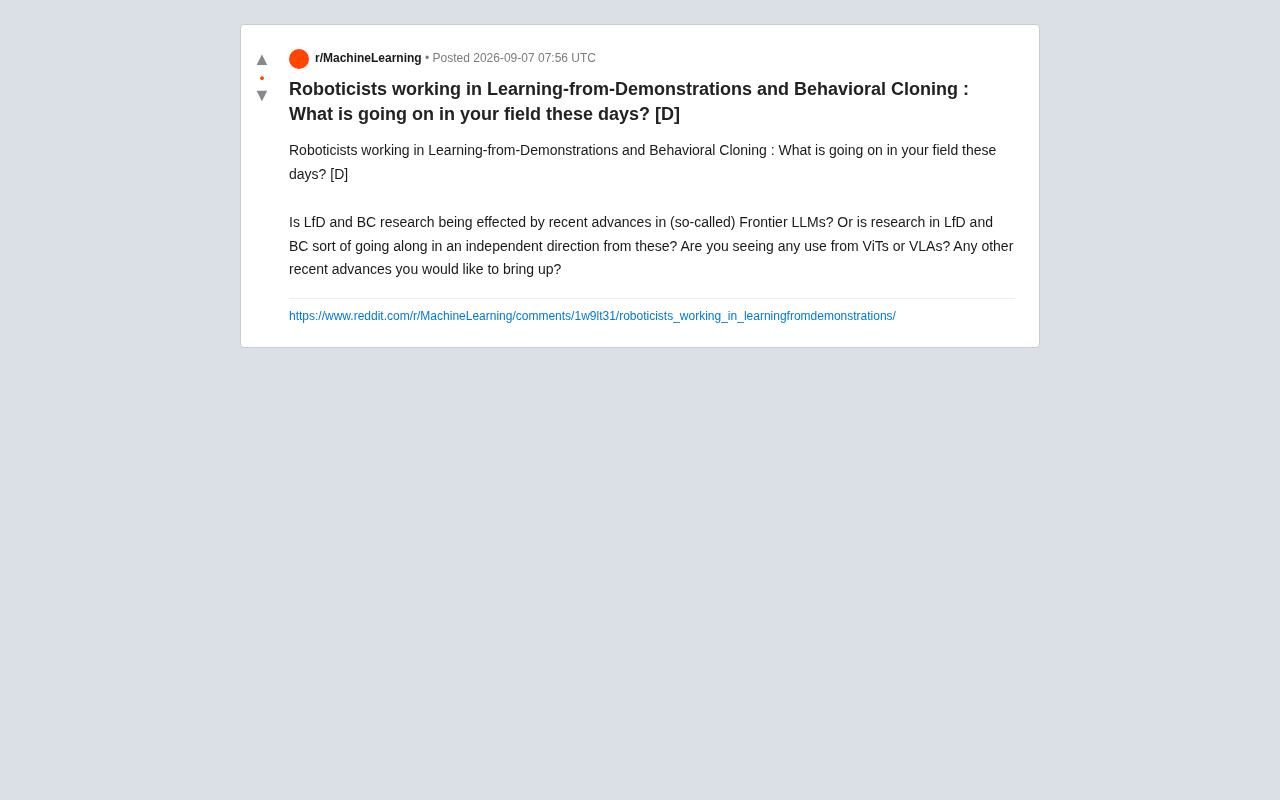
The robot learning community is undergoing a profound technological transformation. A Reddit user in the r/MachineLearning forum raised a core question: what are the current research directions in Learning from Demonstrations (LfD) and Behavioral Cloning (BC)? Are these traditional robot learning methods being completely reshaped by new technologies like Large Language Models (LLMs), Vision Transformers (ViTs), and Vision-Language-Action models (VLAs)?
This question touches on a core tension in robot learning: are traditional end-to-end learning methods and emerging foundation model technologies converging or diverging?
Challenges Facing Learning from Demonstrations and Behavioral Cloning
Learning from Demonstrations and Behavioral Cloning are classic paradigms in robotics. Learning from Demonstrations (LfD) originated from Programming by Demonstration research in the late 1980s. Its core idea is to let robots learn skills by observing expert operation trajectories rather than manually writing complex control rules. A typical LfD workflow includes: demonstration collection (recording expert actions through teleoperation, motion capture, etc.), feature extraction (extracting state representations from raw sensor data), policy learning (fitting state-to-action mappings using supervised learning methods), and policy execution and generalization.
Behavioral Cloning (BC) is the most straightforward implementation method in LfD, essentially a supervised learning problem. The algorithm treats expert demonstration data as a training set of (state, action) pairs, training a policy network by minimizing the difference between predicted actions and expert actions. BC's mathematical formulation is: given expert trajectory τ={(s₁,a₁),...,(sₙ,aₙ)}, learn policy π_θ to minimize loss function L=Σ||π_θ(sᵢ)-aᵢ||². These two methods have mature applications in industrial robotics, medical assistance, and other scenarios.
However, traditional methods face several inherent limitations:
- Low data efficiency: Typically requires hundreds to thousands of demonstrations to train usable policy models
- Limited generalization: Difficulty handling new scenarios outside the training distribution
- Insufficient environmental robustness: Sensitive to minor changes in lighting, object positions, etc.
- Distribution shift problem: BC's main issue is that during training, the policy always starts from expert states, but small errors during execution accumulate, leading to unseen states and cascading failures
These pain points create opportunities for new technologies like foundation models to intervene.
How Foundation Models Bring Paradigm Shifts
Large foundation models have begun deeply penetrating the robot learning field. Vision Transformer (ViT) is Google's breakthrough work from 2020 applying Transformer architecture to computer vision. Unlike traditional convolutional neural networks with local receptive fields, ViT divides images into fixed-size patches (like 16×16 pixel blocks) and treats each patch as a token input to a Transformer encoder, enabling modeling of global spatial relationships.
Through powerful visual representation capabilities acquired via self-supervised learning, ViT enables robots to learn more complex manipulation tasks with fewer demonstration data. In robotics, ViT's value manifests in: visual representations learned through pretraining on large-scale image datasets (like ImageNet-21K) have strong generalization ability and better understand object semantics and spatial relationships; self-attention mechanisms can adaptively focus on task-relevant visual regions; unified token representations facilitate fusion with language models. Representative works like Google's RT-2 and Stanford's VoxPoser have proven that pretrained vision-language models can significantly improve robots' zero-shot generalization capabilities.
Zero-shot generalization refers to a model's ability to perform new tasks using only pretrained knowledge without specific task training. In robotics, this means robots can understand and execute instructions never seen during training, such as 'put the blue cup on the wooden tray'—even if the combination of 'blue cup' and 'wooden tray' never appeared in training. Foundation models achieve zero-shot through: learning rich prior knowledge of objects, actions, and spatial relationships from massive internet data; compositional generalization ability to combine known concepts in new ways; language as an interface enabling flexible task specification.
More notably, Vision-Language-Action models (VLAs) are redefining the overall architecture of robot learning. These models unify visual perception, language understanding, and action generation in a single framework, enabling robots to receive natural language instructions and directly output control signals. Typical VLAs like Google's RT-2 (Robotic Transformer 2) adopt the following design: first use a pretrained vision-language model (like PaLI) as the backbone to jointly encode image observations and natural language instructions; then at the output end, generate not only text tokens but also discretized action tokens (quantizing continuous robot actions into vocabulary); through unified token sequence modeling, VLAs can pretrain on internet-scale vision-language data to acquire common-sense reasoning capabilities, then fine-tune with small amounts of robot demonstration data to achieve new tasks.
Transformer-based unified architectures can share knowledge across multiple tasks, fundamentally breaking through the task isolation problem of traditional behavioral cloning methods. This architecture's revolutionary nature lies in breaking the modular boundaries of perception, planning, and control in traditional robot learning.
LfD and Foundation Models: Independent Evolution or Technological Convergence
Current research trends indicate that Learning from Demonstrations and Behavioral Cloning are not being "replaced" by foundation models but are undergoing "augmentative fusion." Mainstream directions include:
Hybrid Architecture Design
Using pretrained vision-language models to extract high-level semantic features, then combining traditional behavioral cloning methods for fine motion control. This approach balances semantic understanding capabilities with action execution precision, making it a technical route actively explored by both industry and academia. Pretrained models handle understanding high-level instructions like "pick up the red block" and identifying target objects, while traditional controllers handle low-level execution details like grasp trajectory planning and force control.
Few-shot and One-shot Demonstration Learning
Few-shot learning refers to training models to adapt to new tasks using very few labeled samples (typically 5-10). In robotics scenarios, collecting large amounts of demonstration data is costly and time-consuming, making few-shot learning practically valuable. Leveraging foundation models' prior knowledge dramatically reduces the number of demonstrations needed for LfD from hundreds to single digits.
Mechanisms enabling few-shot robot learning with foundation models include: meta-learning, where models learn 'how to quickly learn new tasks' during multi-task training; in-context learning, similar to GPT's prompt mechanism, using few demonstrations as context conditions; transfer learning, using pretrained representations to reduce downstream task sample requirements. Related research shows that with appropriate prompt engineering strategies, some manipulation tasks can even achieve one-shot learning, greatly reducing data collection costs. For example, using representations from vision-language models like CLIP, few-shot performance on robot grasping tasks can improve by 30-50%.
Deep Utilization of Multimodal Data
Traditional behavioral cloning mainly relies on vision-action paired data, while new-generation methods integrate language descriptions, tactile feedback, torque sensing, and other multimodal signals to build richer, more robust policy representations. Language descriptions provide explicit specifications of task goals and constraints; tactile and force feedback are crucial for contact-rich manipulation (like insertion, assembly); proprioception (joint angles, velocities) helps models understand robot self-state. Multimodal fusion enables policies to establish correspondences between different sensor signals, improving robustness to sensor failures.
Open Questions in Future Research
Despite clear convergence trends, the robot learning field still faces many unresolved challenges:
-
Real-time challenges: How to adapt foundation models' computational overhead to robots' real-time control latency requirements? Large Transformer models typically have inference latency above 100ms, while robotic arm control requires frequencies of 100-1000Hz. Current solutions include model distillation, early exit mechanisms, and hierarchical architectures using foundation models for high-level planning while low-level control uses lightweight models.
-
Explainability requirements: How to ensure decision explainability in safety-critical applications (like surgical robots, autonomous driving)? The black-box nature of end-to-end neural network policies creates challenges for fault diagnosis and safety certification. Research directions include attention visualization, counterfactual explanations, and neurosymbolic methods combining neural policies with symbolic planning.
-
Transfer boundaries for physical interaction: What are the boundaries of transfer capability for pretrained knowledge in tasks involving physical contact and force interaction? Vision-language pretraining mainly comes from static images and text, lacking real experience of physical dynamics and causal relationships. Contact-rich manipulation (like cloth folding, liquid pouring) requires precise physical modeling where pure visual pretraining offers limited help. Hybrid approaches include pretraining with physics simulators or using tactile foundation models to supplement physical priors.
-
Data collection and evaluation standards: How to establish unified robot learning benchmarks and evaluation protocols? Different labs use different robot platforms, task definitions, and success criteria, making research results difficult to compare. Large-scale multi-robot datasets like Open X-Embodiment and standardized evaluation protocols are improving this situation.
Answers to these questions will determine the field's future direction. What's certain is that Learning from Demonstrations and Behavioral Cloning won't disappear, but their implementation forms are being profoundly rewritten—evolving from isolated algorithmic modules to core components of intelligent systems working synergistically with large-scale foundation models. The fine control, safety guarantees, and domain knowledge accumulated by traditional methods remain indispensable, while foundation models' semantic understanding, common-sense reasoning, and generalization capabilities open new possibility spaces. The most promising future direction is organically combining both advantages to build robot intelligence systems that can understand high-level intent while precisely executing low-level actions.
Key Takeaways
- Learning from Demonstrations and Behavioral Cloning face inherent challenges of low data efficiency, weak generalization, and distribution shift
- Vision Transformers provide powerful visual representation capabilities through global attention mechanisms and large-scale pretraining
- Vision-Language-Action models unify multimodal perception with action generation, achieving end-to-end instruction-to-execution mapping
- Current mainstream directions involve augmentative fusion: hybrid architectures, few-shot learning, and multimodal integration
- Real-time performance, explainability, and physical interaction transfer are key open questions in the field
- Future robot learning will organically combine traditional fine control with foundation models' semantic understanding
Related articles
How Short-Form Video Creators Are Using AI Video Generation Tools
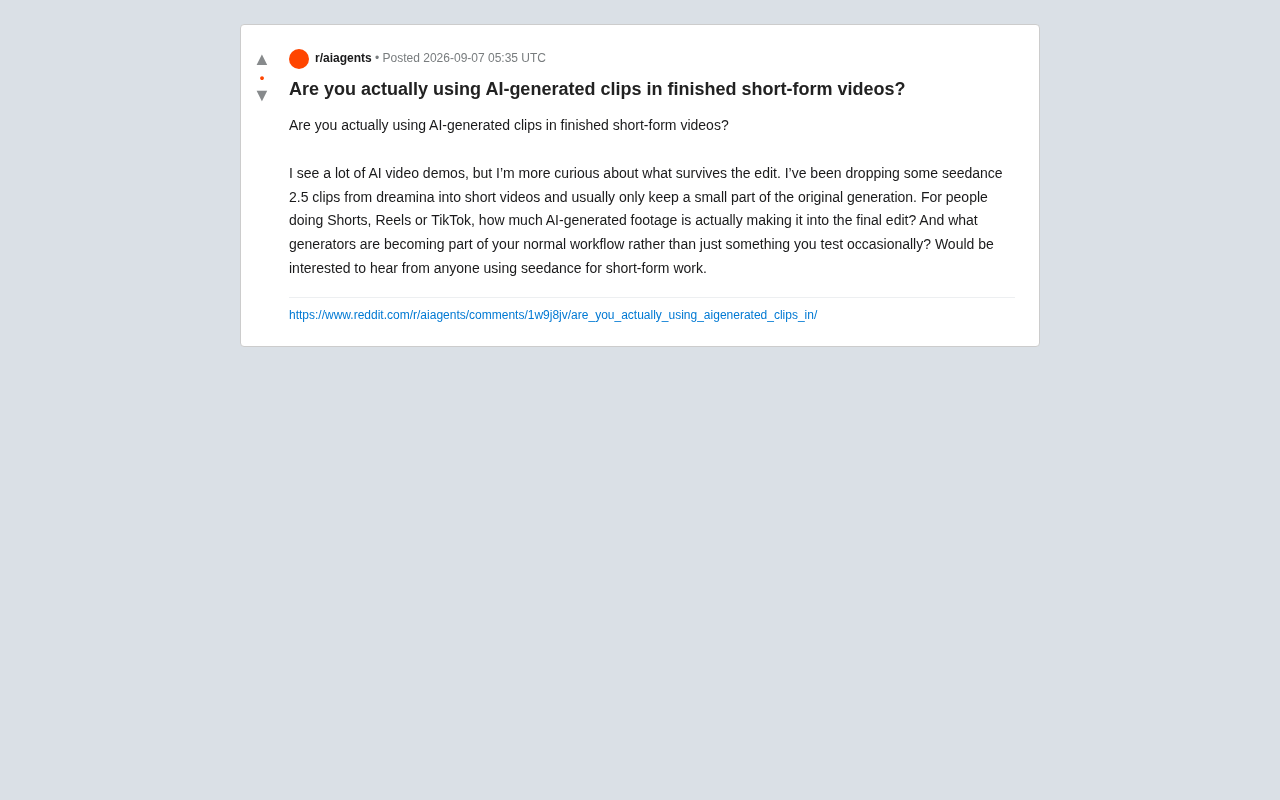
Exploring the real-world application of AI video generation tools in short-form video creation. From Seedance to Runway, how do creators integrate AI assets? Revealing the gap between demos and production use.
Home Data Center Setup Guide: A Complete Self-Hosted Private Cloud Implementation
Deep dive into building a home data center: hardware selection, software architecture, cost analysis, and operational challenges. From data sovereignty to technical implementation, build your private cloud infrastructure and control your digital assets.
Engrim: A Local Memory Engine Solution for AI CLI Tools
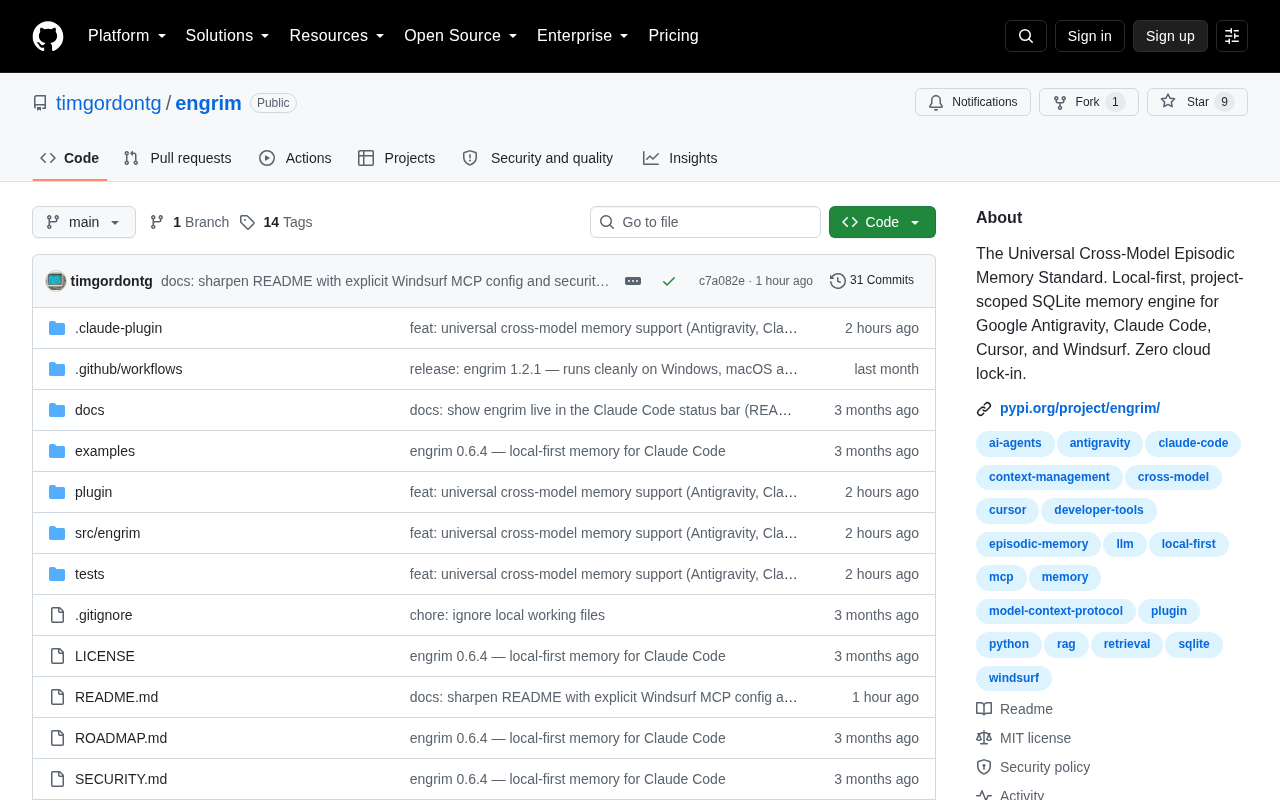
Engrim is an open-source, local-first SQLite memory engine built for AI CLI tools like Claude Code and Aider, solving context loss while keeping data private.