Frugon: Local LLM Call Analysis That Pinpoints Cost-Reduction Opportunities

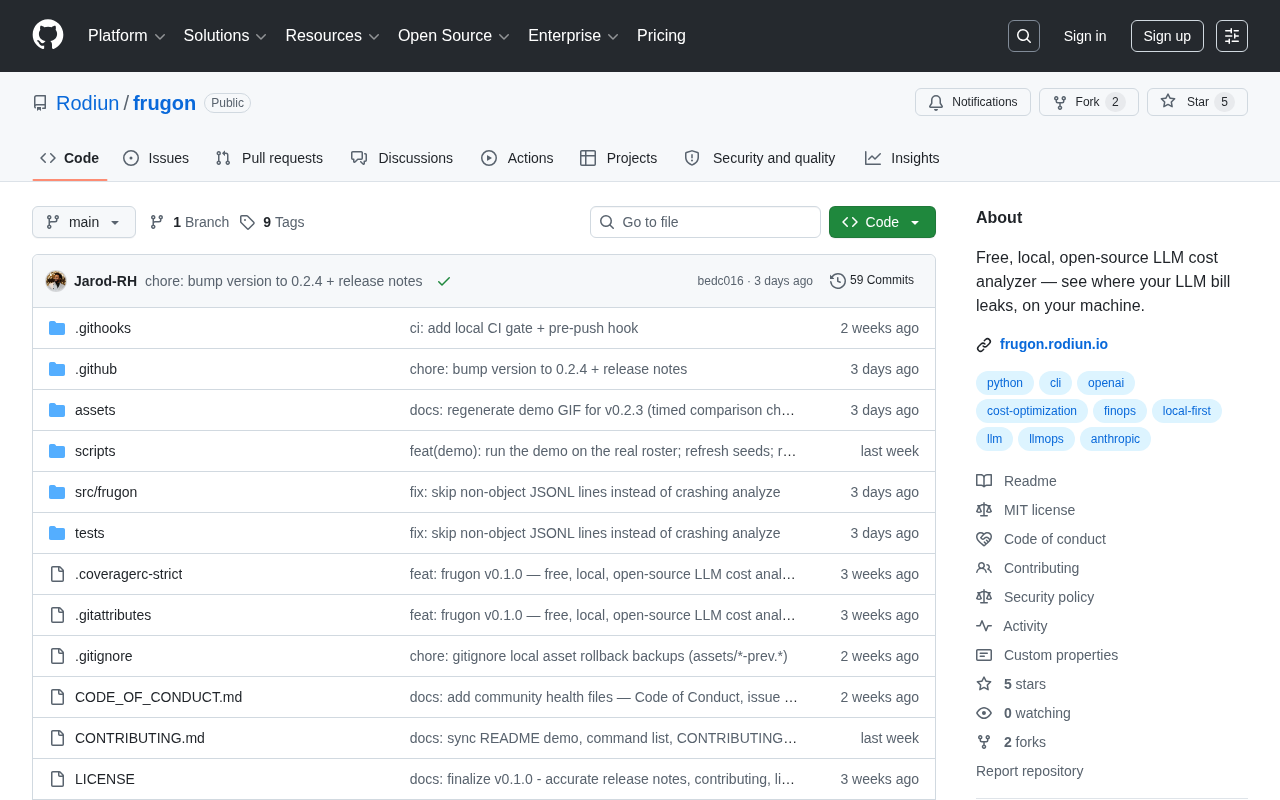
Frugon is a local, open-source tool that analyzes LLM call logs to identify cost-saving model downgrade opportunities.
Frugon is an MIT-licensed open-source tool that runs entirely locally to analyze your LLM API call history and pinpoint which requests could be handled by cheaper models. Without uploading any logs or prompts, it delivers data-driven model migration recommendations — making it a privacy-friendly, practical component for LLMOps cost governance.
LLM Cost Optimization: From "Use the Best" to "Use the Right One"
As large language models (LLMs) become deeply embedded in production environments, API call costs are turning into an unavoidable financial pressure for many teams. Mainstream LLM providers universally adopt a token-based, pay-per-use billing model — tokens are the basic units LLMs use to process text, roughly corresponding to 3/4 of an English word or 1–2 Chinese characters. Take OpenAI as an example: GPT-4o is priced at approximately $2.50 per million input tokens, while GPT-4o-mini costs only about $0.15 — a cost gap of more than 16×. For a production system handling millions of calls per day, this difference can translate into tens of thousands of dollars in monthly spending.
A widespread source of waste is that large numbers of simple requests are being routed to expensive flagship models (such as GPT-4-class), when cheaper, smaller models could handle them just as well. Precisely identifying these "overkill" calls has become the central entry point for LLM cost reduction.
Recently, an open-source tool called Frugon made its debut on Hacker News as a "Show HN" post. Its mission is crystal clear: help developers identify which LLM calls can be handled by a cheaper model. The tool is open-sourced under the MIT license and emphasizes its "local" nature — a particularly attractive quality for teams that prioritize data privacy.
The Core Problem Frugon Solves
Hidden Waste Behind Expensive Models
In real-world business scenarios, the complexity of LLM calls varies enormously. Some requests require complex multi-step reasoning and long-context understanding, genuinely demanding top-tier models. But others may only involve simple text classification, formatting, keyword extraction, or short-form generation — tasks that a smaller model can handle perfectly well, often at a tenth of the cost or less.
The problem is that teams typically lack a systematic way to distinguish between these two categories. Developers tend to make a gut-feel, one-size-fits-all decision by routing all requests to the same model, causing large amounts of API spend to be wasted on scenarios that don't require premium capabilities. Frugon targets exactly this pain point.
Data-Driven Model Downgrade Decisions
Frugon's core approach is to analyze actual LLM call records and identify requests that "a cheaper model could handle." Rather than encouraging a blanket, wholesale model switch, it provides data-driven migration recommendations that help teams optimize their cost structure in a targeted way while maintaining output quality.
This is far more prudent than simply "switching everything to a smaller model" — it attempts to strike a balance between cost and quality, avoiding over-downgrading that could degrade the user experience.
The Dual Value of Local Execution and Open Source
Privacy-First: No Log Uploads Required
Frugon explicitly highlights the "local" attribute as a key characteristic: the entire analysis runs locally, with no need to upload call logs, prompts, or response content to third-party servers. For enterprises handling sensitive data, this is critical — LLM inputs and outputs frequently contain user privacy, trade secrets, or internal knowledge, and any risk of exposure must be avoided.
Local execution not only reduces compliance risk but also allows the tool to integrate seamlessly into internal enterprise workflows without triggering additional data security reviews.
MIT License: Freedom to Customize
Frugon is open-sourced under the MIT license. The MIT license is one of the most permissive in the open-source world. Compared to GPL (which requires derivative works to also be open-sourced) or Apache 2.0 (which includes patent grant clauses), MIT requires only that the original copyright notice be retained, placing virtually no restrictions on commercial use, modification, or redistribution. This makes MIT-licensed projects especially well-suited as foundational components for internal enterprise tools or commercial products. In the LLMOps tooling ecosystem, widely adopted projects like LangChain and Ollama both use the MIT license — a choice that helps reduce legal compliance burdens for enterprises and accelerates community adoption and contributor participation.
For teams building out an LLMOps (Large Language Model Operations) stack, a freely customizable, open-source cost analysis tool offers far more flexibility and long-term value than a closed SaaS service.
Frugon's Position in the LLMOps Ecosystem
A Specialized Component for Cost Observability
LLMOps draws from the philosophies of DevOps and MLOps, evolving specifically to address the deployment, monitoring, and maintenance needs of large language models in production. Observability refers to the ability to infer the internal state of a system from its external outputs (logs, metrics, traces). In the LLM context, this spans latency monitoring, token consumption tracking, prompt version management, output quality assessment, and more. LangSmith, Langfuse, and Helicone are among the leading LLM observability platforms today.
Frugon can be seen as a specialized component within the LLM observability and cost governance ecosystem, focused on the niche of "model selection optimization" — complementing broader monitoring tools. A typical use pattern: run Frugon for a cost audit, identify which calls can be migrated, then use evaluation tools to verify that quality remains acceptable after the downgrade.
Synergy with Other LLM Cost-Reduction Strategies
Model downgrading is just one of several LLM cost-reduction strategies. Other common approaches include: Semantic Caching (using vector similarity retrieval to determine whether a new request is semantically close to a historical one, and returning the cached result directly to avoid another API call — GPTCache is a leading open-source implementation); Prompt Compression (reducing token consumption by removing redundant expressions and shortening context length — Microsoft Research's open-source LLMLingua is a typical implementation); Batching (merging multiple independent requests into a single API call); and routing-based dynamic model selection.
Among these, Model Routing deserves special attention: it works by training a lightweight routing classifier to assess the complexity of incoming requests, sending simpler tasks to smaller models and complex tasks to larger ones. Stanford University's open-source RouteLLM system has demonstrated real-world cost reductions of 40–70% while maintaining GPT-4-level output quality. The historical call analysis data that Frugon produces is a natural fit as training data for routing rules, enabling a complete optimization loop of "audit → rule extraction → automatic routing" — realizing truly intelligent cost governance.
Early Assessment and Future Outlook
Based on early feedback on Hacker News, Frugon is still in its early stages, without yet achieving large-scale community traction. This is consistent with the typical trajectory of many "Show HN" projects — a small but focused tool that solves a real pain point takes time to accumulate users and reputation.
The tool's future growth potential lies primarily across three dimensions: analysis accuracy (can it reliably determine whether a request is safe to downgrade?), model and provider coverage, and ease of integration with mainstream development frameworks. If it continues to improve on these fronts, Frugon has the potential to become a practical, long-term component of the LLM cost governance toolkit.
Conclusion
In today's era of large-scale LLM application deployment, "using the right model" is often more commercially rational than "using the most powerful model." Frugon offers a local, open-source, and focused solution that helps teams make smarter model selection decisions based on actual call data. While the project is still early-stage, the direction it represents — granular, data-driven LLM cost governance — is precisely the capability that an increasing number of production teams urgently need. For developers struggling with API bills, Frugon is worth watching and trying out.
Related articles
Ditch the Vector Database: Building a Memory Layer for LangChain Agents with BM25
CogniCore replaces vector databases with BM25 retrieval for LangChain agent memory, outperforming embeddings in small-context benchmarks with zero external dependencies.
Are All-in-One AI Platforms Actually Worth It? A Practical Guide to Escaping Subscription Overload
Tired of paying for ChatGPT, Claude, and Midjourney separately? We break down whether all-in-one AI platforms are actually worth it — and what a smarter subscription stack looks like.
Volkswagen Mission Efficiency: The World's Lowest-Drag EV Breaks Multiple Efficiency Records
Volkswagen's Mission Efficiency prototype claims the world's lowest drag coefficient, built on MEB+ platform with ID. Polo and ID. Cross components. Here's what it means for EV efficiency.