Full Breakdown of Cracking the Jane Street Reverse Engineering Challenge: Approach, Tools, and Techniques
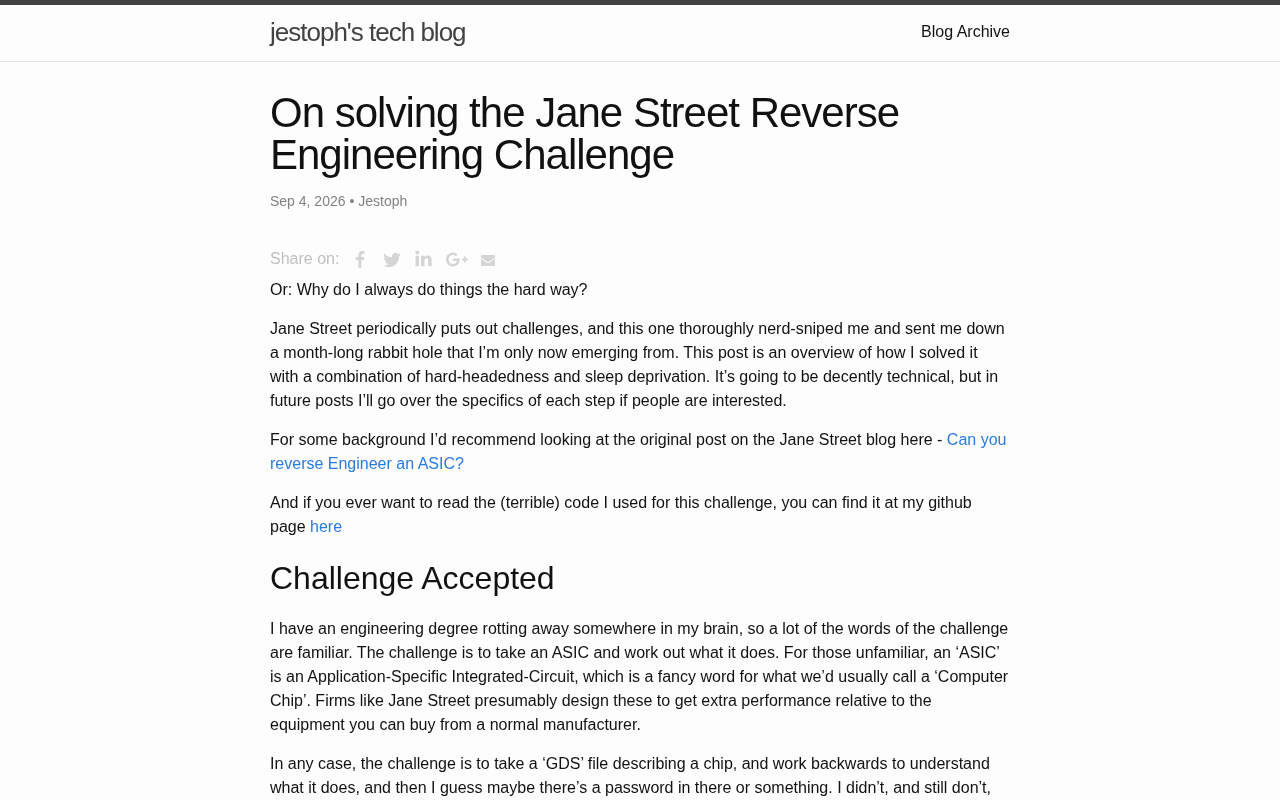
A complete technical breakdown of solving Jane Street's reverse engineering recruiting challenge.
This article provides a detailed walkthrough of cracking Jane Street's reverse engineering hiring challenge, covering the full workflow from static analysis with Ghidra and IDA Pro, to dynamic debugging with GDB and Pwndbg, to automated constraint solving with Z3 and Angr. It explores why quantitative trading firms value low-level reverse engineering skills and offers practical advice for developers looking to build these capabilities.
Introduction: A Hardcore Recruiting Challenge
Quantitative trading giant Jane Street is renowned in the industry for its highly demanding technical challenges and rigorous hiring standards. Headquartered in New York, Jane Street is one of the world's top quantitative trading firms. Founded in 2000, it's known for its technology-driven trading strategies and deep adoption of the functional programming language OCaml. The firm primarily engages in Electronic Market Making and quantitative trading, providing liquidity across global equity, options, ETF, and bond markets. With a large technical team and a strong engineering culture, it's famous for extremely high compensation (new graduate salaries often exceeding $300,000) and an exceptionally rigorous hiring process. Interviews typically include multiple rounds of algorithm problems, probability and statistics questions, and system design challenges — and in recent years, the process has expanded to include low-level skills assessments like reverse engineering.
Recently, a technical article titled Solving the Jane Street reverse engineering challenge sparked heated discussion on Hacker News, garnering 374 upvotes and 83 comments, quickly becoming a focal point in the reverse engineering and security research communities. Hacker News (often abbreviated HN) is a tech community run by Y Combinator, Silicon Valley's well-known startup accelerator. Founded in 2007, it's one of the most active discussion platforms for developers, entrepreneurs, and tech enthusiasts worldwide. Its content focuses on computer science, software engineering, startups, and tech industry developments, using a vote-based ranking system. An article receiving this level of attention on HN signals significant discussion value within the tech community.
These kinds of challenges aren't just a means for companies to filter talent — they're also a litmus test of an engineer's mastery of low-level systems, assembly language, and debugging tools. This article systematically reviews the core approach and technical highlights of this reverse engineering challenge, drawing from the original source material, and explores the technical value behind it.
What Is a Reverse Engineering Challenge?
The Essence of the Challenge
Reverse engineering refers to analyzing the behavior, structure, and data flow of a binary program to understand its internal workings — all without access to the source code. Fintech companies like Jane Street favor reverse engineering problems precisely because they comprehensively assess several key abilities in candidates:
- Low-level systems understanding: Mastery of CPU architecture, memory layout, and calling conventions
- Toolchain proficiency: The ability to skillfully use disassemblers, debuggers, and other specialized tools
- Logical reasoning: Inferring program intent from limited observations
- Patience and resilience: Reverse analysis is often a long process of trial and error
The Typical Problem-Solving Workflow
Looking at the general approach to these challenges, solvers typically follow a standardized workflow.
The first step is static analysis — examining the binary's assembly code without running the program, using disassembly tools like Ghidra, IDA Pro, or objdump to identify key functions and control flow structures. Ghidra is a reverse engineering framework open-sourced by the NSA (National Security Agency) in 2019. It supports multiple processor architectures and includes a built-in disassembler, decompiler, and scripting engine — completely free and remarkably powerful. IDA Pro, on the other hand, is the traditional gold standard in commercial reverse engineering software, developed by Hex-Rays. The professional version costs several thousand dollars and is renowned for its decompiler and rich plugin ecosystem. objdump is a lightweight disassembly tool in the GNU Binutils toolchain, commonly used for quick inspection of a binary's basic structure. The goal of this step is to build a high-level understanding of the program's overall architecture.
The second step is dynamic analysis — actually running the program through debuggers like GDB or Pwndbg, step by step observing changes in registers, memory, and stack frames to verify or correct assumptions made during static analysis. GDB (GNU Debugger) is the most classic debugger on Linux systems, supporting core features like breakpoints, single-step execution, memory inspection, and register monitoring. Pwndbg is a Python plugin for GDB specifically designed for reverse engineering and binary exploitation scenarios. It provides color syntax highlighting, automatic disassembly display, stack frame visualization, heap memory structure parsing, and many other enhancements that dramatically improve dynamic analysis efficiency. The two methods corroborate each other, gradually converging on the program's true logic.
Technical Breakdown of the Cracking Approach
Locating the Key Validation Logic
The core of most reverse engineering challenges lies in finding the section of the program that determines whether the input is correct — the validation logic. The solver needs to trace the processing path of user input: Does it go through hash computation, XOR encryption, mathematical transformation, or simple string comparison?
Once the key comparison instruction is located — for example, cmp paired with jne/je conditional jumps in x86 assembly — you've essentially found the linchpin of the entire challenge. Tracing the data flow backward from this comparison point allows you to reconstruct the complete validation algorithm.
Reverse-Engineering the Correct Answer
After finding the validation logic, solvers typically face two paths:
- Reverse computation: If the validation process involves reversible mathematical operations (such as linear transformations or simple encryption), the correct input can be derived directly by working backward from the target value.
- Constraint solving: When the logic is more complex or involves multiple layers of nested conditions, solvers often turn to symbolic execution and constraint solving engines like Z3, translating the program logic into mathematical constraints and letting the solver automatically search for input values that satisfy all conditions.
Z3 is a high-performance SMT (Satisfiability Modulo Theories) solver developed by Microsoft Research. It can automatically solve constraint systems involving integers, floating-point numbers, bit vectors, arrays, and many other theories. In reverse engineering, engineers can translate a program's validation logic into a set of mathematical constraints and hand them to Z3 to automatically find inputs satisfying all constraints. Z3 uses the DPLL(T) algorithm framework, combined with heuristic search and theory solvers, to handle complex problems with thousands of variables and constraints in reasonable time. This automated reasoning capability can compress hours of manual reverse computation on complex validation logic down to mere seconds.
Constraint solving has become a standard tool in modern CTF (Capture The Flag) competitions and reverse engineering challenges, dramatically reducing the manual analysis cost of complex problems. CTF is the most popular competition format in the cybersecurity field, originating at the 1996 DEFCON hacker conference. Participants must solve a series of security challenges within a time limit, covering reverse engineering, binary exploitation, web security, cryptography, forensic analysis, and more. Top global CTF events include DEFCON CTF, Google CTF, and PlaidCTF. They serve not only as competitive platforms but also as important channels for security researchers to exchange knowledge and recruit talent.
The Power of Tool Combinations
Successfully cracking these challenges rarely depends on a single tool — it requires the organic coordination of multiple tools:
| Tool Type | Representative Tools | Core Function |
|---|---|---|
| Disassembler | Ghidra, IDA Pro | Macro-level structure mapping, identifying functions and control flow |
| Debugger | GDB, Pwndbg | Micro-level behavior verification, real-time program state observation |
| Symbolic Execution Engine | Z3, Angr | Automated constraint reasoning, solving complex validation logic |
Symbolic execution is a program analysis technique that treats program inputs as symbolic variables rather than concrete values, collecting all constraints along execution paths, and ultimately using a solver to compute inputs that trigger specific program paths. Angr is an automated binary analysis framework based on symbolic execution, developed at UC Santa Barbara. It integrates disassembly, control flow analysis, symbolic execution, and constraint solving, and is widely used in vulnerability discovery and reverse engineering automation.
This collaborative model — "humans handle strategic decisions, tools handle heavy computation" — is the core methodology of modern reverse engineering.
The Value and Insights Behind the Challenge
Why Quantitative Trading Firms Value Reverse Engineering Skills
The quantitative trading environment is extremely sensitive to both performance and security. Engineers need to understand how compilers optimize code, how CPUs schedule instructions, and how systems behave under extreme conditions. Reverse engineering ability demonstrates precisely whether an engineer can "see through the abstraction layers" and reach the truth at the system's lowest level.
For Jane Street, which processes massive trading volumes and pursues microsecond-level latency, this ability to go deep has tangible business value — it directly impacts trading system performance tuning and security assurance. Electronic Market Making is one of the core functions of modern financial markets. Market makers provide liquidity by simultaneously posting buy and sell orders, profiting from the bid-ask spread. Unlike traditional manual quoting, electronic market making relies on high-frequency trading systems that can adjust quotes within microsecond-level latency based on market information, processing millions of trades per day. This type of business demands extreme system performance — any millisecond of delay could result in massive losses — placing ultimate demands on engineers' low-level optimization capabilities and depth of system understanding.
Practical Advice for Learners
For developers looking to enter security research or systems programming, these challenges offer excellent learning opportunities. The following insights are worth considering:
-
Build a solid assembly foundation: No matter how advanced the tools, reading assembly code remains the bedrock of reverse engineering. Start with the x86-64 instruction set and gradually familiarize yourself with common compiler-generated patterns. x86-64 (also known as AMD64 or x64) is the dominant processor architecture for today's personal computers and servers. Introduced by AMD in 2000, it's a 64-bit extension of the traditional 32-bit x86 architecture. Learning x86-64 assembly requires mastering common instructions (such as mov, add, cmp, jmp, call, ret), register purposes (rax for return values, rdi/rsi for function arguments), and stack frame structure (managed by the rbp and rsp registers).
-
Leverage automation tools: Symbolic execution and constraint solving can dramatically improve analysis efficiency and prevent getting stuck in tedious manual computation. Learn the basics of Z3 and Angr as early as possible. The main challenge of symbolic execution is the path explosion problem — too many program branches can produce an exponential number of paths, which must be mitigated through heuristic search strategies and path pruning.
-
Develop systems thinking: Reverse engineering isn't about looking at individual instructions in isolation — it's about understanding how the entire program's data flow and control flow work together.
-
Stay patient and embrace trial and error: As reflected in the Hacker News community discussion, real breakthroughs often come only after repeated debugging and hypothesis testing.
Conclusion
Jane Street's reverse engineering challenge has sparked such widespread discussion not merely because of its clever design, but because it reflects the low-level competencies that excellent engineers should possess. In an era where AI-powered coding tools are becoming increasingly prevalent, the ability to dive into the binary level and understand systems at their core is becoming ever more scarce and valuable.
For every technology practitioner, these challenges represent a worthwhile self-assessment: When all the high-level abstractions are stripped away, can you still understand what the machine is actually doing? This may be the most profound insight that reverse engineering offers us.
Related articles
GPT-6 Astra Code Review in Practice: Balancing Efficiency Gains, Data Privacy, and Cost
An in-depth analysis of GPT-6 Astra's real-world code review performance, examining efficiency gains, data privacy risks, and Token costs to build a decision framework for engineering teams.

Declarative Attention: Letting LLMs Control Their Own Attention, Boosting Long-Context Inference Efficiency by 52%
Declarative Attention (DA) lets LLMs autonomously declare attention regions during inference via global, focus, and local modes, reducing attention tokens by 52% in zero-shot evaluation.

Meta Executive Exposed for Torrent Piracy: The AI Training Data Legality Debate Intensifies
A Meta executive's torrent piracy exposure reignites debate over AI training data legality. Analysis of fair use defenses, data compliance trends, and copyright challenges facing tech giants.