Meta Executive Exposed for Torrent Piracy: The AI Training Data Legality Debate Intensifies
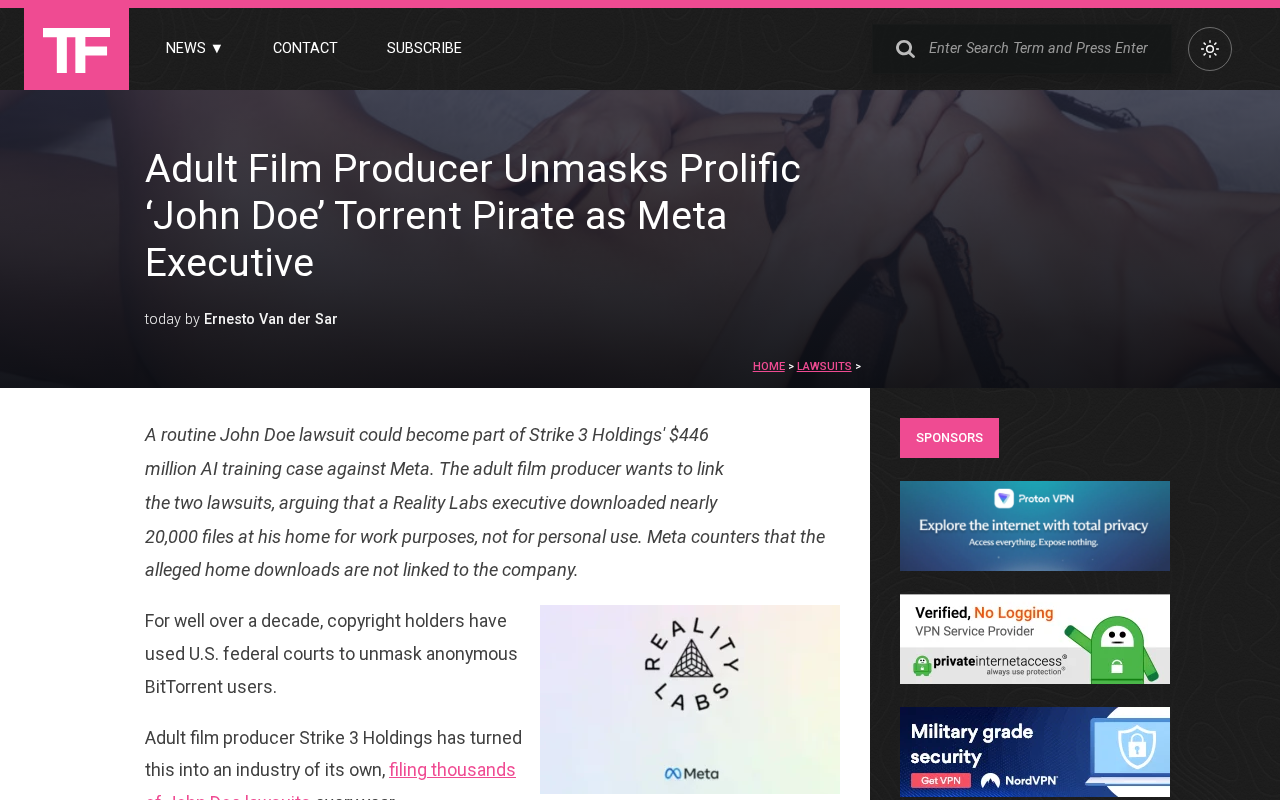
Meta executive's piracy exposure amplifies scrutiny over AI training data legality and copyright ethics.
An adult film company's torrent piracy investigation unexpectedly unmasked a Meta executive, reigniting debate over AI training data legality. The incident connects to broader concerns about tech giants using copyrighted content — including pirated books — to train large language models. The article examines the fair use defense, BitTorrent's anonymity limitations, the emerging data licensing market, and what this means for AI industry compliance and creator rights.
How a Torrent Trace Unmasked a Meta Executive
An adult film production company recently unmasked the true identity of a torrent pirate known only as "John Doe" — a senior executive at Meta. The case has drawn widespread attention across the tech world, not just because of the individual's sensitive position, but because it touches on one of the most contentious issues in the AI industry today: the legality of training data sources.
According to TorrentFreak, the accused "John Doe" had been downloading and sharing copyrighted content via the BitTorrent network over an extended period. The production company traced IP addresses through technical means and used legal proceedings to strip away layers of anonymity, ultimately identifying the Meta employee. The story garnered 290 upvotes and 178 comments on Hacker News, a testament to the level of interest it generated.
Why Personal Piracy Strikes a Nerve Across the Entire AI Industry
On the surface, this is a copyright dispute triggered by an employee's personal behavior — seemingly unrelated to their employer's business. Yet the community discussion quickly shifted from "personal ethics" to a much larger question: Where exactly do tech giants source the massive volumes of text, image, and video data used to train their large language models?
Multiple lawsuits have already accused Meta of using datasets containing pirated books to train its Llama model series — most notably the infamous "Books3" dataset, which allegedly contains a vast number of unauthorized e-books. Books3 is a dataset comprising approximately 196,000 English-language books totaling around 37GB, widely used for training large language models. It was originally created as part of a larger corpus project called "The Pile," aimed at providing high-quality text for open-source AI research. However, Books3's origins are highly controversial — it was primarily scraped from private torrent sites like Bibliotik and contains a large volume of unauthorized pirated e-books. In 2023, several prominent authors (including John Grisham, Jonathan Franzen, and others) filed a joint lawsuit against Meta, alleging that its use of the Books3 dataset in training the Llama model series constituted large-scale copyright infringement. Similar lawsuits have been filed against other AI companies, including OpenAI.
When a Meta employee is caught engaging in personal torrent piracy, the public naturally connects the dots, questioning whether this "take what you need" mentality has become an unspoken norm within the industry. It's important to emphasize that there is currently no evidence linking the executive's personal downloads to Meta's model training in any direct way. But the reason this incident became a flashpoint is precisely because it taps into widespread public anxiety about how AI companies source their data.
The Technical Reality of BitTorrent Anonymity
From a technical perspective, this case also serves as a vivid lesson in privacy. Many users assume that using BitTorrent provides complete anonymity, but the reality is quite different. BitTorrent is a peer-to-peer (P2P) file-sharing protocol developed by Bram Cohen in 2001. Its core mechanism splits large files into small pieces, allowing downloaders to simultaneously retrieve different segments from multiple sources while uploading already-obtained portions to other users. This "download-while-uploading" model dramatically improves transfer efficiency but also introduces privacy concerns.
The torrent protocol is fundamentally an open P2P network where participants' IP addresses are visible to all nodes within the same swarm. In the BitTorrent network, nodes sharing the same file form a "swarm." The protocol requires each node to report its IP address to a tracker server so that other nodes can locate it. This means any node that joins the swarm — including monitoring nodes deployed by copyright holders — can directly see the IP addresses of other participants. Copyright holders simply need to run monitoring nodes to collect infringing IP addresses in bulk, then use court subpoenas to compel ISPs to disclose the corresponding user identities.
For downloaders who don't use a VPN or proxy, this so-called "anonymity" is essentially nonexistent. This also explains how a tech executive with deep technical expertise could still get caught — there is often an enormous gap between technical knowledge and actual operational security habits.
The AI Training Data Legality Dilemma: A Fundamental Conflict Between Scale and Copyright
The real value of this individual case lies in how it brings the AI industry's long-avoided core contradiction into the open.
The capabilities of generative AI are highly dependent on the scale and quality of training data. GPT, Llama, Claude, and other models all require internet-scale text corpora without exception. Llama (Large Language Model Meta AI) is Meta's large language model series, taking a different approach from OpenAI's closed API strategy — releasing model weights in open-source or semi-open-source form, allowing researchers and developers to deploy and fine-tune models locally. Llama 1, released in February 2023, included multiple versions ranging from 7B to 65B parameters; Llama 2 in July of the same year further opened up commercial licensing; and the Llama 3 series in 2024 saw significant performance improvements, establishing itself as a benchmark for open-source models. This open strategy earned Meta widespread support from the developer community, but also made its data sourcing issues even more sensitive.
However, the vast majority of high-quality content on the internet — books, news, academic papers, code — is protected by copyright. This creates a fundamental tension:
- Technical demand: Bigger models are better, and more data is better;
- Legal constraints: Copyrighted content cannot be freely copied and used;
- Commercial reality: Obtaining individual licenses is prohibitively expensive, and many rights holders are unwilling to grant them at all.
Can the "Fair Use" Defense Hold Up?
Facing copyright lawsuits, AI companies commonly invoke the "Fair Use" doctrine under U.S. copyright law, arguing that model training constitutes "transformative use" — that data is used to generate entirely new content rather than directly copying the original works. Section 107 of the U.S. Copyright Act establishes the "fair use" doctrine, which permits the use of copyrighted works without authorization under certain circumstances. The criteria include: the purpose and character of the use, the nature of the copyrighted work, the proportion of the work used relative to the whole, and the effect on the work's market value. "Transformative use" is key — if the new work adds new meaning or functionality beyond the original, it is more likely to be deemed fair use.
However, this defense has yet to receive definitive judicial endorsement. AI companies argue that model training is highly transformative: original text is decomposed into statistical features, the model learns language patterns rather than specific content, and the final output is entirely newly generated text. But copyright holders counter that: (1) the training process involves complete copying of original works; (2) generative AI is directly competing with and replacing the market for original works (e.g., AI writing tools replacing human authors); (3) large-scale commercial use is difficult to classify as "fair." If the training data itself was obtained through pirated channels, then the premise of "fair use" — lawful access to the work — no longer holds. In other words, the transformative nature of how data is used cannot launder the illegality of how it was obtained.
This is the deeper logic behind why this incident sparked such heated discussion: when personal piracy and corporate data practices are juxtaposed in public discourse, suspicion about the industry's "original sin of data" is reignited once again.
Three Key Takeaways for the AI Industry: Compliance, Licensing, and Privacy
This seemingly tabloid-worthy case actually reflects several trends worth contemplating in the AI era.
First, data compliance will become both a core competitive advantage and a risk factor for AI companies. As lawsuits multiply and regulations tighten, companies that can demonstrate the legality of their training data sources will hold a long-term competitive edge. Conversely, models built on gray-area data may face forced retraining, damages, or even removal from the market.
Second, the industry is driving the commercialization of data licensing. Content platforms (such as Reddit and News Corp) have begun signing data licensing agreements with AI companies, transforming previously "free-to-scrape" content into paid resources. As legal risks around AI training data escalate, content platforms are beginning to treat data as a monetizable asset. Since 2024, several major content platforms have reached licensing agreements with AI companies: Reddit signed a $60 million/year data licensing deal with Google; News Corp reached a multi-year content licensing agreement with OpenAI; and Stack Overflow also began selling its Q&A data to AI companies. This trend is creating a new data economy ecosystem: content platforms gain new revenue streams, AI companies gain legally compliant training data, but new problems also arise — individual creators (such as Reddit users, Stack Overflow contributors) often cannot share in the revenues from platform licensing deals, sparking new debates about the value attribution of "data labor." This may be one practical path toward resolving the data legality problem.
Third, the technological myths around privacy and anonymity need to be re-examined. Whether for individual users or enterprises, no one should overestimate the level of concealment that technical measures can provide. In the face of increasingly sophisticated tracking and forensic capabilities, any behavior in gray areas can potentially be traced.
Conclusion: A Mirror Reflecting AI Data Ethics
A Meta executive's personal piracy behavior alone is hardly enough to shake a trillion-dollar tech giant. But the reason it resonates so widely is that it serves as a mirror, reflecting the entire AI industry's ambiguous stance on data acquisition.
As model capability ceilings become increasingly determined by data scale, and high-quality data remains largely shrouded in copyright protection, AI companies will ultimately be unable to dodge the fundamental question: Should the road to artificial general intelligence be built on respect for creators' rights? This small case may well be yet another footnote in that much larger conversation.
Related articles
GPT-6 Astra Code Review in Practice: Balancing Efficiency Gains, Data Privacy, and Cost
An in-depth analysis of GPT-6 Astra's real-world code review performance, examining efficiency gains, data privacy risks, and Token costs to build a decision framework for engineering teams.
Declarative Attention: Letting LLMs Control Their Own Attention, Boosting Long-Context Inference Efficiency by 52%
Declarative Attention (DA) lets LLMs autonomously declare attention regions during inference via global, focus, and local modes, reducing attention tokens by 52% in zero-shot evaluation.
Full Breakdown of Cracking the Jane Street Reverse Engineering Challenge: Approach, Tools, and Techniques
Deep analysis of cracking Jane Street's reverse engineering hiring challenge, covering static analysis, dynamic debugging, constraint solving, and the full workflow from locating validation logic to deriving the correct answer.