GPT-6 Astra Code Review in Practice: Balancing Efficiency Gains, Data Privacy, and Cost
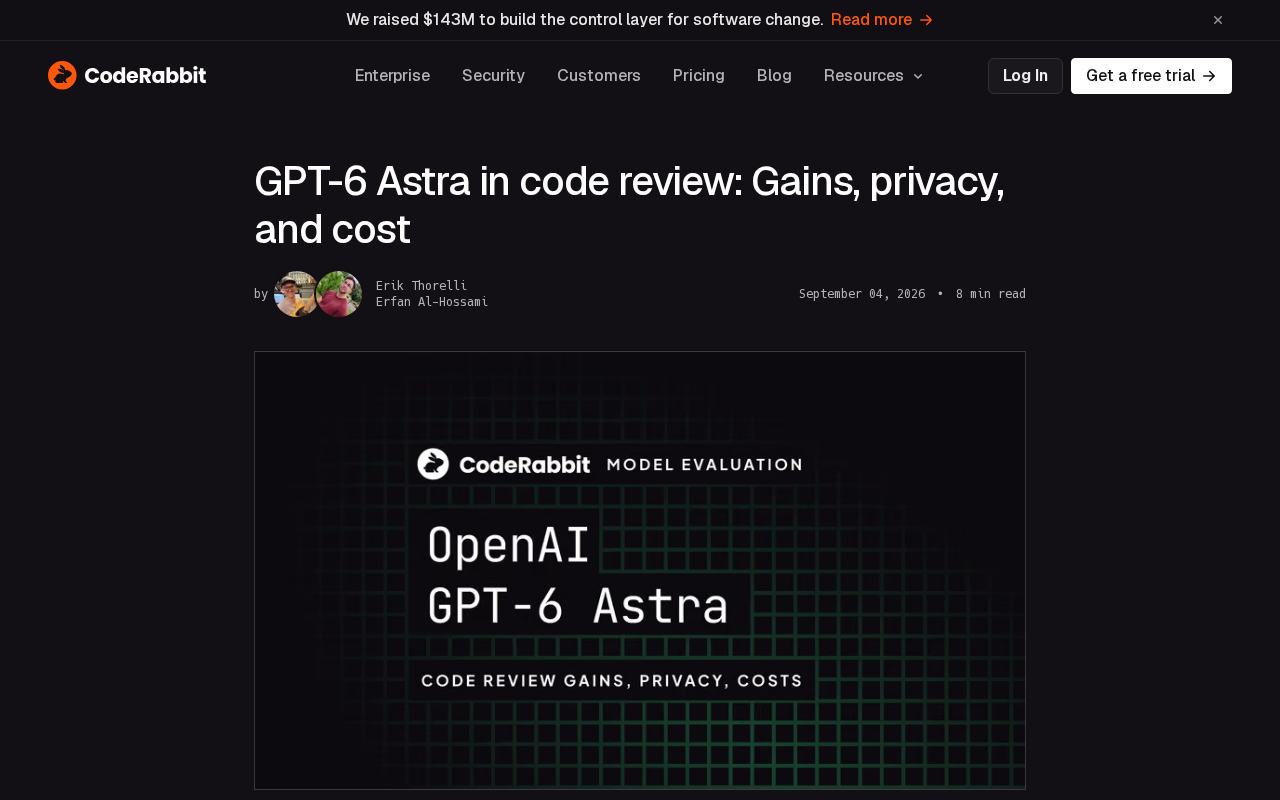
Evaluating GPT-6 Astra for code review across efficiency, privacy, and cost trade-offs.
This article examines GPT-6 Astra's practical performance in code review through three lenses: efficiency gains from real-time AI feedback, data privacy risks of sending source code to external services, and the economics of Token consumption. It argues that AI code review presents an "impossible triangle" where top capability, data privacy, and cost control cannot all be maximized simultaneously, and offers a tiered strategy framework for engineering teams to find their own balance.
Introduction: AI Code Review Enters a New Phase
As large language models continue to leap forward in capability, exploration of their application in software engineering practices deepens alongside them. Recently, the tech community has engaged in extensive discussion around GPT-6 Astra's real-world performance in code review scenarios. While public discussion remains limited in volume, the three core issues it touches on — efficiency gains, data privacy, and usage costs — are precisely the unavoidable realities every engineering team must confront when adopting AI-powered review tools.
Code review has long been both a critical and time-consuming part of the software development process. It's not only about code quality and defect detection but also serves as a vehicle for knowledge transfer and team collaboration. The practice of code review dates back to the 1970s, when IBM's Michael Fagan introduced the "Fagan Inspection" method — a highly structured peer review process. With the rise of the open-source movement and distributed version control systems like Git, code review evolved from formal meeting-based reviews to asynchronous, Pull Request-based online reviews. The PR mechanism popularized by GitHub in 2008 made it a standard practice in modern software development. Research shows that effective code review can catch 60%-90% of software defects at a cost far lower than fixing bugs during the testing phase. In recent years, code review automation has undergone a qualitative leap — from early regex-based Lint tools, to static analysis platforms like SonarQube, to today's LLM-powered intelligent review. When AI enters this equation, does it truly liberate productivity, or does it introduce new risks and overhead? This article will break things down across these three dimensions.
Efficiency Gains of AI Code Review: From Human Bottlenecks to Real-Time Feedback
The Core Pain Points of Traditional Code Review
The biggest bottleneck in traditional code review is its heavy dependence on senior engineers' time. A complex Pull Request often waits hours or even days for feedback, directly slowing iteration velocity. The core value of AI code review lies in transforming this process from asynchronous waiting to near real-time feedback.
Taking next-generation models like GPT-6 Astra as an example, their capabilities in understanding code context, cross-file correlation analysis, and identifying potential logic defects have notably improved over predecessors. The underlying technical principle is the Transformer architecture's Self-Attention mechanism, which captures long-range dependencies in code — for instance, a variable declared at the beginning of a file and incorrectly referenced hundreds of lines later. Cross-file correlation analysis relies on longer context windows; next-generation models typically support 128K or even longer Token contexts, enabling them to simultaneously "see" multiple related files. Additionally, through Instruction Tuning and RLHF (Reinforcement Learning from Human Feedback), models are trained to output structured review comments following review specifications rather than simple code completions. Based on these technical advances, AI can provide initial feedback on naming conventions, missing boundary conditions, potential null pointers, and security vulnerabilities the moment a developer submits code.
Where Are the Limits of AI Review Benefits?
However, the benefits are not unlimited. AI review excels at pattern-based, rule-based issues — such as inconsistent code style, common anti-patterns, and obvious security vulnerabilities. But for reviews involving deep business logic, architectural soundness, and team-specific conventions, AI still cannot replace human engineering judgment.
Therefore, a more pragmatic approach is to position AI as the "first filter": it handles the bulk of low-level issues, freeing human reviewers to focus their limited energy on high-value decisions that truly require experience and insight. This human-AI collaboration model, rather than AI replacement, is the path to maximizing returns today.
Data Privacy: The Security Risks of Exposing Enterprise Code
Source Code Is a Core Asset
For the vast majority of enterprises, source code is among the most critical intellectual property. Submitting code to a third-party AI service for review essentially means transmitting the company's most sensitive assets to external servers. This raises several serious privacy and compliance concerns:
- Will the data be used for model training? If submitted code snippets are incorporated into training data, there is a theoretical risk of leakage through other channels. This risk is not hypothetical: in 2023, a Google DeepMind research team successfully extracted original text fragments from ChatGPT's training data using specific prompt engineering techniques, confirming that large language models exhibit Memorization of training data. For code, this means attackers could theoretically craft prompts to "coax" the model into outputting fragments highly similar to a company's original source code. Even if service providers promise "not used for training," data remains at risk of interception during transmission and temporary storage, or exposure through security vulnerabilities. Techniques such as Differential Privacy and Federated Learning are being explored as mitigation strategies, but they have not yet been widely adopted in commercial LLM services.
- Is data transmission and storage secure? Whether encryption measures during code transit and server-side storage are sufficiently robust.
- Industry compliance issues. For heavily regulated industries like finance and healthcare, transmitting code externally may directly violate data compliance requirements.
Three Viable Paths for Privacy Protection
Facing privacy concerns, the industry is exploring several approaches. The first is enterprise-grade private deployment or dedicated instances, ensuring data is not mixed with public models, with explicit provider commitments against using it for training. Taking Azure OpenAI Service's dedicated instances as an example, enterprises can obtain physically isolated compute resources where data is not shared with other tenants, but such solutions typically cost several times — even ten times — more than public APIs.
The second is locally deployed or edge-deployed smaller models. While they compromise on capability, data never leaves the internal network. Represented by open-source models like Meta's Code Llama and Deepseek Coder, models in the 7B-34B parameter range can run on a single server equipped with a high-end GPU, though their code comprehension capabilities still lag significantly behind GPT-4-class models. Notably, the recent rise of model quantization techniques (such as GPTQ and AWQ) and inference optimization frameworks (such as vLLM and TensorRT-LLM) are narrowing this gap, making it feasible to deploy larger parameter models on limited hardware.
The third is code anonymization and fragmentation, stripping sensitive information before submission.
For high-capability models like GPT-6 Astra, how to strike a balance between "powerful capabilities" and "data staying on-premises" will be the key factor determining whether they achieve large-scale enterprise adoption. Generally speaking, the more powerful the cloud-based model, the more pronounced the privacy concerns.
Usage Costs: The Economics of Token Consumption and Hidden Overhead
Direct Costs: High Token Consumption Cannot Be Ignored
Capability improvements in next-generation large models often come with increased inference costs. Code review is a typical high-Token-consumption scenario — it requires feeding large volumes of code context into the model to obtain meaningful analysis results. A single medium-sized Pull Request might consume tens of thousands or even hundreds of thousands of Tokens.
Specifically, a Token is the basic unit of measurement for how large language models process text. For code, one Token corresponds to roughly 3-4 characters, and a typical line of code consumes about 10-20 Tokens. Taking a PR with 500 lines of changes as an example, the code input alone requires approximately 5,000-10,000 Tokens. However, meaningful review also requires incorporating necessary context (related files, function signatures, type definitions, dependencies, etc.), potentially inflating actual input to 50,000-200,000 Tokens. Using GPT-4 Turbo pricing (approximately $10 per million input Tokens) as a reference benchmark, the direct cost per review falls between $0.5 and $2. For a mid-sized engineering team producing an average of 50 PRs per day, monthly costs could reach $750-$3,000. If using higher-end models or longer contexts, this figure could multiply further — and this doesn't even include output Token costs, which are typically 2-3 times the input Token price.
If a team has dozens of PRs to review daily, cumulative API call costs can become substantial. Therefore, conducting detailed cost analysis before fully adopting AI review is crucial: Do the efficiency gains from review sufficiently offset the API costs?
Easily Overlooked Hidden Costs
Beyond direct API fees, the following hidden costs should also be factored in:
- False positive handling costs. If AI suggestions contain a high volume of false positives, the time engineers spend filtering and dismissing this noise is itself an overhead.
- Integration and maintenance costs. Integrating AI review tools into existing CI/CD pipelines, configuring review rules, and continuous tuning all require additional engineering effort. CI/CD (Continuous Integration/Continuous Deployment) is core infrastructure in modern software engineering, representing the automated pipeline from code commit to production deployment. Integrating AI code review typically requires writing custom Pipeline steps on platforms like GitHub Actions, GitLab CI, or Jenkins — listening for PR events via Webhooks, calling the AI review API, and writing results back to the PR interface as inline comments. This process involves engineering details such as API rate limit handling, timeout retry mechanisms, Token budget management, and structured parsing and deduplication of review results. Furthermore, rule configuration (e.g., which file paths require review, which rules can be silenced, tiered review strictness levels) requires ongoing maintenance and tuning to avoid "Alert Fatigue" that causes engineers to ignore all AI suggestions.
- Vendor lock-in risk. Over-reliance on a single AI service can leave teams vulnerable during service outages or pricing changes.
The truly rational approach is to adopt a tiered strategy based on code sensitivity and review frequency: use high-capability models for deep review of high-value, high-frequency core modules; use lower-cost solutions for peripheral code; and even consider locally deployed lightweight models.
Conclusion: Finding Balance in the Triangle of Capability, Privacy, and Cost
GPT-6 Astra's entry into code review essentially presents a classic "impossible triangle" — top-tier capability, data privacy, and manageable costs are difficult to maximize simultaneously. The concept of the "Impossible Trinity" (Trilemma) originally comes from the Mundell-Fleming model in international finance and has been widely borrowed for technology decision-making. In distributed systems, the CAP theorem (only two of consistency, availability, and partition tolerance can be satisfied simultaneously) is the most classic technical impossible triangle. In AI code review, this structural constraint applies equally: pursuing the strongest review capabilities often means relying on cloud services and paying premium fees; safeguarding privacy may require sacrificing some model capability; and strict cost control demands trade-offs in review depth and coverage. Specifically, privately deploying a high-capability model can simultaneously ensure capability and privacy, but at extremely high cost; using public APIs can balance capability and cost, but sacrifices privacy; local lightweight models can balance privacy and cost, but with limited capability.
For engineering teams, there is no one-size-fits-all answer. The right approach is to return to your own business reality: assess code sensitivity levels, review frequency and scale, and budget constraints, then find your own balance point across the three dimensions of returns, privacy, and cost. Understanding this structural constraint helps teams avoid the unrealistic expectation of "having it all" and instead make clear-headed priority decisions.
The wave of AI code review is irreversible, but how to truly use it well still tests every team's engineering judgment and decision-making wisdom.
Related articles
Declarative Attention: Letting LLMs Control Their Own Attention, Boosting Long-Context Inference Efficiency by 52%
Declarative Attention (DA) lets LLMs autonomously declare attention regions during inference via global, focus, and local modes, reducing attention tokens by 52% in zero-shot evaluation.

Meta Executive Exposed for Torrent Piracy: The AI Training Data Legality Debate Intensifies
A Meta executive's torrent piracy exposure reignites debate over AI training data legality. Analysis of fair use defenses, data compliance trends, and copyright challenges facing tech giants.
Full Breakdown of Cracking the Jane Street Reverse Engineering Challenge: Approach, Tools, and Techniques
Deep analysis of cracking Jane Street's reverse engineering hiring challenge, covering static analysis, dynamic debugging, constraint solving, and the full workflow from locating validation logic to deriving the correct answer.