GameToMac: Using AI to Run Windows Games on Mac

GameToMac uses an AI-driven compatibility layer to run Windows games on Apple Silicon Macs, though its core technical claims need verification.
GameToMac is a Windows game compatibility tool for Apple Silicon Mac users, claiming to use AI to automate game compatibility adaptation so titles like CS2, Overwatch, and Age of Empires IV can run at high frame rates on Mac. It addresses a real pain point — Apple Silicon hardware is powerful enough, but the gaming software ecosystem still has gaps — and aims to be more accessible than traditional solutions like CrossOver and Wine. However, its claim of being built on "GPT-6 Astra" lacks public verification, and whether AI can truly automate compatibility at scale, whether competitive games with aggressive anti-cheat can run in a compatibility environment, and what actual frame rate performance looks like all remain open questions that real-world testing needs to answer.
After Apple's shift to its own silicon, Mac performance has soared — but the gaming ecosystem remains a weak spot. A vast number of AAA Windows titles and competitive online games can't run natively, leaving Mac users with a persistently limited gaming experience. GameToMac, which recently launched on Product Hunt, is attempting to solve this long-standing problem with an AI-powered compatibility layer.
What Is GameToMac
GameToMac has a straightforward pitch: get Windows games running smoothly on Apple Silicon Macs at high frame rates. Its selling point isn't simple porting — it's using AI to handle game compatibility.
According to its Product Hunt page, the product was built by Marc Ibrahim. It received 80 upvotes after launch, ranked 20th on the daily leaderboard, and was tagged under Mac, Developer Tools, Artificial Intelligence, and OpenAI Day. This suggests it hits both a niche pain point in Mac gaming and the broader wave of applied AI.
For Mac users, playing Windows games in the past typically meant relying on compatibility layers like CrossOver or Wine, or Apple's own Game Porting Toolkit — all of which come with high configuration barriers and inconsistent stability. GameToMac packages this complex process into a more accessible product, lowering the cost of entry for everyday gamers.
Wine and CrossOver are currently the most mature Windows compatibility solutions on Mac. Wine (Wine Is Not an Emulator) runs Windows programs by translating Windows API calls into native calls for macOS, Linux, and other systems. It's not an emulator — it's an API mapping layer — so in theory it incurs less performance overhead than a virtual machine. CrossOver is a commercial product built on top of Wine by CodeWeavers, offering a graphical interface and a more complete game compatibility database, with an annual fee of roughly $18–30. Apple's Game Porting Toolkit (GPTK), released in 2023, is also Wine-based and includes graphics API translation optimized for Apple Silicon, letting developers quickly test how DirectX 12 games run on Mac — though it targets developers rather than end users. The shared pain point across all these solutions: compatibility for each game requires individual debugging, the supported game list grows slowly, and ordinary users are often put off by complex command-line configurations.
AI Compatibility Is the Core Selling Point
The most attention-grabbing aspect of GameToMac is its claim of being built on "GPT-6 Astra." While official materials don't disclose technical details about this model, the product description suggests AI is responsible for automating game compatibility adaptation — a process that traditionally requires engineers to manually debug each game one by one, making it time-consuming and labor-intensive.
If AI can automatically analyze a game's runtime requirements and graphics API calls and generate a corresponding compatibility solution, it could theoretically accelerate support for new games significantly. This also explains the confidence behind the official claim that "thousands of Windows games will soon be playable on Mac." Using AI to solve long-tail compatibility problems at scale is precisely what distinguishes this kind of tool from traditional approaches.
It's worth noting that "GPT-6 Astra" currently lacks any public third-party verification, and its actual capabilities and real-world performance remain to be validated as the product matures. There's often a gap between marketing language and actual experience, and users should maintain a rational perspective alongside their excitement.
Game compatibility adaptation involves two major technical challenges: graphics API translation and system call mapping. Windows games predominantly use DirectX (especially DX11/DX12), while Mac natively supports the Metal graphics API — two architecturally very different systems. Translation layers like MoltenVK and DirectX-to-Metal must handle complex issues such as shader compilation and render pipeline differences. In theory, AI could analyze a game executable's API call patterns to automatically infer the optimal translation configuration and even predict which shaders need special handling — replacing the manual debugging process. However, no mature public implementation of this kind of technology currently exists in the industry, and any AI solution claiming to "automate compatibility adaptation" requires specific technical disclosure before its credibility can be assessed. It's also worth noting that "GPT-6 Astra" is not a publicly released OpenAI model name, which raises significant questions about this branding.
Supported Games
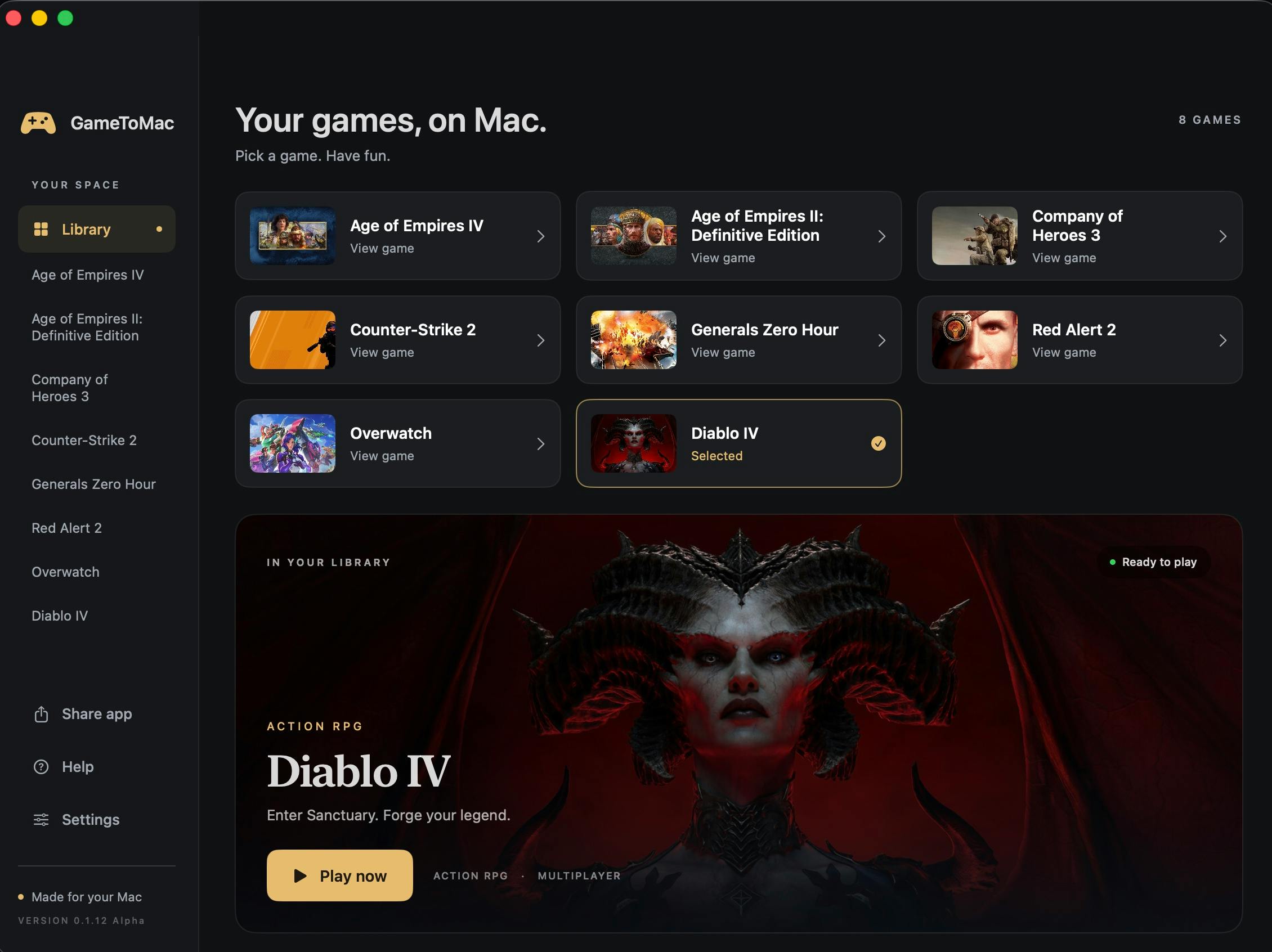
Based on the currently announced support list, GameToMac has prioritized a selection of mainstream titles:
- Real-Time Strategy / Strategy: Age of Empires IV, Age of Empires II, Company of Heroes 3, Command & Conquer: Red Alert 2, Command & Conquer: Generals
- Competitive Shooters: Counter-Strike 2 (CS2), Overwatch
The choice of lineup is deliberate. Strategy games and competitive shooters both have stable core player communities and have long lacked native Mac versions. Competitive titles like CS2 and Overwatch — which demand high frame rates — will be the real test of whether this kind of tool can deliver a smooth experience and build a reputation.
The official messaging emphasizes "smooth performance and high FPS," which is the metric competitive players care about most. That said, frame rate performance is highly dependent on specific hardware configurations and per-game optimization, so real data from independent testing is still needed.
A Missing Piece in the Mac Gaming Ecosystem
The emergence of GameToMac reflects a broader trend: as Apple Silicon performance continues to improve, the hardware foundation for Mac as a gaming platform is already there — what's missing is the final piece of software compatibility. Apple itself has been encouraging developers to port games through the Game Porting Toolkit, but progress has been slow.
Third-party tools using AI to fill that gap represent a more flexible path. They don't require game publishers to take the initiative — they solve the problem from the user's side. If the model proves out, it would be a genuine addition to the Mac gaming ecosystem.
Of course, compatibility layer tools face unavoidable challenges: anti-cheat system compatibility (many competitive games will ban accounts when anti-cheat detects a virtual or compatibility environment), lag in adapting after game updates, and potential copyright and licensing issues. These are questions GameToMac must answer on its path to maturity.
Anti-cheat systems are one of the most difficult obstacles compatibility layer tools face. Anti-cheat systems like VAC (Valve Anti-Cheat) used in CS2 and Warden used in Overwatch actively check whether the runtime environment is a "normal" Windows system. Under Wine or a compatibility layer, the system fingerprint and kernel call paths differ from native Windows, making it easy for anti-cheat software to flag the environment as a cheating tool — resulting in account bans. This is why, even though CrossOver and GPTK can technically run some games, competitive titles with aggressive anti-cheat remain off-limits for compatibility layer solutions. Currently, only a handful of games (such as Cyberpunk 2077 and Death Stranding) run stably after actively being adapted for Mac. For GameToMac to genuinely support CS2 and Overwatch, it must directly address anti-cheat compatibility — a challenge that carries extreme difficulty on both technical and legal fronts.
Conclusion
GameToMac represents an appealing direction — using AI to solve Mac gaming compatibility at scale. Its supported game lineup addresses the needs of strategy and competitive players, and the product concept hits a real pain point in the Apple Silicon era.
But as a freshly launched product, it currently lives more in the realm of vision than proven reality. The actual capabilities of "GPT-6 Astra," real-world high-FPS performance, anti-cheat compatibility — all of these critical questions need real user experiences to validate. For users hoping to play Windows games on their Mac, it's worth keeping an eye on — but it's too early to draw conclusions.
Related articles

Gaussian Process Bandit Optimization: Exploration Strategies and Inference Regret Guarantees
Cumulative regret guarantees in Bayesian optimization fail to reflect final recommendation quality. This article examines a new study that provides inference regret guarantees for Gaussian process bandit optimization through exploration query strategies and fill distance analysis, validated on hyperparameter optimization and control tasks.

The Most Detailed Codex Guide on Bilibili: From Installation to Real-World Practice
The most detailed Codex guide on Bilibili: from app store installation to daily work mode configuration, with a real coffee shop project demonstrating file organization, data extraction, dashboard creation, and other practical tasks. Learn to use Plan Mode and desktop pets to leverage Codex efficiently.

Appearance Compensation in Volume Rendering: Why RGB Accuracy Cannot Guarantee Density Correctness
Volume rendering research reveals that volumetric data perfectly reproducing external RGB views may still contain density errors: appearance compensation can double central density and keep external rays unchanged even when L2 error exceeds 14.52%. Density recovery depends on appearance capacity, spatial resolution, and measurement design.