garden-skills Open Source Project Analysis: How AI Skill Libraries Are Reshaping Developer Workflows

How the garden-skills open source project is reshaping AI development with modular, reusable skill libraries.
The GitHub project garden-skills by ConardLi has gone viral with 11,000+ Stars, offering a modular AI skill library covering web design, knowledge retrieval, and image generation. Built on the Tool Use/Function Calling paradigm, it provides an abstraction layer that packages AI best practices into reusable modules, helping developers rapidly build AI assistants without dealing with fragmented APIs. The project signals a broader shift from writing code to orchestrating AI capabilities.
garden-skills: A Viral Open Source Project
Recently, an open source project called ConardLi/garden-skills has taken GitHub by storm, rapidly accumulating over 11,406 Stars and 1,417 Forks, with a single-day Star increase as high as 415, making it a hot topic in the tech community. Maintained by well-known frontend tech blogger ConardLi, the project positions itself as an open-source "Skills collection," covering practical scenarios including web design, knowledge retrieval, and image generation.
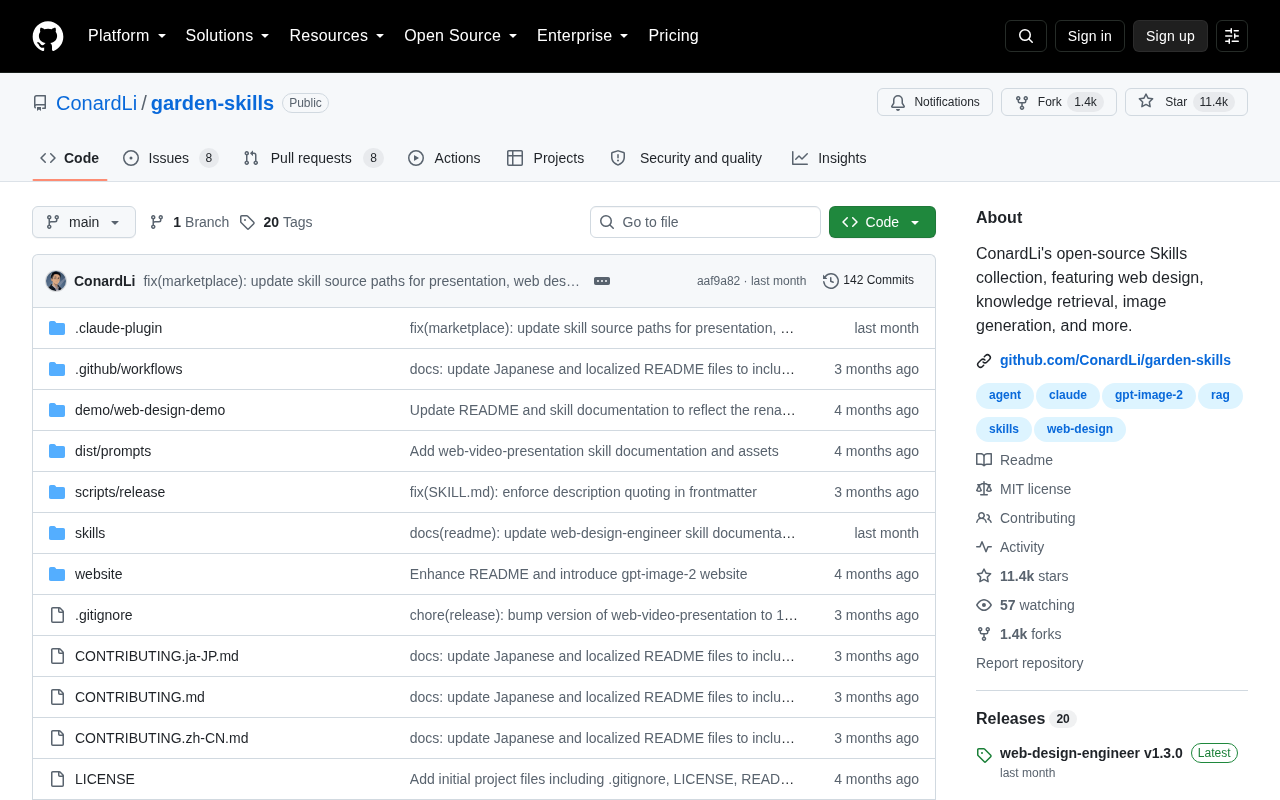
You may not have noticed, but the project's primary language is labeled as CSS — GitHub uses an open-source library called Linguist to automatically detect project languages based on the byte proportion of each language's files in the repository. The fact that CSS has the highest proportion means the repository contains a large number of pre-built style templates and design system files. This reflects that it's not a traditional codebase, but rather a collection of "skill" resources built around AI capabilities. As AI Agents and LLM tool calling become increasingly prevalent, this kind of structured skill library is gradually becoming critical infrastructure for boosting developer productivity.
What Is an AI "Skills" Library?
From Tool Calling to Capability Encapsulation
To understand Skills, you first need to understand the Tool Use / Function Calling mechanism in large language models. This capability was first popularized at scale by OpenAI in 2023, allowing LLMs to identify when external functions need to be called during conversations and automatically generate standardized calling parameters. This broke the limitation of models being able to only generate text, enabling them to operate APIs, query databases, execute code, and more. Anthropic's Claude, Google's Gemini, and other models subsequently adopted similar mechanisms.
"Skills" can be understood as a higher-level encapsulation built on top of tool calling — packaging specific AI capabilities or workflows into reusable, composable modules. Unlike traditional code functions or individual tool calls, Skills don't just define function interfaces; they also include complete task workflows, prompt templates, and error handling logic, with a stronger emphasis on end-to-end task-oriented solutions. Taking garden-skills as an example, it abstracts developers' most common high-frequency needs into several core skill categories:
- Web Design: Provides ready-to-use design templates and style generation capabilities — one of the reasons CSS is the project's primary language.
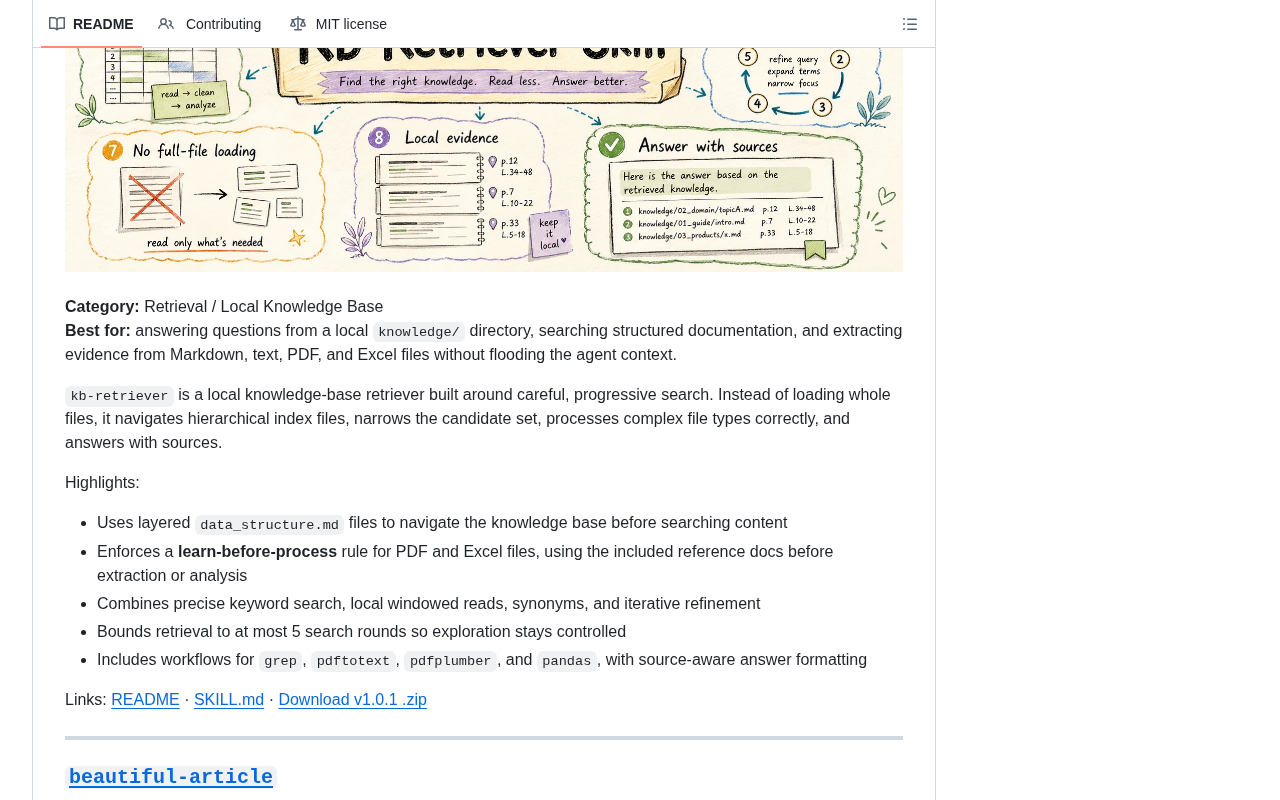
- Knowledge Retrieval: Integrates information querying and knowledge base retrieval functions, helping AI obtain more accurate context when answering questions. The core technology involved here includes RAG (Retrieval-Augmented Generation), which retrieves relevant document fragments from external knowledge bases as context before the LLM generates a response, significantly improving answer accuracy and timeliness.
- Image Generation: Encapsulates image creation capabilities, lowering the barrier to visual content production.
Why Developers Love the Skill-Based Model
This "skill-based" organizational approach is essentially a response to the fragmentation pain points in AI applications. The current AI tool ecosystem faces severe fragmentation: if developers want to build a full-featured AI application, they often need to integrate multiple heterogeneous services simultaneously — one API for text generation, another for image generation, and knowledge retrieval may require connecting to vector databases (such as Pinecone or Weaviate) and RAG pipelines, with each service having different authentication methods, data formats, and error handling mechanisms. In the past, if developers wanted an LLM to complete a complex task, they had to write extensive prompts, stitch together multiple APIs, and handle various edge cases on their own.
The value of a skill library lies in building a critical abstraction layer between the application layer and the infrastructure layer. It packages these validated best practices into ready-to-use modules, dramatically reducing the cost of putting AI capabilities into production and eliminating enormous amounts of repetitive work.
garden-skills' Technical Positioning and Core Value
Infrastructure for the AI Agent Era
An AI Agent refers to an AI system with autonomous perception, decision-making, and action capabilities that can automatically plan task steps based on user goals and call external tools to complete complex work. As LLMs like Claude and GPT have progressively opened up Skills mechanisms, and as various AI Agent frameworks have matured, how to provide AI with high-quality, structured capability extensions has become a new technical focal point.
Between 2024 and 2025, mainstream AI platforms have rolled out their own Skills or Skills-like mechanisms: Anthropic launched Projects and custom instructions for Claude, allowing users to define persistent capability configurations for specific projects; OpenAI's GPTs (which evolved into a more open Agent mechanism) let users create customized assistants with specific knowledge and tool-calling capabilities; additionally, MCP (Model Context Protocol), an open standard proposed by Anthropic, is becoming the universal protocol layer connecting AI models with external tools.
garden-skills hits right at the heart of this trend — it's not another large language model, but rather a "capability adaptation layer" that gives general-purpose AI the ability to handle specific professional tasks. As a third-party skill library, it occupies a valuable position in the ecosystem: providing cross-platform, reusable capability modules that reduce the cost of migration and adaptation across different AI platforms.
For individual developers, this means they can quickly build AI assistants with composite capabilities like web design, content retrieval, and image generation without starting from scratch. For teams, the standardized skill format also facilitates collaboration and reuse.
The Driving Force of Open Source Community
Breaking 10,000 Stars in such a short time demonstrates strong community demand for practical open-source projects of this kind. As a tech creator with significant influence in the Chinese frontend community, ConardLi's project naturally carries a certain reputational foundation. But the deeper reason is that garden-skills addresses real pain points in the current AI tool ecosystem: scattered capabilities, high barriers to entry, and lack of unified standards.
Practical Takeaways for Developers
From Writing Code to Orchestrating AI Capabilities
The viral success of garden-skills reflects a subtle shift in the software development paradigm. Looking back at history, software development has undergone multiple major leaps — from assembly to high-level languages, from procedural to object-oriented programming, and from monolithic architectures to microservices. The current transformation is equally profound: in AI-deeply-integrated workflows, developers' core competency is migrating from "writing specific code" to "orchestrating and composing AI capabilities."
This pattern is sometimes called "AI-Native Development," with the core idea of treating AI models as first-class citizens and designing system architecture around a model's capability boundaries. Under this paradigm, Prompt Engineering, capability orchestration, evaluation, and monitoring become key skills, while traditional algorithm implementation and low-level coding won't disappear but are abstracted to a deeper layer in many scenarios. The skill library model represented by garden-skills is a concrete manifestation of this paradigm shift at the practical level. Mastering and effectively leveraging such skill libraries may become a foundational competency for future developers.
Maintaining a Rational Perspective on Project Popularity
Of course, we also need to maintain a rational perspective. The actual value of skill library projects ultimately depends on the quality of their skills, breadth of coverage, and compatibility with mainstream AI platforms. 11,406 Stars represent community attention, but whether the project can sustain iterative development and form a stable ecosystem remains to be proven over time. Particularly worth monitoring is whether the skill library can keep pace with the rapid evolution of mainstream platform APIs and protocols — for example, the MCP protocol is still iterating rapidly, and skill library formats and interface standards may need continuous adaptation. For developers with relevant needs, it's recommended to start with small-scale validation based on your own use cases before deciding whether to deeply integrate.
Conclusion
The explosive popularity of garden-skills is no accident — it's a quintessential example of the trend toward engineering and modularizing AI capabilities. As large language models gradually become the "operating system," the skill ecosystem built around them becomes the new competitive frontier. Whether you're an individual developer or a technical team, it's worth following the evolution of projects like this — because they may well be defining how the next generation of AI applications will be built.
Key Takeaways
Related articles

Chain of Thought Isn't Just for AI: How Humans Can Use CoT to Improve Thinking Quality
Chain of Thought isn't just a prompt trick for large models. Starting from a Hacker News discussion, this article analyzes why CoT works for human thinking too, breaks down actionable ways to transfer it, and highlights the key differences between human CoT and machine CoT.
Cloudflare Teams Up with OpenAI: Closi…
Cloudflare Teams Up with OpenAI: Closing the Loop from Vulnerability Discovery to Defense with AI
Cloudflare uses OpenAI Daybreak to investigate security vulnerabilities and generate reviewable remediation plans, while developers use Codex to boost coding efficiency and quality.

Orca Multi-Agent Orchestration in Practice: A Guide to Parallel Collaboration with Claude and Codex
Orca is Stable AI's free open-source agent workbench supporting 34 agents like Claude Code and Codex in parallel. Learn its Git worktree isolation, multi-model orchestration, and mobile management.