Gartner's First Magic Quadrant for Data Lakehouse Platforms: Databricks Named a Leader

Gartner's first lakehouse platform Magic Quadrant names Databricks a Leader, signaling lakehouse architecture's entry into mainstream procurement.
Gartner released its first "Magic Quadrant for Data Lakehouse Platforms," naming Databricks a Leader, marking the lakehouse's transition from concept to mainstream enterprise procurement. The article analyzes the significance of the first Magic Quadrant: a standalone category indicates mature vendors, replicable cases, and clear standards. Databricks won its Leader spot through first-mover advantages in open-source projects like Delta Lake, but competition will intensify around open table formats, query engines, and governance. The article advises enterprises to use the report as a starting point, not the sole basis, and to validate with proofs of concept based on their own data scale, migration costs, and team capabilities.
Lakehouse Architecture Earns Authoritative Recognition
Gartner has released its first-ever "Magic Quadrant for Data Lakehouse Platforms," naming Databricks a Leader. The news was announced by Databricks on social media and quickly drew attention across the data industry. For Databricks, which has long championed the lakehouse architecture, this is not just recognition from a third-party analyst firm—it marks the lakehouse's transition from a conceptual advocacy phase into the evaluation scope of mainstream enterprise procurement.
In its tweet, Databricks described this as a major milestone for the lakehouse architecture, validating the category it pioneered and expressing pride that the category has been included in a Magic Quadrant. While the official wording carries a marketing flavor, Gartner's decision to establish a standalone quadrant itself sends a clear signal: the boundary between data lakes and data warehouses is dissolving, and the market needs a unified evaluation framework.
Gartner Magic Quadrant is a market research report published by Gartner that visually evaluates vendors in a specific technology domain using a two-dimensional coordinate system. The horizontal axis represents "Ability to Execute," measuring a vendor's product maturity, market coverage, and customer satisfaction; the vertical axis represents "Completeness of Vision," assessing strategic vision, innovation capability, and market direction. Vendors are classified into four quadrants: Leaders, Challengers, Visionaries, and Niche Players. The Magic Quadrant is typically updated annually and has become a widely referenced third-party evaluation tool for enterprise IT selection.
Why the First Magic Quadrant Matters
The Gartner Magic Quadrant has long been an important reference for enterprise technology selection. When a new category enters a Magic Quadrant, it usually means the field has accumulated enough mature vendors, replicable customer cases, and relatively clear technical standards. Data lakehouse platforms previously appeared mostly as "architectural concepts" or "product features" within data warehouse or data lake evaluations. Now that they are listed separately, it indicates that Gartner believes the category has its own independent procurement logic and competitive landscape.
From an industry evolution perspective, the lakehouse aims to solve the fragmentation between data lakes and data warehouses in traditional data architectures: data lakes are low-cost and open-format but lack transactional guarantees and performance optimization; data warehouses offer strong performance and mature governance but are closed and expensive. The goal of lakehouse platforms is to provide warehouse-like management capabilities and query performance on top of open data formats. Databricks holds a first-mover advantage in this direction thanks to open-source projects such as Delta Lake, which is an important backdrop to its Leader positioning.
Delta Lake is an open-source table format project led by Databricks, designed to provide ACID transactions, schema evolution, and unified metadata management for data lakes. By adding a transaction log layer on top of existing storage systems, it enables data lakes to support reliable data engineering and SQL queries. Delta Lake, along with Apache Iceberg and Apache Hudi, are currently the mainstream open table formats, and their competition and collaboration together drive the standardization of lakehouse architecture. Databricks has secured a first-mover position in the lakehouse race through its early ecosystem accumulation around Delta Lake.
What Databricks' Leader Position Means
In a Magic Quadrant, a "Leader" typically possesses both strong Ability to Execute and Completeness of Vision. Databricks' placement as a Leader reflects Gartner's overall assessment of its product maturity, market coverage, and strategic direction. It should be noted, however, that this is Databricks' own citation—the specific scores and competitive comparisons in the full report require consulting the original document.
For users, the practical significance of this result is that lakehouse platforms are no longer just experimental choices for technical teams but have entered the formal candidate list for enterprise-level procurement. Organizations evaluating paths to modernize their data architecture can use Gartner's report as a starting point for vendor screening, but should still validate against their own data scale, existing technology stack, and team capabilities.
The Competitive Landscape of the Lakehouse Race
The release of the first Magic Quadrant also means competition in the lakehouse space will become more transparent. Beyond Databricks, cloud providers and other data platform vendors are also ramping up lakehouse capabilities—for example, competition among open table formats, integration of query engines, and filling gaps in unified governance. By establishing the category independently, Gartner has effectively placed these vendors in the same arena.
For Databricks, Leader status is both an endorsement and pressure. Long-term challenges for the lakehouse architecture remain: performance optimization of open formats, cross-engine consistency, and migration costs from traditional data warehouses. Whether it can translate its first-mover advantage as category creator into sustained product barriers will determine its position in future quadrants.
Open Table Format is a core technical component of lakehouse architecture. It defines a metadata specification on top of data files, enabling different compute engines to read and write the same data consistently while providing capabilities such as transaction isolation, time travel, and schema evolution. Currently mainstream open table formats include Delta Lake, Apache Iceberg, and Apache Hudi. The choice of table format directly affects cross-engine compatibility and vendor lock-in risk, making it a key consideration for enterprises selecting lakehouse platforms and one of the focal points of vendor competition.
Calm Advice for Enterprise Selection
Gartner reports are an important reference but not the sole basis for decision-making. When evaluating lakehouse platforms, enterprises are advised to focus on several aspects: first, compatibility with open formats to avoid vendor lock-in; second, migration costs for existing data pipelines; third, whether governance and security capabilities meet compliance requirements; and fourth, the team's learning curve and community ecosystem. Databricks' Leader rating can serve as a ticket to the shortlist, but real validation still needs to return to specific business scenarios and proof-of-concept testing.
As the lakehouse architecture moves from concept to mainstream, Gartner's first Magic Quadrant is a clear footnote. Databricks' Leader position is worth noting, but more importantly, this category finally has an evaluation framework that allows for horizontal comparison—which is good for the entire data infrastructure market.
One-line Summary
Gartner's first lakehouse platform Magic Quadrant names Databricks a Leader, signaling the lakehouse architecture's entry into mainstream procurement consideration.
Paragraph Summary
Gartner released its first "Magic Quadrant for Data Lakehouse Platforms," naming Databricks a Leader, marking the lakehouse architecture's transition from conceptual advocacy into mainstream enterprise procurement evaluation. The article analyzes the significance of the first Magic Quadrant: a standalone category indicates the field now has mature vendors, replicable cases, and clear technical standards. Databricks earned its Leader position through first-mover advantages in open-source projects like Delta Lake, but competition in the lakehouse race will become more transparent, with open table formats, query engines, and governance capabilities becoming key battlegrounds. The article concludes by reminding enterprises to use the Gartner report as a starting point for selection rather than the sole basis, and to conduct proof-of-concept testing based on their own data scale, migration costs, and team capabilities.
Related articles
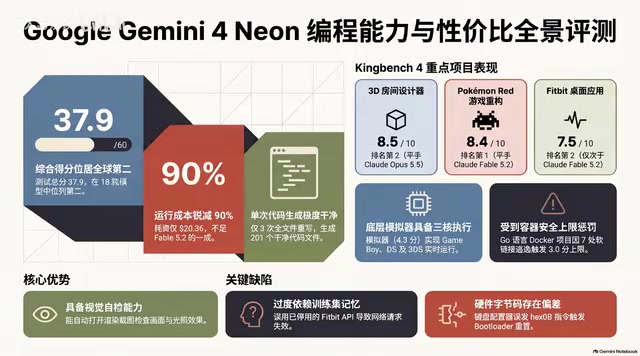
Gemini 4 Neon Hands-On: Value King or Confident Catastrophe?
Gemini 4 Neon review: 1M-token context, four thinking levels, 201 files in one KingBench4 pass at one-tenth Fable 5.2's cost—but it hallucinates fake data, leaves 7 symlink escapes, and bricks keyboards.

Google Gemini 4 Neon Hands-On: 6 3D Works That Impress and Fail
Hands-on with Google Gemini 4 Neon on a 3060 laptop: 6 3D works tested. Sunshower Fishing Harbor and mechanical keyboard impress; soft-body physics and faces fall short.

Gemini 4 Neo Web Novel Writing Test: Faint AI Flavor, Textured Dialogue
Bilibili creator's first-look review of Gemini 4 Neo for Chinese web novel writing: testing a Three Kingdoms transmigration opening with faint AI flavor, emotionally textured dialogue, and strong crisis building, plus comparison of 4A/4H/4C models and full workflow demos.