Gastown: A Git-Backed Coordination Tool for Managing Multiple AI Coding Agents

Gastown uses Git as a persistent foundation to provide traceable, recoverable orchestration for multiple AI coding agents.
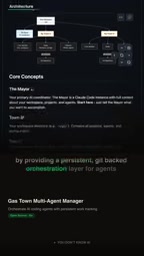
Gastown is a workspace manager for multiple AI coding agents that persists agent work state into Git-backed structured hooks rather than relying on fragile context memory. It organizes workflows using a Mayor–Convoy–Rig metaphor: the Mayor acts as the primary coordinator, Rigs map to code repositories, and Convoys group tasks for management. The system automatically dispatches agents and provides real-time visibility. It addresses three core pain points — coordination chaos across many agents, difficulty tracking complex multi-step tasks, and state recovery after crashes — representing a shift in AI tooling from single-agent capability competition toward multi-agent cluster orchestration.
The Chaos Problem in Multi-Agent Collaboration
Anyone who has tried orchestrating multiple AI coding agents simultaneously has probably experienced that sense of losing control: agents losing context, tasks conflicting with each other, and a single crash forcing you to start from scratch. When you're running just one agent, the problems are manageable — but once you scale to a dozen or even dozens of agents, coordination becomes a nightmare.
Gastown is a Workspace Manager built specifically to address these pain points. It provides a Git-backed, persistent orchestration layer for coding agents like Claude Code and GitHub Copilot. Rather than relying on the fragile memory of individual agents to preserve work state, it stores WorkState in structured hooks — making the entire workflow more controllable and auditable.
When Do You Actually Need Gastown?
Not every project needs an orchestration system like this. For simple tasks handled by a single agent, Gastown would be serious over-engineering. Its real value emerges in these scenarios:
- Scaling up to dozens of agents working simultaneously, where manual coordination is no longer practical;
- Reliably tracking complex, multi-step tasks, ensuring every step leaves a traceable record;
- Keeping workflows alive through random crashes or restarts, so prior work isn't lost.
The underlying logic across all three is consistent: when the complexity and scale of an AI workflow exceeds what human oversight and single-agent memory can handle, you need an external, persistent coordination hub. Gastown positions itself as the "town square" for AI workers — the place where all agents register, receive assignments, and collaborate.
Core Concepts and Workflow
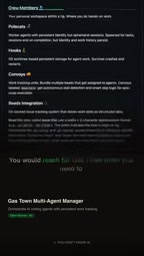
Gastown uses a vivid "town" metaphor to organize its workflow. Understanding a few key concepts is all you need to get started.
Mayor: The Coordination Hub
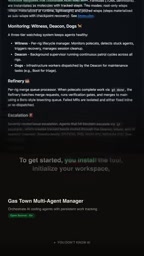
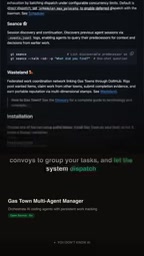
After installing the tool and initializing your workspace, the first step is to "attach the mayor." The Mayor acts as the primary coordinator, responsible for orchestrating the entire team of agents. Think of it as the manager of the town — deciding which tasks go to whom and when.
Rigs and Convoys
Next, you add your project repositories as rigs — each rig corresponds to a codebase or unit of work. You then create convoys to group and manage tasks. This layered structure breaks large tasks down into manageable collections rather than a chaotic pile of instructions.
Automatic Dispatch and Real-Time Visibility
Once configured, the system automatically dispatches agents to their respective tasks to handle the heavy lifting. The entire process is kept visible and orderly through a real-time system — you can see at a glance which agent is doing what and how far along it is. This kind of transparency is exactly what's most lacking in multi-agent development.
The concept of an Orchestration Layer originates from distributed systems engineering. In microservice architectures, orchestrators like Kubernetes manage the lifecycle, dependencies, and failure recovery of large numbers of independent services — without those services needing to know about each other's existence. Gastown transplants this same philosophy into the AI agent world: each coding agent focuses on executing its assigned coding task, while Gastown as the orchestration layer handles task distribution, state synchronization, and error handling. This separation of concerns means that swapping out the underlying agent (say, replacing Claude Code with Copilot) theoretically won't disrupt the overall workflow — orchestration logic and execution logic remain decoupled.
Why Git-Backed Is the Key Design Decision
Gastown's most noteworthy design choice is building state management on top of Git rather than on agents' ephemeral memory. This delivers two immediate benefits.
First, persistence. Agents have limited context windows and tend to forget earlier information during long-running tasks. Writing WorkState to Git-backed structured hooks gives that state a reliable home — it won't vanish just because a session ends or the program crashes.
Second, traceability and recoverability. Leveraging Git's native version management, every node in a complex multi-step task can be recorded. When the system unexpectedly restarts, the workflow can resume from its persisted state rather than starting over. For teams genuinely deploying AI agents in production, this kind of reliability often matters more than the intelligence of any single execution.
The choice of Git as a persistence layer is no accident. Large language models (LLMs) face a fundamental limitation when handling long-running tasks: the context window is finite and ephemeral — once a session ends, the agent's "memory" of prior work evaporates. This is tolerable in single-agent scenarios, but causes catastrophic state inconsistency when multiple agents run in parallel.
Git's core characteristics happen to address this gap perfectly: every commit is a timestamped, immutable snapshot; the branching mechanism naturally supports parallel workflows that don't interfere with each other; and merge/rebase provides a standardized way to resolve conflicts. Serializing WorkState into Git means the entire agent collaboration history becomes auditable — you can roll back to any historical point, and use diffs to pinpoint exactly which agent introduced a problem at which step. This is especially valuable for production environments that require compliance auditing or post-incident debugging.
Conclusion
Gastown represents an evolutionary direction for AI coding tools: now that a single powerful agent is no longer the bottleneck, orchestrating and coordinating a team of agents has become the new engineering challenge. It uses Git as a persistent foundation, employs the Mayor–Convoy–Rig metaphor to lower the learning curve, and aims to bring order to the chaos of multi-agent development.
If your AI workflow is stuck in a swamp of lost context and task conflicts, this kind of orchestration layer is worth exploring. One caveat: the material for this article comes from a brief product introduction video, and deeper performance characteristics and real-world results will still need validation against official documentation and hands-on use.
Related articles

Amphibious Transforming Drone: Beyond 100x Power Savings, What Are the Real Needs?
Is the amphibious transforming drone just a gimmick? Starting from the 100x power difference of the M4 Morphobot, explore real application scenarios and thesis topic ideas, analyzing boundary conditions where pure drones and pure ground robots both fail.

Warhound Raises $200 Million: Genetically Engineered "War Dogs" Paired with Anduril Gear
Warhound raises $200M, backed by Ben Lamm and Palmer Luckey, to genetically engineer dogs for military and law enforcement use and equip them with Anduril gear. This article analyzes its technology direction, funding logic, and ethical controversy.

Claude API Comes to Google Cloud: IAM Integration and SDK Access Guide
Anthropic hosts the full Claude API on Google Cloud with IAM-controlled permissions and unified billing. This guide covers the Vertex AI and Anthropic-hosted entry points, IAM role configuration, and SDK access.