Gaussian Splatting Accelerates Density Functional Theory: A New Paradigm for Quantum Chemistry on GPUs

Inspired by computer vision, Gaussian splatting DFT turns basis functions into optimizable Gaussian point clouds, cuts memory to quadratic scaling, and enables 2700-atom simulations on a single GPU.
Andreas Goodman-Cordero at Mila proposed a Gaussian splatting DFT method inspired by computer vision. It replaces nucleus-anchored basis functions with 3D Gaussian primitives jointly optimized with mixing coefficients via gradient descent, using Löwdin orthogonalization. Sparse adaptive auxiliary bases from Gaussian products reduce memory from cubic to quadratic, enabling a single H200 GPU to simulate a 2700-atom viral protease (~60,000 basis functions). Accuracy scales better with basis size and generalizes across PBE and r2SCAN, with densities, forces, and ionization potentials matching baselines. Limitations include density-fitting error and more convergence steps.
Density functional theory (DFT) is the cornerstone of computational quantum chemistry, generating labels for nearly all large-scale machine learning force field datasets (such as OMol and OC20), and serving as a core tool for materials screening and conformer ranking. However, DFT is extremely computationally expensive, and its traditional implementations rely heavily on CPUs and struggle to leverage modern GPU acceleration, limiting us to systems of roughly 350 atoms. Andreas Goodman-Cordero, a PhD student at Mila, the Quebec AI Institute (Université de Montréal), has proposed a novel method inspired by computer vision—reconstructing DFT calculations with Gaussian Splatting, reducing memory complexity from cubic to quadratic and making simulations of systems with thousands of atoms possible.
Why Does DFT Need a "Visual Revolution"?
The core idea of DFT is to simplify the complex many-body electronic wavefunction (3N-dimensional) into a three-dimensional electron density, with theoretical exactness guaranteed by the Hohenberg-Kohn theorem. In practice, the density is constructed from the sum of squared moduli of Kohn-Sham orbitals, and the orbitals are linear combinations of fixed basis functions. Traditional basis functions (such as Gaussian-type orbitals) are anchored to atomic nuclei with fixed shapes, and only the mixing coefficients can be optimized. This leads to two fundamental problems:
- Scaling bottleneck: The electron-electron repulsion term involves four-center integrals, and naive computation grows as the fourth power of the number of basis functions; even with density fitting approximations it only drops to cubic, with enormous memory consumption.
- Limited physical description: Fixed basis functions cannot describe diffuse densities (such as anion tails); computing forces requires additional handling of the effect of basis functions moving with nuclei, and manual augmentation of basis sets is needed.
These shortcomings directly limit the scope of DFT, which in turn constrains the machine learning models that depend on it for generating data.
The Hohenberg-Kohn theorem is the theoretical foundation of density functional theory, proposed by Pierre Hohenberg and Walter Kohn in 1964. The theorem contains two core conclusions: first, the ground-state electron density of a system uniquely determines the external potential (and hence the Hamiltonian), so the electron density contains all information about the system; second, there exists a universal energy functional whose minimum corresponds to the ground-state energy. This provides a rigorous basis for replacing the 3N-dimensional wavefunction with a three-dimensional electron density. However, the theorem only guarantees existence and does not give the exact form of the exchange-correlation functional; practical calculations must rely on approximations (such as LDA, GGA, hybrid functionals). This "functional approximation" is the main source of DFT accuracy—and an important factor in the label uncertainty of machine learning force fields.
Gaussian Splatting: From Rendering Images to Solving the Schrödinger Equation
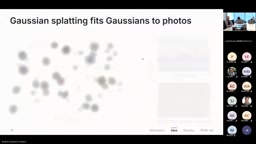
Goodman-Cordero's insight is that 3D Gaussian splatting in computer vision reconstructs images by optimizing the positions, shapes, orientations, and blending weights of Gaussian point clouds; in quantum chemistry, we are likewise optimizing basis functions (Gaussian point clouds) to fit physical laws. Both share the same differentiable rendering framework—only the loss function changes from photometric error to the energy functional.
Specifically, each Gaussian primitive has 9 parameters (position, covariance), can move, stretch, and rotate freely, and is no longer anchored to atomic nuclei. These primitives, together with the mixing coefficients, are jointly optimized via gradient descent to directly minimize the DFT energy. To satisfy the orthonormality constraint of orbitals, the author employs the well-established Löwdin orthogonalization technique from quantum chemistry, projecting optimization steps back onto the feasible manifold.
Adaptive Auxiliary Basis Set: Making Density Fitting More Efficient
Traditional density fitting requires a predefined auxiliary basis set, whereas the basis functions of Gaussian splatting can themselves provide the auxiliary basis. By the Gaussian product theorem, the product of two Gaussians is still a Gaussian, but the number of products grows as the square of the number of basis functions. The key is that only spatially nearby Gaussians produce significant overlap, so the number of effective neighbors per Gaussian is bounded. The author retains only pair products with non-negligible overlap, constructs a sparse auxiliary basis set, and adaptively updates it every K steps. This technique reduces the memory scaling from cubic to quadratic while preserving the accuracy of density fitting.
Löwdin orthogonalization is a classical method in quantum chemistry for handling orthonormality constraints on basis sets. Given a set of non-orthogonal basis functions with overlap matrix S, Löwdin orthogonalization transforms the basis set into an orthogonal basis via S^{-1/2}. In variational optimization, if the gradient of the energy with respect to basis function parameters is taken directly, the updated basis set may violate the orthonormality condition, so the gradient must be projected onto the subspace that preserves orthogonality (i.e., projected gradient on the Stiefel manifold). In practice, re-orthogonalizing after each parameter update, or using preconditioning akin to natural gradients, ensures that the orbitals always satisfy ⟨φ_i|φ_j⟩=δ_ij. This technique enables Gaussian splatting DFT to stably and jointly optimize basis function positions, shapes, and mixing coefficients.
Density fitting (also known as Resolution of Identity, RI) is an approximation technique for accelerating the computation of electron repulsion integrals. The four-center integral (ij|kl) can be approximated as a combination of three-center and two-center terms: Σ_P (ij|P)(P|Q)^{-1}(Q|kl), where {P} is the auxiliary basis set. Traditional implementations require a predefined auxiliary basis set (such as def2-SVP/C), typically 2-3 times the size of the atomic orbitals, and the storage and inversion of the (P|Q)^{-1} matrix in memory is the bottleneck. The innovation of Gaussian splatting DFT is that the auxiliary basis is generated directly from products of Gaussian basis functions being optimized, and only pairs with significant spatial overlap are retained, forming a sparse auxiliary basis set. Combined with the Gaussian product theorem, the product of two s-type Gaussians is still a Gaussian (centered on the line connecting the two), so auxiliary basis functions can be constructed analytically without manual design, and sparsity reduces memory from O(N^3) to O(N^2).
Performance Validation: More Accurate, More Efficient, More General
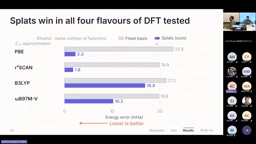
Tests on several small molecules and biological systems show that Gaussian splatting DFT is slightly less accurate than traditional methods at the same number of basis functions, but as the number of basis functions increases, its accuracy improves more steeply and can ultimately surpass fixed basis sets. More importantly, because of higher memory efficiency, the same GPU node can accommodate more basis functions, thereby achieving higher overall accuracy.
Observables such as electron density, forces, and ionization potentials are highly consistent with baseline methods. Particularly interesting is that ionization potentials computed via Goodman's theorem match Hartree-Fock reference values perfectly, validating the correctness of the method. Tests of exchange-correlation functionals cover different families such as PBE and r2SCAN, all outperforming the baseline, indicating that the method does not depend on a specific functional form.
For challenging scenarios such as anions and stretched bonds, Gaussian splatting basis functions can autonomously move to regions that need coverage, matching or even surpassing augmented basis sets in accuracy without manual augmentation, and using fewer basis functions.
Goodman's theorem (here referring to the Goodman model in quantum chemistry) is used to estimate ionization potentials from Kohn-Sham orbital energies: IP ≈ -ε_HOMO, i.e., the negative of the highest occupied orbital energy. This approximation holds rigorously in Hartree-Fock theory (Koopmans' theorem), but in DFT it typically underestimates ionization potentials due to the self-interaction error of the exchange-correlation functional. However, when optimized Gaussian splatting basis functions are used, orbital energies are closer to true physical values, making ionization potentials based on Goodman's theorem highly consistent with Hartree-Fock reference values—indirectly validating the quality of the basis function optimization. This test serves as an important benchmark for evaluating basis set flexibility and physical fidelity.
Practical Scale: From 350 Atoms to 2700 Atoms
Traditional DFT already requires hundreds of millions of CPU core-hours to handle a 350-atom system, whereas Gaussian splatting DFT, through sparse pair products, can run a 2700-atom viral protease system (about 60,000 basis functions) on a single H200 GPU. Although it requires more optimization steps than traditional self-consistent field iterations, the cost per step is extremely low, and traditional methods simply cannot handle systems of this size.
Limitations and Future
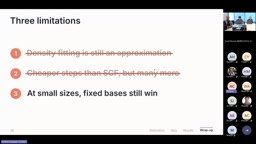
The author candidly points out three limitations of the current method: a small error introduced by density fitting (but since the auxiliary basis comes from the optimized basis set, the error is already smaller than traditional methods), a relatively large number of iterations required for convergence, and fixed basis sets still being better for very small molecules. However, the team is developing an improved version that is accurate and fast-converging, and plans to extend the method to crystalline materials (periodic systems) and hybrid functionals. In addition, adaptive pruning and densification (similar to 3D GS in vision) are also future directions.

This work demonstrates the power of cross-disciplinary thinking: differentiable rendering and geometric optimization from computer vision precisely match the needs of quantum chemistry for efficient, flexible basis functions. As GPU-native DFT solvers mature, ab initio simulations of large biomolecules and materials may open up new possibilities.
One-line Summary
Inspired by computer vision, Gaussian splatting DFT turns basis functions into optimizable Gaussian point clouds, cuts memory to quadratic scaling, and enables 2700-atom simulations on a single GPU.
Paragraph Summary
Andreas Goodman-Cordero at Mila (Université de Montréal) proposed a Gaussian splatting density functional theory (DFT) method inspired by computer vision. Traditional DFT relies on basis functions fixed to atomic nuclei, and the memory of electron repulsion terms grows cubically with the number of basis functions, limiting it to about 350 atoms. This method replaces basis functions with freely movable, stretchable, and rotatable 3D Gaussian primitives (9 parameters each), jointly optimized with mixing coefficients via gradient descent to directly minimize DFT energy, while using Löwdin orthogonalization to satisfy orbital constraints. By leveraging the sparsity of Gaussian products to build an adaptive auxiliary basis set, it reduces memory complexity from cubic to quadratic, enabling a single H200 GPU to simulate a 2700-atom viral protease system (about 60,000 basis functions). Tests show slightly lower accuracy at the same number of basis functions, but accuracy improves faster as basis functions increase, and it automatically covers diffuse density regions without manual basis augmentation; it generalizes across functionals such as PBE and r2SCAN, with electron density, forces, and ionization potentials consistent with baselines. Current limitations include small density-fitting errors and a large number of convergence steps; the team is developing an accurate, fast version and extending to periodic systems.
Related articles

AI Can Read Neural Network Weights Directly: Do Models Already Exceed Expectations?
A Reddit developer experiment shows language models can directly read neural network weights and infer their function. Astra, Opus 5.5, and Muse Spark 1.3 all passed the test, sparking discussion on model generalization and training sources.

India's Microdrama Market Explodes: EloElo Secures $80M Investment from NBCUniversal
EloElo secures $80M from NBCUniversal to boost StoryTV, its microdrama platform with over 33M monthly active users, as India's microdrama market draws global capital.

Acoustic Detection of Multi-Rotor UAVs: Fusing Handcrafted Features with Pre-Trained Embeddings
Study reveals data leakage from random splits in UAV acoustic detection, proposes source-disjoint protocol with stacked ensemble of handcrafted features and YAMNet embeddings, achieving 95.29% accuracy for low-cost drone detection.