Geekerwan's Yunfei Talks AI Agents: Codex/Kimi K3 in Practice and the Reverse-Engineering Porting Boom

Yunfei shares Agent usage insights, noting AI is greatly lowering the barrier to reverse-engineering porting.
Geekerwan's Yunfei shares his daily AI Agent habits: Codex as the development workhorse, Claude used by the team, GLM preferred for reverse engineering, and Kimi K3 praised as the strongest domestic model. He notes frontend tools are homogenizing and model capability is what matters, with sophisticated users mixing models by task. The interview highlights AI reverse-engineering porting: the team ported 3DMark to HarmonyOS, with potential to extend to Switch games, AAA titles, and web versions of old games. Yunfei says AI has turned expert-only reverse-engineering porting into "a matter of time and tokens," though reverse-engineering thinking and task decomposition still rely on human experience.
From Tool Chit-Chat to Tech Trends: Yunfei's Take on the State of AI Agents
In a video, Yunfei, a member of the Bilibili channel Geekerwan, answered viewers' questions about which AI Agent he recommends. He revealed that in his daily work he uses Codex most frequently, while Claude is mainly used by the development team; he also uses DeepSeekAd Harness as a frontend, along with Kimi K3/Kimi Code, GLM, and other models. This seemingly casual tool-sharing actually reflects the current segmented landscape of the AI coding assistant market—and a trend that deserves more attention: AI is making reverse-engineering porting, once the domain of a select few experts, accessible to almost anyone.
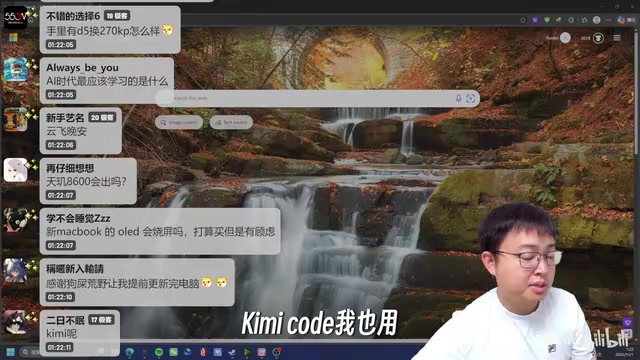
Agent Tools in Practice: Codex Used Frequently, Kimi Models Praised
A Division of Labor Between Development and "Doing Bad Things"
Yunfei's usage habits are quite representative: Codex is the daily development workhorse, Claude is used more by team developers, and GLM is what he jokingly calls his choice for "doing bad things"—he leans toward GLM for reverse engineering. As for Kimi, he stated plainly, "I think Kimi's K3 model is pretty good," and even said outright, "The strongest domestic model right now still feels like Kimi." This kind of evaluation based on real usage scenarios reflects a model's capability boundaries better than benchmark leaderboards.
He also noted that differences between frontend tools "don't really matter"—what truly creates a gap is the model capability behind them. DeepSeek Harness as an Agent frontend and 4.1 Flash as an alternative model form a workflow that mixes multiple models. This shows that sophisticated users don't lock themselves into a single tool, but switch flexibly based on task type.

Codex is a code generation model series launched by OpenAI, initially serving as the underlying engine for GitHub Copilot and later developing into standalone API and Agent products, excelling at multi-file engineering modifications and terminal operations. Claude is Anthropic's conversational model, and its Claude Code product is positioned as a terminal Agent that can autonomously execute development tasks, with strengths in long-context understanding and code safety. GLM is a model series from Zhipu AI, while Kimi K3 and Kimi Code come from Moonshot AI, the latter optimized specifically for coding scenarios. DeepSeek Harness is not an official DeepSeek Agent product, but rather what the community commonly refers to as an Agent execution framework/frontend that wraps model capabilities into a callable toolchain. These tools differ markedly in capability focus, context length, instruction following, and price, so Yunfei's approach of switching by task scenario is representative.
AI Reverse-Engineering Porting: From 3DMark to AAA Games, a New Way to Play
Porting 3DMark to HarmonyOS Is Just the Beginning
The most informative part of the interview is Yunfei's view on AI reverse-engineering porting. He mentioned that the team recently ported 3DMark to HarmonyOS, and believes similar operations can absolutely be applied to the gaming field. He observed that people have already reverse-engineered Switch games and ported them natively to iPhone, and there are even rumors of a native iPhone version of Cyberpunk 2077—though the latter is actually based on the Mac version, achieved through something like GBDK.
GTA5 was also mentioned, and even more extreme are web versions of old games: web versions of Need for Speed: Underground 8 and Need for Speed: Most Wanted 9 have already appeared, and running them with WebGL is "relatively easy to implement." These cases would have been almost unimaginable a few years ago, yet today they've become projects that ordinary developers can attempt as long as they're willing to put in the time.

Reverse-engineering porting usually refers to restoring program logic without source code through decompilation, dynamic debugging, and behavior analysis, then rewriting or adapting it for the target platform. Traditionally this requires deep expertise in assembly, system calls, and graphics APIs. WebGL is a browser-based JavaScript graphics interface that can directly invoke GPU rendering, allowing old games to run in a web page without installation, reducing distribution and adaptation costs. GBDK is the Game Boy development kit, often used metaphorically for translation/wrapping solutions that "downgrade" PC games to run on mobile. AI's role in such tasks is to accelerate decompiled code comprehension, generate platform adaptation layers, and automate testing—but target platform differences (such as HarmonyOS's ArkTS or iOS's Metal) still require humans to design the porting architecture.
"It's Just a Matter of Giving It Some Time and Some Tokens"
Yunfei's judgment on AI lowering the technical barrier is very blunt: things he used to think only experts could do—"actually now you can do whatever you want to do, it's just a matter of giving it some time and some tokens." However, he also points out soberly that reverse compilation "isn't really something you can teach"—different software has completely different considerations, and it's more about differences in approach than standardized, teachable steps. This is worth being wary of: AI can accelerate execution, but task decomposition and reverse-engineering thinking still depend on human experience.

Takeaways for Developers
Yunfei's experience points to several practical conclusions. Model selection should be scenario-based: use Codex for development, lean toward GLM for reverse engineering, and look to Kimi K3 among domestic models—rather than seeking a universal tool. AI Agent frontends are homogenizing, and competitiveness returns to the models themselves. Reverse-engineering porting is a high-value scenario for AI deployment, from filling gaps in the HarmonyOS ecosystem to cross-platform gaming, there are plenty of "weird" needs that can be met.
Of course, Yunfei also admits that the team's subsequent integration may lean heavily on AI, but the actual results still need to be tested in practice. For ordinary developers, rather than agonizing over "which Agent to learn," it's better to just start using them, as he says.
One-line Summary
Yunfei shares his Agent usage insights, noting that AI is dramatically lowering the barrier to reverse-engineering porting.
Paragraph Summary
Yunfei, a member of the Bilibili channel Geekerwan, shares his daily AI Agent usage habits: Codex is his development workhorse, Claude is used by the team, GLM is preferred for reverse engineering, and he praises Kimi K3 as the strongest domestic model. He emphasizes that frontend tools are becoming homogenized, and what really determines results is the model capability behind them—sophisticated users mix multiple models by task. The interview's focus is AI reverse-engineering porting: the team has already ported 3DMark to HarmonyOS and believes it can extend to Switch games, AAA games, and even web versions of old games. Yunfei believes AI has turned reverse-engineering porting—once doable only by experts—into "a matter of giving it some time and some tokens," but reverse-engineering thinking and task decomposition still rely on human experience.
Related articles

RePlan-VLA: Progress-Aware Replanning Breakthrough for Long-Horizon Robotic Manipulation
The RePlan-VLA framework converts VLA models' short-horizon capabilities into reliable long-horizon execution through progress-aware adaptive replanning, improving success rates by 21.9% and 10.4% on RoboCasa365 and CALVIN, and validating real-world deployment on a Franka Research 3 robot.

Geometric Bridge Flow Matching: A New Breakthrough in Blind Rigid Motion Correction
Geometric bridge flow matching enables blind rigid motion correction in head CBCT, achieving 37.1 dB PSNR and 0.27 mm RPE on simulated data in ~9.1 minutes, outperforming existing methods.

Google Releases Gemini 4 Hydrogen: 2.5x Faster Without Sacrificing Intelligence
Google releases the lightweight Gemini 4 Hydrogen: 2.5x faster task completion, AA Intelligence Index of 54 beating its flagship sibling, 7.3s single-step on Agent Arena faster than Claude and GPT rivals, four thinking levels with pay-as-you-need pricing, now available across AI Studio and more.