Gemini 3.7 Flash Deep Dive: Half the Price, Faster Speed, and Why 3.5 Pro May Never Launch

Gemini 3.7 Flash delivers near-flagship intelligence at half the price with faster speed, signaling a new value era.
Google launched Gemini 3.7 Flash just three weeks after 3.6, cutting prices by 50% while boosting intelligence to near-Terra levels and improving speed. The model lands on the Pareto frontier for the intelligence-speed tradeoff. A credible leak suggests 3.5 Pro may never release. The Flash route represents a strategic push into price-sensitive markets previously unable to afford flagship models.
Three-Week Iteration: Four Keywords Defining Gemini 3.7 Flash
Just three weeks after the previous generation's release, Google officially launched Gemini 3.7 Flash. This iteration pace is remarkably rare in today's large model race, reaffirming that the arms race among top-tier players in reasoning efficiency and cost control has entered a white-hot phase.
According to a summary analysis by Bilibili creator DP, this new model can be encapsulated in four keywords: faster, half-price, smarter, and free. If summed up in one sentence: "faster, cheaper, and a bit smarter." It should be noted that all benchmark data cited in this article comes from publicly available online sources and is for reference only—please refer to official documentation for actual capabilities.
A noteworthy detail: alongside the 3.7 Flash launch, Google simultaneously lowered the price of the previous-generation 3.6 Flash. This means 3.7 and 3.6 are now at the same price point, both reduced by 50% from the original. The official intent is crystal clear—use 3.7 Flash to comprehensively replace 3.6 Flash.
Benchmark Data: Gemini 3.7 Flash Intelligence Approaches Terra Level with Better Speed
Let's start with intelligence benchmarks. On charts measuring model intelligence (higher values = smarter), 3.7 Flash High clearly surpasses the previous 3.6 Flash, positioning itself above GPT-5.6 Nano but below Terra, closely hugging Terra's line. This means a model positioned as a lightweight "Flash" variant is approaching flagship-level intelligence.
The Flash series' core design philosophy trades reasoning efficiency for scalable deployment potential. Compared to the flagship Pro series, Flash models typically employ fewer parameters, more aggressive knowledge distillation strategies, and more efficient attention mechanisms (such as Grouped Query Attention/GQA, sliding window attention, etc.), dramatically reducing per-inference compute cost and latency while maintaining acceptable intelligence levels. Target users are typically developers in high-concurrency API call scenarios—chatbots, code completion, document summarization, and other latency- and cost-sensitive applications. This is precisely why a Flash model approaching flagship intelligence becomes strategically significant.
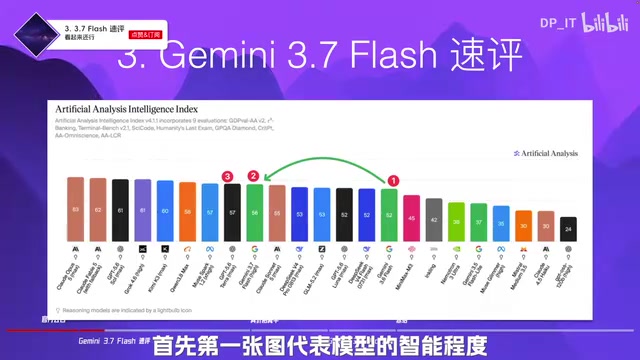
Now for runtime comparison. 3.7 Flash High's runtime is noticeably shorter than 3.6 Flash—meaning it got faster while also getting smarter. Switching to Low and Medium thinking intensities yields even further speed improvements.
The thinking intensity levels (Low, Medium, High) correspond to the popular "Thinking Budget" mechanism in recent large models. This mechanism allows users to specify reasoning chain depth when calling the model—in High mode, the model performs longer internal reasoning (Chain-of-Thought), consuming more tokens but achieving higher accuracy; Low mode limits reasoning steps, sacrificing some accuracy for faster response speed and lower cost. This essentially hands control of "inference-time compute" to the user, enabling a single model to flexibly adapt to tasks of varying complexity.
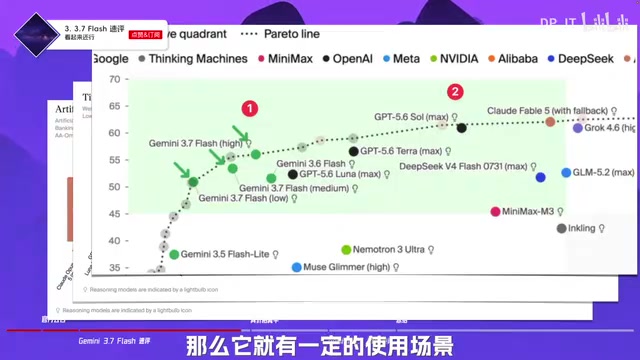
Even more noteworthy is the comprehensive Pareto frontier chart. In this chart, vertical height represents intelligence, and further left means faster speed. 3.7 Flash High shows clear intelligence improvement over 3.6 Flash (lower right), while also being slightly faster, successfully landing on the Pareto frontier.
The Pareto Frontier originates from the Pareto optimality concept in economics, referring to the set of solutions in multi-objective optimization where no objective can be improved without sacrificing another. In the context of large model evaluation, a model on the Pareto frontier means: at the same speed, no smarter model exists; at the same intelligence, no faster model exists. When a new model successfully "lands on" this line, it has achieved the engineering-practical optimum along that trade-off dimension, offering direct guidance for real deployment scenarios. 3.7 Flash High has reached the current optimal boundary in the "intelligence vs. speed" trade-off, demonstrating practical value for real-world use cases.
Price War Signals: Gemini 3.7 Flash Cuts Another 50% on Top of the Initial Reduction
The most compelling selling point of this update is undoubtedly the 50% price cut—and the number is real.
At launch, prices displayed in Google AI Studio clearly showed: across the three generations of 3.5 Flash, 3.6 Flash, and 3.7 Flash, the 3.7 Flash price is genuinely half that of its predecessor. After the model officially went live, Google further reduced 3.6 Flash's price to match, bringing both to parity.
The 3.6 to 3.7 upgrade primarily focuses on coding capability, aligning with the broader industry trend of model vendors competing for the AI programming market. This priority directly relates to the explosive growth in AI-assisted programming—industry data shows that AI coding assistants (GitHub Copilot, Cursor, Windsurf, etc.) saw user growth exceeding 300% during 2024-2025. Coding tasks place unique demands on models: they must understand natural language instructions while precisely generating syntactically correct code, understanding project context, and performing multi-step debugging reasoning. Vendors racing to top coding benchmarks (SWE-bench, HumanEval, LiveCodeBench) are essentially competing for the gateway to the high-value AI developer tools market.
Even more aggressively, some third-party platforms stacked an additional 50% discount on top of the official 50% reduction, driving final prices so low it raises questions about an outright price war. DP commented directly in the video: "I genuinely thought they were starting a price war." This level of price compression reflects vendors actively competing for price-sensitive user segments.
The large model price war began in the second half of 2024, marked by Chinese vendors like DeepSeek and Zhipu drastically lowering API prices, with OpenAI and Google subsequently forced to follow. The underlying logic of price reduction includes: continued improvement in inference chip efficiency (Google TPU v5e, NVIDIA H200), maturation of model distillation and quantization techniques enabling small models to approach large model capabilities, and vendors' strategic calculus of capturing developer ecosystems through low-price strategies. This price war isn't simple "cash burning"—it's cost pass-through built on genuine technological dividends.
Gemini 3.5 Pro May Never Launch? A Precise Prediction Sparks Speculation
Beyond the model itself, DP shared an attention-grabbing rumor—Gemini 3.5 Pro may never be released.
The credibility of this claim stems from a leaked image that circulated before 3.7 Flash's launch. The leaker accurately predicted two things: first, that the model would launch that same day; second, correctly estimating the 50% price reduction. Cross-referencing the official announcement timeline confirms this leak was published before the official announcement, with the price prediction hitting the mark exactly.
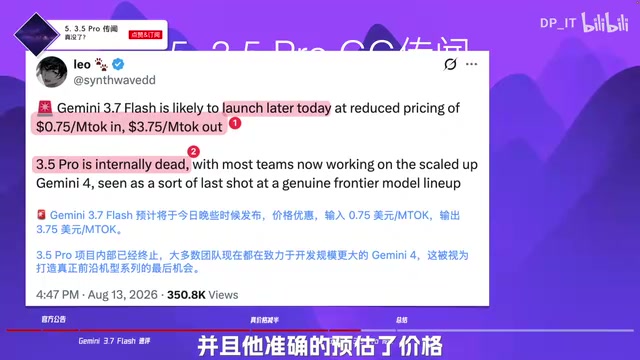
Because the earlier predictions proved accurate, the leak's claim that "3.5 Pro will not be released" carries a degree of credibility. Of course, this remains a rumor from a single source, and final conclusions should defer to official documentation. DP also urged: "Please just release 3.5 Pro—there's real market demand, and many users are waiting."
An intriguing detail: the earlier 2.5 Pro remains available via API and AI Studio to this day. This situation of "old flagship retained, new flagship absent" makes Google's product strategy appear somewhat enigmatic.
The Downmarket Strategy: Flash Route's Strategic Significance
In his analysis, DP raised a thought-provoking point—the downmarket strategy. He observed that both Gemini 3.7 Flash and the recent DeepSeek V4 Flash are pushing into price-sensitive markets, emphasizing the "faster and cheaper" approach.
The "downmarket" here doesn't refer to the traditional consumer concept, but rather to small and medium enterprises, individual developers, and high-frequency call scenarios that previously couldn't afford large-scale use of flagship models. For example, a customer service chatbot system processing millions of API requests daily might cost tens of thousands of dollars per day with flagship models, while Flash-level models can compress costs to an acceptable range, unlocking enormous latent market demand.
This Flash route previously seemed somewhat puzzling. In the 3.6 era, DP considered these models to have "absolutely no use case"—insufficient capability for serious tasks. But with 3.7, things become more nuanced: prices halved while model capability improved and speed increased. If this scissors effect of "rising capability + falling prices" continues to widen, the Flash series may well find its true large-scale application scenarios.
From a practical standpoint, DP believes 3.7 Flash (the video also mentions 3.6) can already replace GPT-5.6 Nano-level models. For work scenarios involving Terra-level requirements, it's worth trying, though users should be aware of certain risks.
Early Testing Notes: Thinking Anomalies and Stability Verification
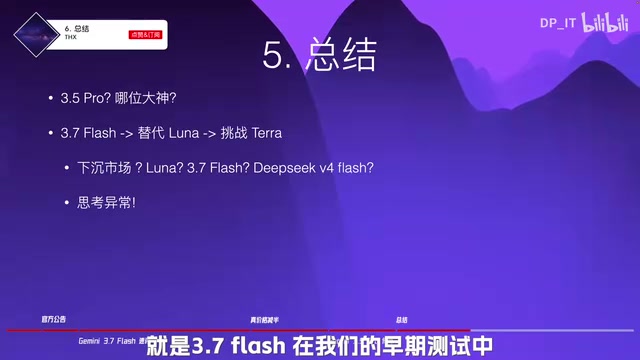
It's worth noting that during early testing, 3.7 Flash exhibited mild thinking anomalies. "Thinking anomalies" typically manifest as logical jumps during reasoning, repetitive loops, or generation of intermediate reasoning steps unrelated to the question. These issues aren't uncommon in models with Chain-of-Thought enabled, especially during early stages after launch before large-scale user feedback optimization. However, given the limited test sample size, this phenomenon cannot yet be treated as a definitive conclusion.
For developers planning to deploy this in production environments, it's recommended to conduct thorough small-scale validation first—especially on tasks involving complex reasoning chains—observing model stability before deciding on large-scale migration. Specific recommendations include: setting up multiple sampling comparisons for critical tasks, monitoring output consistency, and configuring reasonable temperature parameters and maximum token limits to constrain model behavior.
Conclusion: Gemini Flash Route Ushers in a New Era of Value
Gemini 3.7 Flash represents another leap forward in the "value-for-money route" for large models: intelligence approaching Terra level, faster speed, and prices cut in half. It validates a trend—lightweight models are progressively encroaching on flagship models' application territories through continuous capability improvements and price reductions.
As for whether 3.5 Pro will become a swan song, no definitive answer exists yet. But what's certain is that whether it's Google's Flash strategy or DeepSeek's similar moves, the price-sensitive downmarket is becoming a new battleground for large model vendors. For developers, this is undoubtedly a great time to access stronger capabilities at lower costs.
Related articles

Claude Autonomously Designs Proteins with 35% Success Rate, Far Exceeding Human Expert Performance
Anthropic's Claude achieves 35% wet-lab success rate in autonomous protein design, far surpassing the 10-15% human expert average, signaling AI's move toward real scientific productivity.

Perplexity Discover's Multilingual Support Suddenly Disappears — Why Are International Users Upset?
Perplexity Discover's multilingual news feature suddenly dropped non-English support, frustrating international users. We analyze possible causes and the broader challenges of AI product internationalization.

GitHub Daily · August 20: Mojo Tops the Charts & The Local-First Open Source Rebellion
GitHub Trending Aug 20: Mojo tops charts for AI compute stack ambitions, OpenLogi surges 1225 stars with local-first philosophy, and privacy rebellion dominates.