Gemini 3.7 Flash In-Depth Review: Speed, Quality, and Multi-Model Collaboration
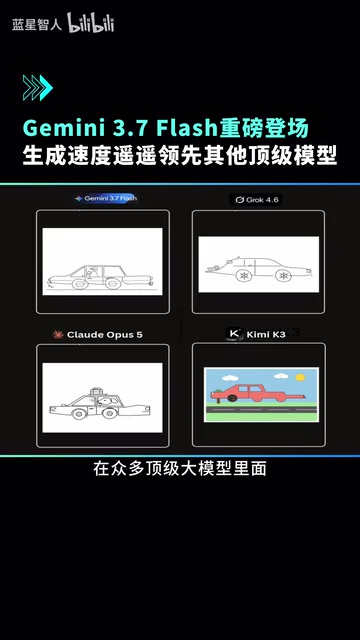
Gemini 3.7 Flash combines breakthrough speed, end-to-end generation, and multi-model orchestration capabilities.
Google's Gemini 3.7 Flash demonstrates three key strengths: industry-leading inference speed through advanced optimization techniques, end-to-end generation capability producing complete playable games from prompts, and a multi-model orchestration architecture that dynamically routes tasks to specialized models. With unified understanding across five modalities and preliminary embodied intelligence exploration, it represents Google's vision for collaborative AI systems that bridge digital and physical worlds.
Google's recently released Gemini 3.7 Flash model has attracted widespread attention. According to hands-on demonstrations by technical content creators on Bilibili, this model not only achieves a "breakthrough lead" in generation speed over many top-tier large models, but also demonstrates remarkable capabilities in generation quality, multi-model collaboration, and multimodal understanding. This article will examine and analyze its core highlights based on demonstration materials.
It should be noted that the content described in this article is based on a single demonstration source, and some capability claims (such as "breakthrough lead") carry a degree of subjectivity. Specific performance still needs to be verified through official benchmarks and large-scale testing.
Gemini 3.7 Flash's Speed Advantage: Core Competitiveness of the Flash Series
From a product naming perspective, Gemini's Flash series has consistently positioned itself as a "high-speed lightweight" variant, focusing on low-latency, high-throughput inference experience. According to the demonstrator, in horizontal comparisons with many top-tier large models, Gemini 3.7 Flash is consistently the fastest responder.
For practical applications, speed is not merely a "benchmark" metric. In interactive scenarios (such as code generation, real-time dialogue, Agent task chains), response latency directly determines user experience and deployment feasibility. A model that can complete complex generation in seconds means it can be embedded into more products sensitive to real-time performance, such as online programming assistants and real-time creative tools. This is also key to the Flash series' balance between cost and performance.
Technical Foundation of LLM Inference Speed
Large language model inference speed is primarily determined by two phases: the Prefill phase and the Decode phase. The prefill phase processes input prompts and can be computed in parallel; the decode phase generates output token-by-token and must execute serially. The Flash series drastically reduces latency through model distillation, quantization techniques (such as INT8/INT4 quantization), KV cache optimization, and Speculative Decoding. Speculative decoding allows a small model to quickly generate candidate tokens, which are then batch-verified by the large model, potentially boosting generation speed by 2-3x. Additionally, Flash models typically employ smaller parameter scales (such as under 70B) and optimized attention mechanisms (like Grouped Query Attention/GQA), achieving sub-second response while maintaining quality. The comprehensive application of these technologies enables the Flash series to meet the real-time requirements of commercial applications while maintaining relatively high generation quality.
Generation Quality Testing: End-to-End Capability from Code to Playable Games
Speed is just the foundation; breakthroughs in generation quality are what truly impress. According to the demonstration, after inputting a prompt for game generation, the model not only completes development quickly, but the resulting game achieves quite high standards in visual presentation, playability, and interactive experience.
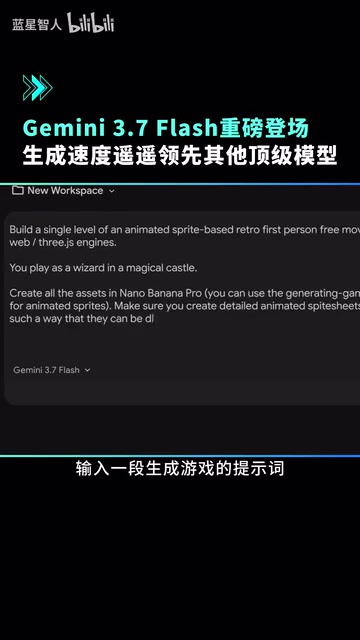
A more impactful example is that an international user generated "the most perfect Minecraft clone" in just one minute using Gemini 3.7 Flash. While the "perfect clone" description contains exaggeration, it at least demonstrates that the model possesses considerable comprehensive capability when handling complex game logic, 3D rendering logic, and interaction design.

Technical Thresholds for End-to-End Code Generation
Generating complete, runnable applications directly from prompts requires multi-level model capabilities: first is accuracy in code syntax and APIs to avoid compilation errors; second is architectural design capability, requiring reasonable organization of file structure, module dependencies, and data flow; third is contextual consistency, maintaining coherence in variable naming and function calls when generating thousands of lines of code; finally is domain knowledge, such as game development requiring understanding of physics engines, collision detection, rendering pipelines, and other specialized concepts. Traditional code models like Codex and CodeLlama primarily excel at function-level completion, while end-to-end generation requires stronger global planning capability and larger context windows (typically requiring 32K+ tokens). The Gemini series enhances these capabilities through million-token-level context and reinforcement learning.
From a technical perspective, generating a complete, runnable game in one shot tests the model's overall control of code structure, game engine logic, and resource scheduling. This "prompt-to-product" end-to-end capability is currently a focal point in the generative AI race. It marks AI's qualitative shift from "programming assistance tool" to "autonomous development system," and signals that software development paradigms may undergo fundamental transformation.
Multi-Model Collaboration Mechanism: Orchestrating Specialized Models for Division of Labor
Another major feature of Gemini 3.7 Flash is its ability to invoke other specialized models within Google's ecosystem to collaboratively complete tasks, forming a "coordinator + specialized modules" division of labor pattern.
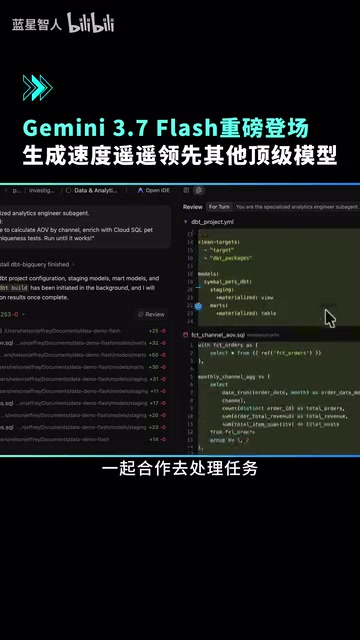
According to the demonstration description, the specific collaboration mechanism includes:
- When creating interactive web pages, it invokes the more specialized Gemini Omni to generate interactive components;
- When generating games, it invokes Nano Banana to generate character and item textures as well as character animations.
Technical Implementation of Model Orchestration Architecture
Model orchestration is a practical application form of Mixture of Experts systems. The core idea is to use a Router Model to analyze task requirements, then distribute subtasks to specialized models for processing. This is similar to API gateways in microservice architectures. Technical implementation needs to address several key issues: granularity control of task decomposition, interface standardization between models, result merging and consistency validation, and call chain performance optimization. In Google's Gemini ecosystem, Flash likely plays the router role, while specialized models like Gemini Omni (multimodal expert) and Nano Banana (game asset generation expert, possibly a fictional name) handle vertical domains. This architecture's advantage is strong scalability, but requires carefully designed orchestration logic to avoid excessive call overhead. Similar technologies are also reflected in OpenAI's GPTs and Anthropic's tool use.
This "Model Orchestration" approach represents an important evolutionary direction for large model applications. Rather than pursuing a single omnipotent model, it's better to have a model with strong planning capabilities dynamically allocate tasks to the most suitable specialized models based on task type. This both ensures output quality at each stage and improves overall efficiency. Of course, the stability of such collaborative capabilities and actual invocation logic still await more independent testing for verification.
Multimodal Understanding and Cutting-Edge Exploration of Embodied Intelligence
The most forward-looking part of the demonstration is Gemini 3.7 Flash's deep multimodal understanding capability. According to the description, it can perform unified understanding across five modalities: text, audio, image, code, and video, and works with three Agents to help robots understand the physical world more quickly.
Technical Evolution of Unified Multimodal Understanding
Traditional multimodal models like CLIP use contrastive learning to align image-text, but only support static understanding. New generation models like GPT-4V and Gemini adopt unified Transformer architectures, converting different modalities into token sequences for joint training. Audio is converted to text or acoustic features through encoders like Whisper; video is sampled into frame sequences; code is processed as special text. Key technologies include: cross-modal attention mechanisms allowing models to capture correlations between different modalities, large-scale multimodal pretraining datasets (such as mixed data containing image-text pairs, video captions, code documentation), and instruction fine-tuning to align with human intent. Unified five-modality understanding means the model can handle complex cross-modal tasks like "generate animation code based on the music rhythm in this video," which is an important step toward Artificial General Intelligence (AGI).
Reality and Challenges of Embodied Intelligence
This description points to one of the hottest directions in current AI—Embodied AI. Embodied intelligence requires AI systems to understand not only digital world data, but also causal relationships, spatial structures, and dynamic changes in the physical world. Core challenges include: closed-loop control of the Perception-Action Loop, construction of World Models to predict action consequences, learning from sparse feedback (reinforcement learning), and sim-to-real transfer (transferring simulation environment training to the real world). In multi-agent collaboration mechanisms, there are typically perception agents (processing sensor data), planning agents (formulating action strategies), and execution agents (controlling robot movement), which coordinate through message passing. Google's RT-2, DeepMind's Gato, and other projects are already exploring Vision-Language-Action (VLA) models, but are still far from general-purpose robot assistants.
If a model can truly integrate multimodal perception and combine multi-agent collaboration to understand the physical world, it will no longer be limited to on-screen text and image generation, but has the potential to drive robots to make decisions and act in real environments. However, we need to remain rational: between "multimodal understanding" and "robots understanding the real world," there remains a huge engineering and theoretical gap. These capabilities more likely reflect Google's ambition and exploration in technical direction. The capabilities mentioned for Gemini 3.7 Flash are more likely preliminary scene understanding rather than complete embodied control. Actual deployment effectiveness needs to be observed through subsequent public demonstrations and product releases.
Summary: Gemini 3.7 Flash's Three-Fold Advantage and Future Outlook
Overall, Gemini 3.7 Flash attempts to establish advantages in three dimensions: extreme generation speed, high-quality end-to-end generation capability, and multi-model collaboration and multimodal understanding. These three combined sketch Google's vision for next-generation AI applications—fast, good, and collaborative.
For developers and content creators, such models mean lower creative barriers and higher production efficiency. But at the same time, note that the above information mainly comes from a single demonstration source, and some performance claims should be viewed cautiously. It's recommended to conduct thorough verification with official documentation, benchmarks, and your own scenarios before actual production use.
The large model AI race has entered a white-hot stage. The triple breakthrough in speed, quality, and collaboration capability may be signaling another round of application ecosystem reshaping. From a technical evolution perspective, we are witnessing AI's leap from "single-point tool" to "collaborative system," from "digital assistant" to "physical world understander," and this process has only just begun.
Key Takeaways
- Inference Speed Breakthrough: Achieves sub-second response through quantization, speculative decoding, and other technologies
- End-to-End Generation: Generating complete, runnable applications directly from prompts requires deep integration of architectural design and domain knowledge
- Model Orchestration Mechanism: Adopts router model + specialized model division of labor architecture, similar to API gateway patterns in microservices
- Unified Multimodal: Unified understanding across five modalities—text, audio, image, code, and video—is a key capability toward AGI
- Embodied Intelligence Exploration: Multi-agent collaboration for physical world understanding, but there's still distance from scene understanding to complete embodied control
Related articles

Uncle Bob on AI Programming: Taming Agents with Deterministic Tools
Uncle Bob shares his AI programming methodology: using deterministic tools like CRAP scoring and mutation testing to constrain agents, building multi-agent pipelines for 4-5x productivity gains, while emphasizing software architecture fundamentals remain timeless.

EcoFlow River Gen4 Review: Are the 256Wh/512Wh Portable Power Stations Worth It?
In-depth analysis of EcoFlow's River Gen4 portable power stations — covering the River 260 Gen4 (256Wh) and River 520 Gen4 (512Wh) in capacity, energy density, portability, and use cases.
OpenAI's Staggering $38.5 Billion Loss: The Financial Truth and Capital Game Before Its IPO
OpenAI faces a reported $38.5B loss before its IPO. This deep dive analyzes compute costs, strategic logic, IPO timing, and what it means for the generative AI industry.