Gemini 3.8 Flash Released: A Coding Powerhouse at 13 Seconds and 1.8 Cents
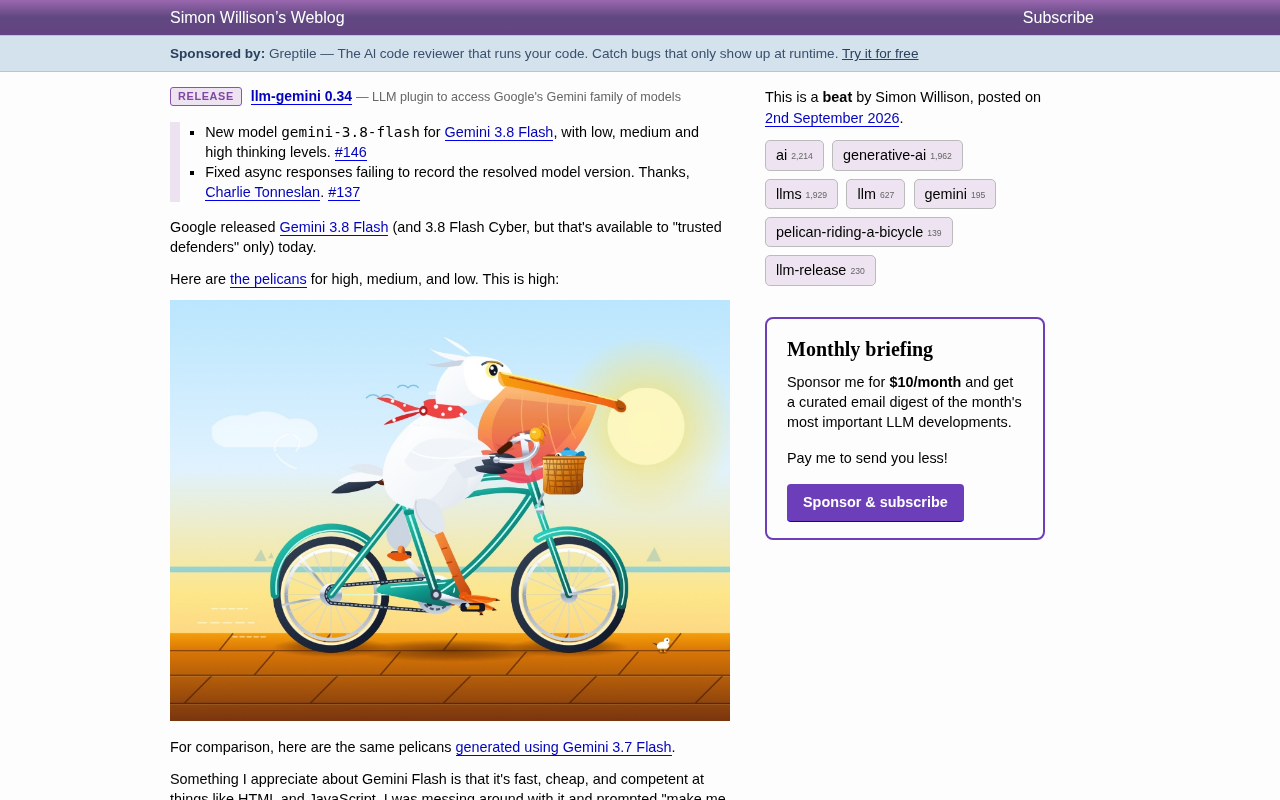
Gemini 3.8 Flash delivers adjustable thinking levels and generates runnable code in 13 seconds for 1.8 cents.
Google's new Gemini 3.8 Flash model introduces three configurable thinking levels (low, medium, high) for balancing speed and reasoning depth. Tests by developer Simon Willison show the model generating runnable interactive HTML code in just 13 seconds at 1.8 cents, and handling real-world tool development tasks including sandboxed HTML rendering. The Flash series continues to excel in the high cost-effectiveness niche for AI-assisted coding.
Google recently released the brand-new Gemini 3.8 Flash model, alongside a simultaneous update of the companion open-source tool llm-gemini to version 0.34. As the latest iteration of the Gemini Flash series, 3.8 Flash carries forward the lineup's hallmark trio of strengths — fast, affordable, and capable — while introducing an adjustable thinking levels mechanism that lets developers flexibly balance response speed against reasoning quality.
What's New in Gemini 3.8 Flash
According to the llm-gemini 0.34 release notes, this update includes two main changes:
- Added the
gemini-3.8-flashmodel with support for low, medium, and high thinking levels; - Fixed an issue where async responses failed to correctly log the resolved model version (contributed by community member Charlie Tonneslan).
Beyond the publicly released 3.8 Flash, Google also introduced a variant called 3.8 Flash Cyber, though this model is currently only available to "trusted defenders" and isn't accessible to regular developers. The naming and access restrictions suggest this variant may be specially optimized for cybersecurity defense scenarios.
Three Thinking Levels: Allocate Reasoning Resources on Demand
Thinking levels represent an important evolution in recent large language models. At its core, this feature lets the model allocate varying scales of "internal reasoning budget" before generating a final answer:
- Low: Best for simple tasks where speed and low cost are priorities
- Medium: Balances speed with reasoning depth
- High: Designed for scenarios requiring complex logical reasoning
This configurable design allows a single model to cover a wide range of needs — from batch processing to deep reasoning — without having to switch back and forth between different models.
The "Pelican Riding a Bicycle" SVG Generation Test
Well-known developer Simon Willison once again used his signature "pelican riding a bicycle" SVG generation test to evaluate the new model's capabilities. He had Gemini 3.8 Flash generate images at all three thinking levels — high, medium, and low.
At the high level, the model produced a remarkably detailed illustration: a cartoon pelican wearing a red-and-white polka dot scarf, riding a teal cruiser bicycle along a seaside boardwalk, with a little blue fish in the bike basket and a glowing sun hanging over the ocean. By comparison, the previous-generation Gemini 3.7 Flash produced noticeably inferior results in terms of detail and composition for the same prompt.
This informal yet highly recognizable test offers an intuitive demonstration of Gemini 3.8 Flash's improvements in spatial understanding and detail rendering.
AI Coding Capability Test: Runnable Code in 13 Seconds for 1.8 Cents
One of the things developers love most about the Gemini Flash series is its exceptional cost-effectiveness for generating frontend code in HTML and JavaScript. Simon Willison casually typed "make me a cool thing in html," and the model generated a runnable interactive piece in just 13 seconds at a cost of only 1.8 cents.
The implications behind these numbers are worth noting: for rapid prototyping, creative experimentation, or batch code generation, such low latency and cost make the price of trial and error essentially negligible. Developers can iterate as casually as doodling on a napkin without worrying about their bills skyrocketing. This is precisely the core competitive advantage of the Flash series over flagship models — it may not be the most powerful, but in the sweet spot of "good enough and cheap enough," it's nearly irreplaceable.
Real-World Example: Adding HTML Rendering to a Tool with Gemini 3.8 Flash
Simon also demonstrated a case much closer to a real-world workflow. He has a markdown-svg-renderer tool that reads Markdown from GitHub Gists and correctly renders SVG code blocks within them. Using Gemini 3.8 Flash together with his own minimalist coding agent plugin llm-coding-agent, he had the model add HTML support to the tool — now HTML code blocks in Markdown are safely rendered through sandboxed iframes.
The value of this example lies in the fact that it's not a toy demo. The model took on an actual development task within a real toolchain, and even accounted for engineering details like security isolation (sandboxed iframes). It demonstrates that Gemini 3.8 Flash is already capable of handling production tasks in lightweight AI coding agent scenarios.
Conclusion: Is Gemini 3.8 Flash Worth Your Attention?
The release of Gemini 3.8 Flash once again confirms two main trajectories in current large model evolution: first, achieving elastic scalability of capabilities through thinking levels; and second, continuously lowering the speed and cost barriers so that AI coding can truly integrate into everyday development workflows. For developers seeking high cost-effectiveness, the Flash series paired with open-source command-line tools like llm-gemini is becoming an ideal combination for rapid iteration and experimentation.
It's worth noting that the evaluations discussed above are largely informal experiences from a single source (Simon Willison). While the pelican test and "cool thing" generation are representative, they don't fully reflect the model's true performance on complex tasks. Interested developers should try it out firsthand via llm-gemini 0.34 and validate with their own real-world use cases whether it truly lives up to the promise of being "fast, cheap, and capable."
Related articles
AI Agent Cost Optimization in Practice: Engineering Wisdom That Saved $1 Million in One Hour
Databricks eliminated $1M/year in wasted AI Agent spend in just one hour. Learn the root causes of Agent cost overruns and key strategies like model tiering, context pruning, and caching.
How the FDA Is Building an AI-Ready Data Foundation on Databricks
Explore how the FDA leverages Databricks for Government to build a unified Lakehouse architecture and AI-ready data foundation while meeting federal security and compliance standards.
The Power of Security Collaboration: Why Vulnerability Discovery Cannot Do Without Human Intelligence
Explore how security collaboration outperforms tool dependency, the value of vulnerability stories, cross-team knowledge sharing practices, and building stronger defenses by investing in people and collaboration.