Gemini 4 Argon Deep Dive: A Three-Dimensional Review of Intelligence, Performance, and Pricing

A three-dimensional framework analyzing Gemini 4 Argon (High) across intelligence, performance, and pricing.
This article applies an "intelligence-performance-price" framework to evaluate Google's Gemini 4 Argon (High). The intelligence dimension examines deep reasoning via thinking budgets; performance focuses on the trade-off between TTFT and throughput; pricing emphasizes cost per completed task over raw token price. High configurations suit complex, low-frequency tasks, while standard versions fit high-frequency real-time use cases. The verdict: no universally optimal model exists — only the best fit for a specific scenario.
Recently, an analysis of Google's next-generation model Gemini 4 Argon (High) — covering its performance and pricing — sparked discussion on Hacker News. As yet another milestone in the intensifying AI model race, the Argon variant's performance across three dimensions — intelligence, inference performance, and pricing strategy — has become a focal point for developers and enterprise users alike.
Note: This article is based on a Hacker News community discussion (42 points, 20 comments). Due to limited source material, some performance details are pending confirmation from official specifications.
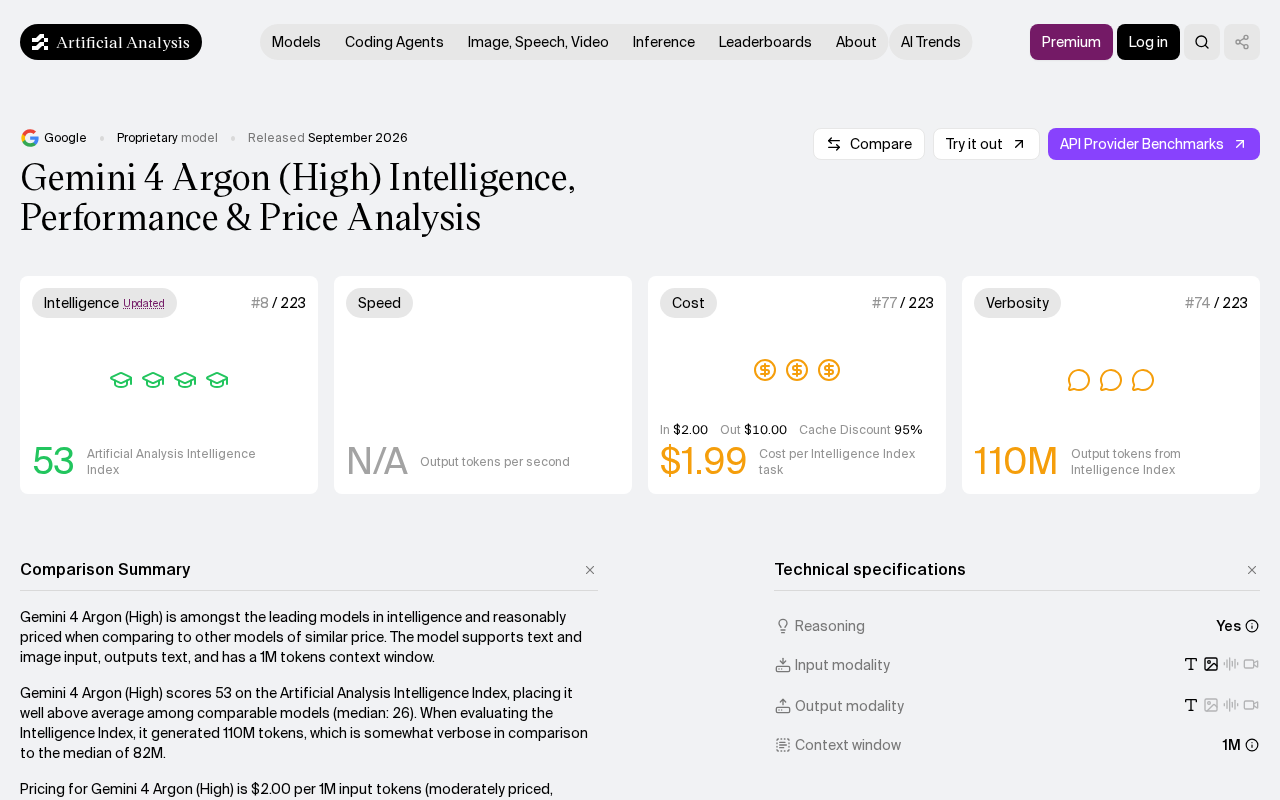
Argon's Position in the Gemini Product Line
From a naming perspective, Argon continues Google's practice of using periodic table elements to name model variants, while the "High" suffix typically indicates a higher inference compute configuration or a deeper thinking budget. These tiers generally correspond to different response latency and cost ranges — the high-end configuration performs better on complex reasoning tasks, but at the cost of higher per-token pricing and longer generation times.
Evaluating a model by benchmark scores alone is no longer sufficient. The industry increasingly favors an "intelligence-performance-price" triangle for holistic assessment: even a top-performing model in terms of intelligence becomes far less viable in production if its inference speed is too slow or its price too high. Argon (High) is being examined through exactly this three-dimensional lens.
The Intelligence Dimension: Where Does Reasoning Capability End?
Intelligence measures a model's real-world capability on complex tasks, including mathematical reasoning, code generation, multi-step logical analysis, and long-context understanding. The "High" configuration typically means the model allocates a larger thinking budget, engaging in more thorough internal reasoning before producing an answer.
This design pays off most clearly on high-difficulty tasks — such as competition-level math problems, complex code refactoring, and multi-hop reasoning Q&A. But for simple queries or format-conversion tasks, the additional reasoning overhead of the high-end configuration may not be worthwhile; the standard version often delivers better cost efficiency. Developers need to clearly understand their task distribution before making a choice, avoiding the trap of over-engineering for simple workloads.
The "thinking budget" is one of the core mechanisms in reasoning-enhanced models in recent years. The fundamental principle is to allow the model to generate an implicit or explicit chain-of-thought internally before outputting a final answer — this intermediate process typically comes at the cost of additional token consumption. OpenAI's o-series, Anthropic's Claude extended thinking mode, and Google's Gemini High configuration all employ similar mechanisms. The "level" of the thinking budget is essentially a cap on the number of tokens the model can use for internal reasoning — the higher the budget, the more opportunity the model has for multi-step verification, backtracking, and hypothesis testing, leading to significant accuracy gains on tasks like mathematical proofs and complex planning. However, this also means the actual token consumption per call far exceeds what appears in the final output, so users should pay close attention to whether reasoning tokens are billed separately.
The Performance Dimension: Real-World Considerations for Speed and Throughput
Performance primarily refers to two metrics: time to first token (TTFT, reflecting response speed) and generation throughput (tokens per second). For real-time user-facing applications — such as conversational assistants and code completion — low latency is critical; for batch processing tasks, total throughput and cost per unit are the core concerns.
The High configuration, in pursuing stronger reasoning, often sacrifices some response speed. This is a universal trade-off for all "deep thinking" model types: longer chains of thought mean users must wait longer to see results. Finding the right balance between reasoning depth and user experience is key to whether these high-end models can achieve widespread adoption.
Time to First Token (TTFT) and generation throughput (tokens/second) are two orthogonal metrics for measuring inference service performance, each pointing to different engineering bottlenecks. TTFT is primarily influenced by the computation during the prefill phase — for High configurations with long thinking chains enabled, the prefill phase must also process a large volume of internal reasoning tokens, making TTFT often several times (or even tens of times) longer than the standard version. Throughput is closely tied to parallelized batch processing during the decode phase, KV-Cache utilization efficiency, and hardware memory bandwidth. For production environment technical selection, it is recommended to use P50/P95 latency (rather than averages) to assess real-time user experience, and to measure throughput under load testing rather than single-request scenarios — actual performance under real concurrency conditions often differs significantly from the single-stream numbers provided by vendors.
The Pricing Dimension: The Full Cost-Effectiveness Equation
Pricing is the factor in the three-dimensional evaluation that most directly impacts deployment decisions. High-end configurations consume more compute and are typically billed separately for input and output tokens, with output tokens (especially reasoning tokens) priced significantly higher.
For enterprise users, the real calculation is "cost per completed task" rather than raw token price. A more expensive model that gets the answer right on the first try may be more economical than a cheaper one requiring multiple retries. This is why more and more evaluations are introducing "cost-performance curves" — plotting a model's intelligence score against its cost per million tokens on the same chart — to help users intuitively identify the optimal choice.
The billing structure for mainstream model APIs typically distinguishes between input and output tokens, and some vendors (such as OpenAI for the o-series) further itemize reasoning tokens as a separate billing line. As a practical cost planning example: a High configuration model with deep reasoning enabled, completing a complex code review task, may consume 5–10× the total tokens of the standard version (including internal thinking chains). Even if the nominal per-token price is similar, the actual bill can differ by an order of magnitude. The "cost-performance curve" (typically plotted with benchmark scores such as MMLU, MATH, and HumanEval on the vertical axis and cost per million tokens on the horizontal axis) is a visualization tool commonly used by third-party evaluation platforms like Artificial Analysis and LMSys. It clearly illustrates the Pareto frontier — models in the upper-right region of the curve represent the highest intelligence at a given cost, or the lowest cost at a given intelligence level, making them the priority candidates for enterprise model selection.
Takeaways from the Community Discussion
The Hacker News discussion around this analysis reflects a maturing methodology for model evaluation within the technical community — people are no longer dazzled by a single leaderboard score, but are increasingly focused on holistic performance in real-world scenarios. This rational evaluation perspective is a positive signal for the healthy development of the broader AI application ecosystem.
It's worth noting that naming conventions and tiering strategies across model vendors change frequently, and specific specifications and pricing should always be verified against official documentation. This article offers a framework-level perspective, giving readers a reusable analytical approach when facing new model releases.
How to Choose the Right Model for Your Use Case
Bringing all three dimensions together, here are practical model selection recommendations:
- High-difficulty, low-frequency tasks (e.g., complex code generation, deep research): Prioritize the High configuration — the intelligence gains justify the cost
- High-frequency, real-time tasks (e.g., customer service chatbots, real-time code completion): Prioritize the standard version to balance latency and cost
- Large-scale batch processing: Focus on cost per completed task; consider a combined strategy of using a smaller model for initial filtering and a larger model for refinement
Model selection is fundamentally about finding the balance between intelligence, speed, and cost that fits your specific business needs. There is no universally "optimal model" — only the best solution for a given use case.
Related articles

Gaussian Process Bandit Optimization: Exploration Strategies and Inference Regret Guarantees
Cumulative regret guarantees in Bayesian optimization fail to reflect final recommendation quality. This article examines a new study that provides inference regret guarantees for Gaussian process bandit optimization through exploration query strategies and fill distance analysis, validated on hyperparameter optimization and control tasks.

The Most Detailed Codex Guide on Bilibili: From Installation to Real-World Practice
The most detailed Codex guide on Bilibili: from app store installation to daily work mode configuration, with a real coffee shop project demonstrating file organization, data extraction, dashboard creation, and other practical tasks. Learn to use Plan Mode and desktop pets to leverage Codex efficiently.

Appearance Compensation in Volume Rendering: Why RGB Accuracy Cannot Guarantee Density Correctness
Volume rendering research reveals that volumetric data perfectly reproducing external RGB views may still contain density errors: appearance compensation can double central density and keep external rays unchanged even when L2 error exceeds 14.52%. Density recovery depends on appearance capacity, spatial resolution, and measurement design.